"Myopia is not simply a blurry vision problem that can be solved with glasses or surgery", Dr. Nguyen Truong Tuong Duy of Hai Yen Eye Center stated on 3/2. The center recently became Vietnam's first ophthalmology facility to receive AACI international quality accreditation.
According to Dr. Duy, myopia is the ultimate consequence of prolonged harmful habits, primarily late nights and excessive electronic device use without allowing eyes to rest. Many studies indicate that continuous near vision work is closely linked to refractive error changes. More dangerously, it alters eye structure, causing the eyeball axis to elongate, the retina to thin, and increasing the risk of degeneration much earlier than natural aging.
Beyond refractive errors, an unhealthy lifestyle also causes young people's eyes to face many conditions typically found in older adults, such as retinal degeneration, glaucoma, and cataracts. While cataracts occur in most older individuals, for those with myopia, especially high myopia, this process can begin earlier, necessitating surgical intervention at a young age.
"In young people, the inflammatory response is often stronger, making post-surgical complication management sometimes more complex compared to older adults", the doctor noted.
A common misconception is thinking, "just let myopia develop, and surgery at 18 will fix it". Dr. Duy explains that refractive surgery only improves vision; it does not shorten the eyeball axis or repair retinal damage. Risks such as retinal degeneration, glaucoma, or cataracts persist because they are located at the back of the eyeball, an area unaffected by refractive surgery. Furthermore, if surgery is performed when refractive error is unstable due to continued worsening vision, the risk of myopia recurrence is very high.
Additionally, dry eyes, eye strain, and accommodation disorders are becoming common among office workers and students. While dry eyes were once primarily an issue for older adults, the incidence among young people has increased significantly due to frequent screen use combined with prolonged late nights.
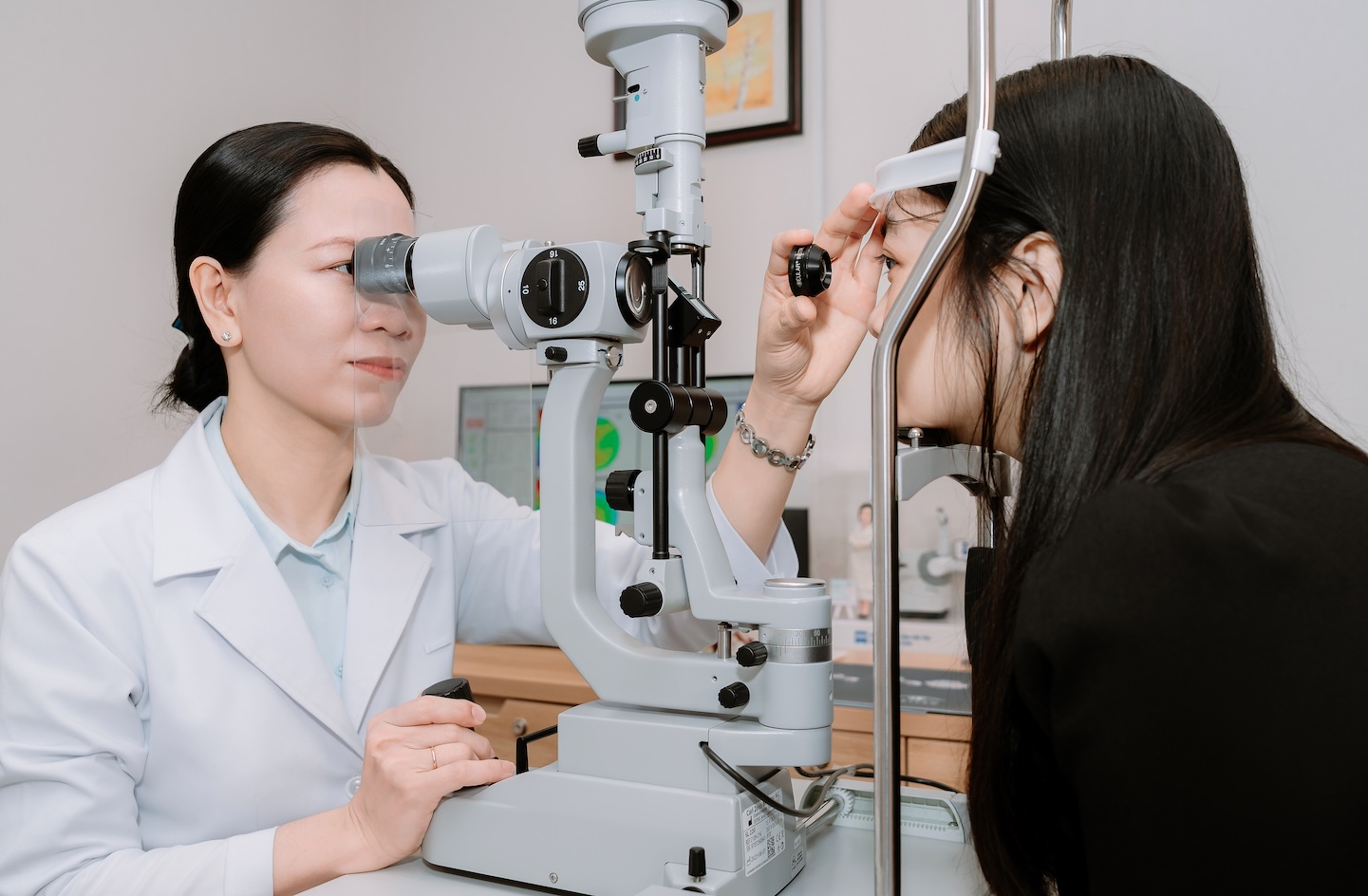 |
Dr. Nguyen Truong Tuong Duy examines a patient's eyes. Photo: Hai Yen Eye Center |
To protect eyes, experts recommend applying the 20-20-20 rule: after every 20 minutes of near vision work, take a 20-second break and look at something 20 feet (about 6 meters) away. For children, the most effective myopia prevention is to increase outdoor activity time, at least two hours daily. If a child already has myopia, scientific control methods such as: Ortho-K lenses, myopia control contact lenses, or specialized eye drops should be applied to limit rapid myopia progression, thereby limiting eye structure deformation.
According to Dr. Duy, myopia control needs to be monitored continuously from childhood to adulthood. Only when refractive error is truly stable and eyes are healthy enough will surgery after 18 years old yield long-term effectiveness.
Maintaining a healthy lifestyle, limiting harmful eye habits, and undergoing regular eye exams help prevent disease and slow vision decline in young people. For those with dry eyes, in addition to supplementing with artificial tears, maintaining eyelid hygiene and applying warm compresses can help alleviate symptoms, but the temperature must be controlled appropriately to avoid causing damage.
Le Phuong