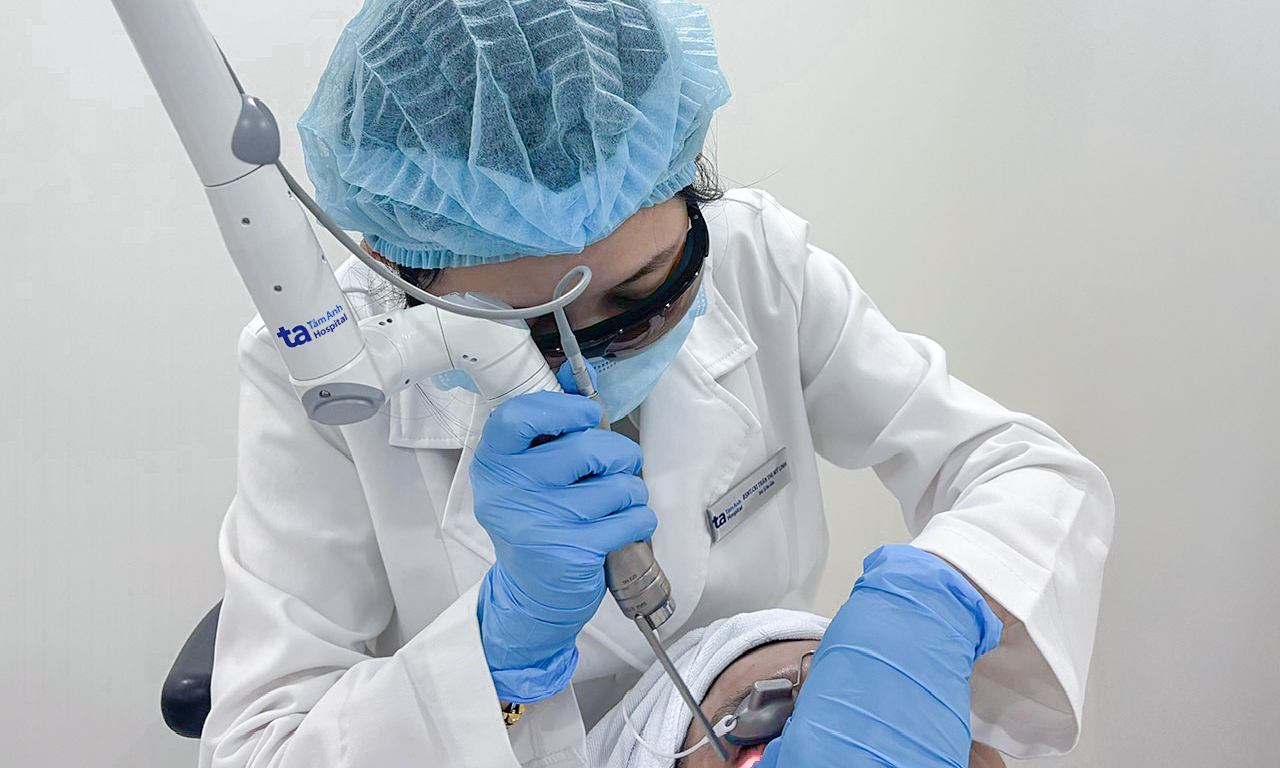
Dr. Quach Thi Bich Van, a dermatologist and aesthetic dermatology specialist at Tam Anh General Hospital in Ho Chi Minh City, states this lesion is a pigmented birthmark, typically located in the dermis. Many pigmented birthmarks tend to change with age, especially during puberty. This is due to hormonal fluctuations that can stimulate the activity of melanocytes—melanin-producing cells—causing pigment to proliferate more strongly. Additionally, frequent sun exposure on the face makes the lesion's discoloration more pronounced.
Treating pigmented birthmarks requires time. Dr. Van prescribed about 10 pico laser sessions for Mai. This technology uses ultra-short pulses, operating on a photomechanical mechanism that breaks down pigment particles into microscopic fragments for the body to gradually eliminate. Unlike purely thermal methods, this approach limits damage to surrounding tissue, reducing the risk of post-inflammatory hyperpigmentation.
 |
A doctor uses a pico laser to treat Mai's pigmented birthmark. *Photo: Tam Anh General Hospital* |
After laser treatment, the treated skin exhibits mild redness and temporary darkening, sometimes with minor pinpoint bleeding. The interval between sessions is maintained at once every 4 weeks to allow for complete skin recovery and to monitor the skin's response.
After 5 sessions, Mai's birthmark had lightened by about 70%, with its borders fading and closely resembling her natural skin tone. Mai must adhere to strict sun protection to limit post-inflammatory hyperpigmentation. Patients need to use broad-spectrum sunscreen, cover up thoroughly, and attend regular follow-ups for the doctor to adjust the energy appropriately. Post-inflammatory hyperpigmentation is usually mild and can be managed with proper skincare.
 |
Mai's birthmark significantly lightened after 5 laser treatments. *Photo: Tam Anh General Hospital* |
According to Dr. Van, for some types of pigmented birthmarks, early intervention is effective when the pigment density is not yet thick or widespread. However, the timing of treatment needs to be individualized, based on the type of lesion, pigment depth, and the patient's cooperation (especially for young children). Patients should visit a hospital with a dermatology - aesthetic dermatology department to receive an accurate diagnosis of the birthmark type and to develop a long-term treatment plan for safe pigment control.
Minh Huong
*Character's name has been changed