Hoang, 59, successfully underwent robotic surgery at Tam Anh General Hospital, Ho Chi Minh City, to remove a challenging cystic kidney tumor. The tumor, classified as Bosniak grade IV with an approximately 90% risk of malignancy, was nearly 4 cm in size, located on his right kidney, and completely obscured by his liver and a thick layer of fat.
Dr. Nguyen Tan Cuong, head of the urological oncology unit at the Center for Urology - Nephrology - Andrology, explained the complexity of the case. For patients with grade II obesity like Hoang, kidney failure risk is elevated due to high blood pressure and diabetes. Traditional surgery faced significant hurdles: the dense perirenal fat obscured anatomical landmarks, increasing bleeding risk and narrowing the surgical field. Furthermore, stabilizing the liver while resecting the deep-seated tumor presented a difficult prognosis.
To overcome these challenges and preserve kidney function, the surgical team, led by Associate Professor, Doctor Vu Le Chuyen, director of the Center for Urology - Nephrology - Andrology, opted for the Da Vinci Xi robot.
During the procedure, Associate Professor Chuyen controlled four robotic arms. A 3D camera magnified images 10-15 times, providing clear differentiation between the tumor and healthy tissue. One arm stabilized the liver, creating vital surgical space, while two other arms precisely resected the tumor without rupturing the cyst, thereby preventing cancer cell dissemination. The renal parenchyma was then swiftly and accurately repaired, minimizing ischemia and protecting remaining kidney tissues. Pathological results confirmed cystic renal cell carcinoma.
Hoang's recovery was swift; within 24 hours, he was able to engage in light activity. He experienced no pain, pneumonia, infection, or hernia, which are common complications in obese patients undergoing traditional surgery.
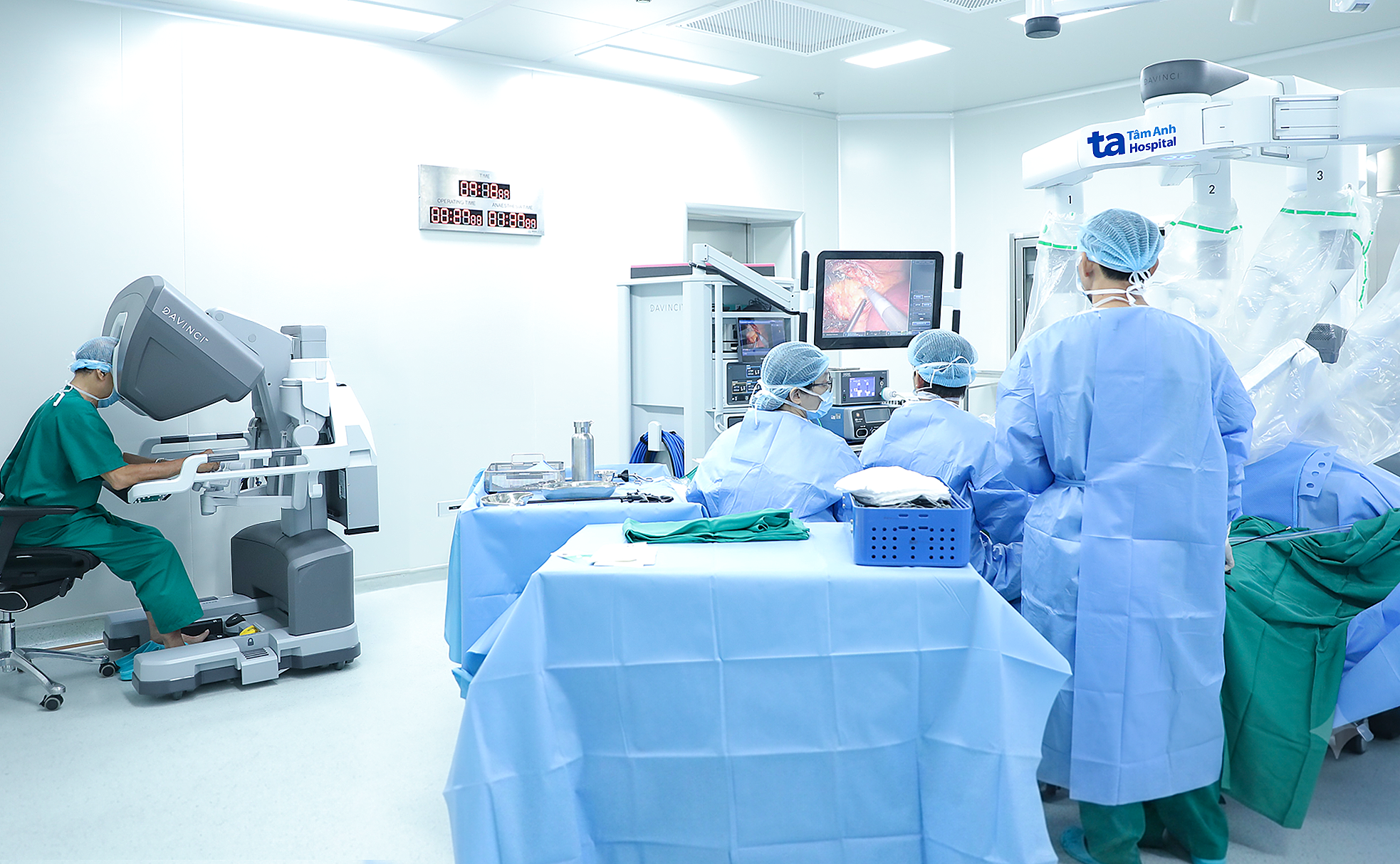 |
Associate Professor, Doctor Vu Le Chuyen (seated) controls the Da Vinci Xi robot during Hoang's surgery. *Photo: Tam Anh General Hospital* |
Cystic kidney tumors are fluid-filled lesions that develop in the kidney, often discovered incidentally during routine ultrasounds or CT scans for general health check-ups or other medical conditions. While small ones are usually asymptomatic, larger tumors can cause dull lower back pain, hematuria (blood in urine), a palpable abdominal mass, or high blood pressure.
Upon noticing these abnormal signs, patients should consult a urology specialist immediately to determine the Bosniak classification of the lesion. This allows doctors to assess the risk and develop a treatment plan. Benign cysts typically require only monitoring, while those with a high risk of malignancy may be recommended for surgical removal.
Dr. Cuong advises the public to maintain a healthy lifestyle, control blood pressure, limit smoking, avoid abusing painkillers, and undergo regular health check-ups for early detection of kidney abnormalities.
Dinh Lam
*Patient's name has been changed
| From now until 30/6/2026, the Tam Anh General Hospital system is organizing a consultation program titled "New Generation 'Super Machines' and Surgical Robots for Safe, Accurate Diagnosis and Treatment, and Rapid Recovery," featuring a team of experienced doctors. Readers can ask questions here. |