This case marks the longest recorded ischemia time for a reattached limb in Vietnam. Typically, the critical timeframe for reattaching a severed limb is around 6 hours.
The patient sustained the injury while on duty aboard an ocean-going vessel off Central Vietnam during Typhoon 12. The ship's violent pitching caused the equipment he was repairing to sever his right index finger. Onboard crew members administered first aid, preserved the detached finger in a thermos, and brought the victim to shore. His family then arranged the earliest flight from Da Nang to Ha Noi that night.
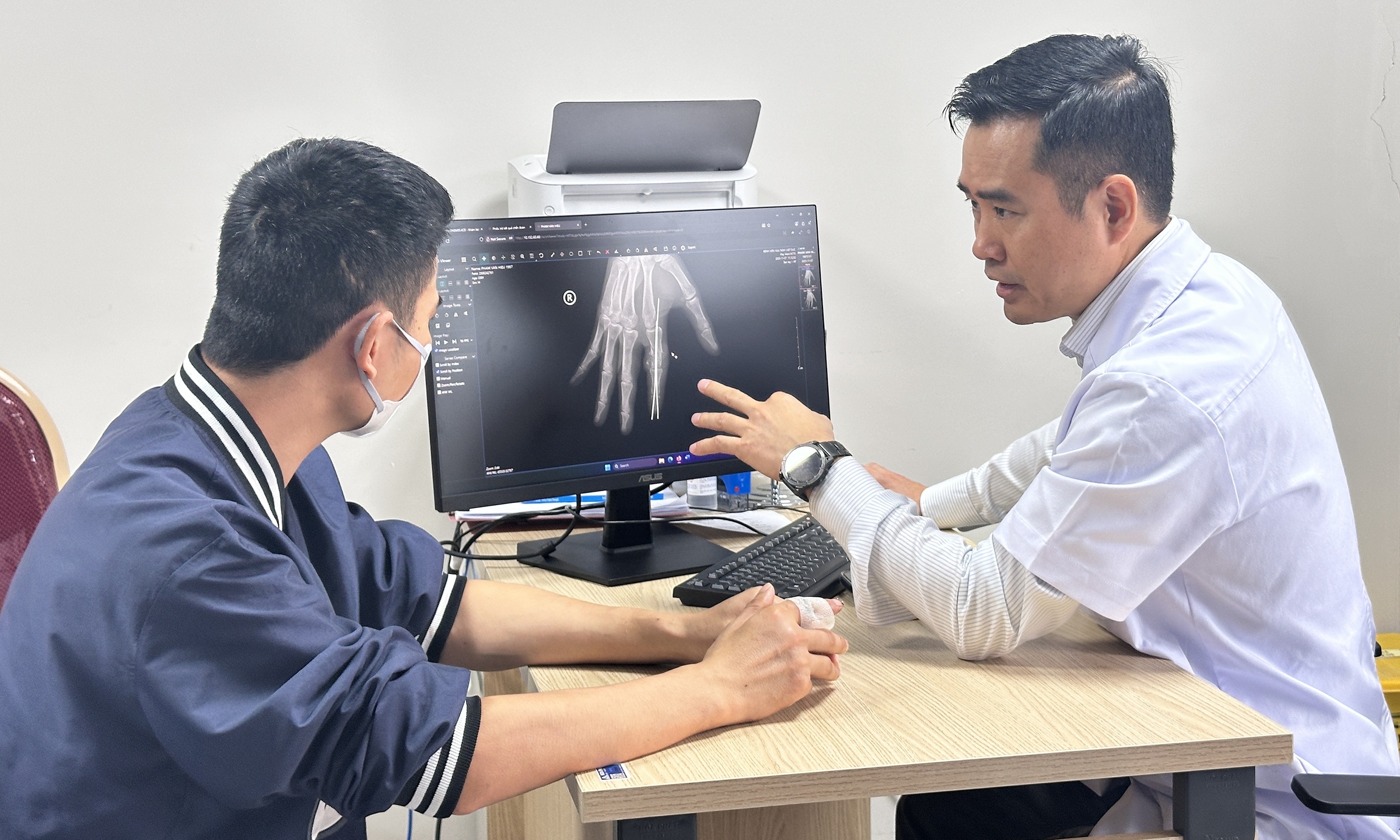 |
Doctors re-examine the patient after surgery. *Photo: Thanh Ngoc*
By the time he arrived at Viet Duc Hospital, more than 24 hours had passed from the accident until he was on the operating table. Despite this, experts assessed the detached finger as well-preserved, with intact tissue structures and flexible finger joints. A consultation council, comprising plastic and aesthetic surgeons, orthopedic trauma specialists, and resuscitation anesthesiologists, decided to perform microsurgery to save the patient's finger.
Doctor Vu Trung Truc, Deputy Head of the Department of Maxillofacial, Plastic, and Aesthetic Surgery, stated that two surgical teams worked in parallel to reduce operating time. One team cleaned the detached finger, while the other prepared the stump. The surgeons used specialized needles to fix the bones, creating a stable axis before connecting tendons and ligaments.
The greatest challenge involved suturing blood vessels and nerves, which measured only 0,8 to 1 mm, under a microscope. Doctor Truc emphasized that this technique demands absolute precision, as even a single blocked connection would lead to necrosis of the finger due to lack of blood supply.
The surgery was successful, and the patient's finger regained its healthy color and full viability. Currently, the patient has had stitches removed and fixation pins withdrawn, and is undergoing physical therapy to restore movement and sensation.
Based on this rare case, doctors advise the public to understand the proper first aid procedures for severed limbs. The critical factor for saving a detached body part is to never immerse it directly in water or any other solution. If the limb is dirty, it should only be gently rinsed under clean tap water or cooled boiled water.
After cleaning, the first responder should wrap the severed part in gauze or a clean cloth, place it in a sealed plastic bag, and then put it into an ice chest. This method prevents direct contact between the limb and ice, which can cause frostbite and tissue death. The patient should be transported to a specialized medical facility as quickly as possible.
Le Nga