"At an age when she should be happily attending preschool, An has become friends with needles, long chemotherapy sessions, and life-or-death surgery," her mother, Kim Nhung, told VnExpress on 11/5/2025.
Previously healthy, Khanh An suddenly developed a fever and fatigue in April 2024. Doctors at Benh vien Da khoa tinh Ha Tinh diagnosed her with a blood infection. After one week of unsuccessful treatment, she was transferred to Benh vien Trung uong Hue, where she was diagnosed with neuroblastoma cancer.
Neuroblastoma is a cancer of the parasympathetic nervous system, a common solid tumor in infants and children under 5 years old. The tumor can form even before a child is born.
Patients with neuroblastoma receive ongoing treatment, but the 5-year survival rate is quite low. Doctors develop appropriate treatment protocols based on the disease stage and the child's condition. Stem cell transplant is considered a "lifeline" for patients, helping to eliminate cancer cells, regenerate healthy cells, achieve remission, and reduce recurrence rates. Currently, after a stem cell transplant, the 5-year survival rate for many patients is approximately 30-60%, depending on individual health.
Neuroblastoma can be detected during prenatal ultrasound. However, most cases are discovered after the cancer has metastasized to other body parts, such as lymph nodes (small, bean-shaped organs that help fight infection), liver, lungs, bones, and bone marrow (spongy, red tissue inside large bones). This was Khanh An's situation. Radiation therapy combined with chemotherapy was her initial treatment protocol.
On the first day of radiation, An's fragile body reacted severely. She developed a high fever, swelling, vomited everything she ate, and became fatigued and pale. She was so terrified of injections and medication that she would cry out in her sleep. Kim Nhung was forced to lie to her daughter repeatedly, telling her she would "be home soon" and "get well soon." This was the lie she most wished would come true at that time.
To treat their daughter, Kim Nhung and her husband tried to borrow money from everyone they knew. The family, already struggling, found themselves in a dead end. Both parents are farmers, earning only about 6 million Vietnamese dong per month. Her husband suffers from a herniated disc, making heavy labor impossible. Kim Nhung stays at the hospital to care for her daughter while also looking after her ailing husband and another young child attending school back home.
Their main income was almost nonexistent, while the treatment costs for a cancer patient, amounting to hundreds of millions of Vietnamese dong, were an enormous sum far beyond a farming family's means.
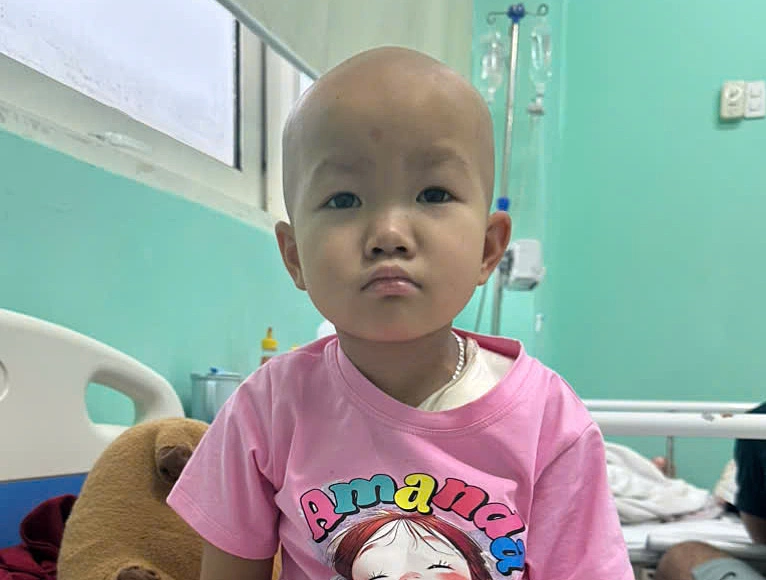 |
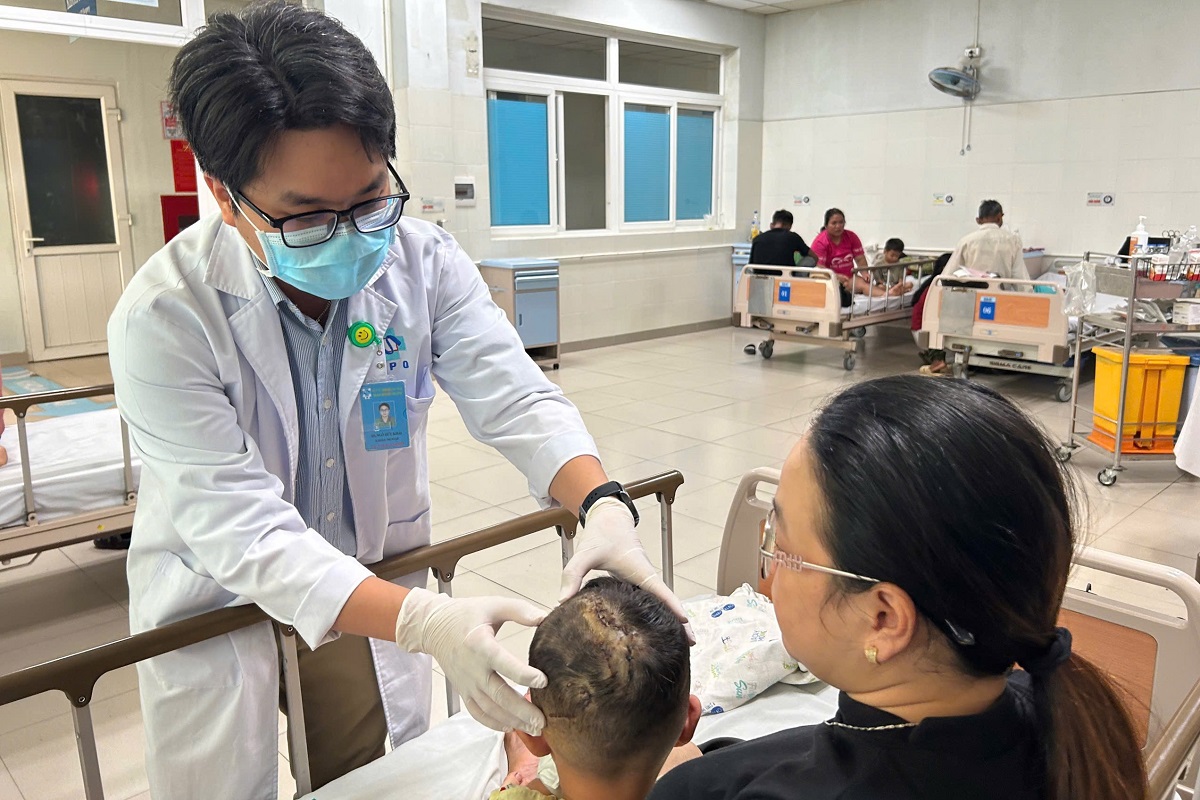
Khanh An continues treatment at Benh vien Trung uong Hue. Photo: Contributed |
Khanh An continues treatment at Benh vien Trung uong Hue. Photo: Contributed
In August 2025, Khanh An entered the most crucial treatment phase: a stem cell transplant. This was the last ray of hope for her survival. However, the 200-300 million Vietnamese dong needed to sustain the stem cell transplant protocol was an unaffordable luxury for the family.
At this critical juncture, An was fortunate to receive 100 million Vietnamese dong from the Mat troi Hy vong program, part of Quy Hy vong (under VnExpress newspaper), to fund the stem cell infusion and prevent distant cancer metastasis.
However, the post-stem cell transplant journey has been far from smooth. After the transplant, An experienced several complications, requiring her to remain in the hospital for monitoring and intensive treatment. Kim Nhung's greatest wish is for her daughter to be healthy, while An's biggest dream is to become a doctor in the future to treat the poor.
An underwent 12 radiation doses and completed the stem cell transplant, but her hair has fallen out, and her limbs have atrophied. Every 10 days, her mother takes her to Hue for blood transfusions.
"The journey ahead is likely long, but I only wish for my child to recover. I am ready to sell our house or do anything necessary," Kim Nhung shared.
The Mat troi Hy vong program, a collaboration between Quy Hy vong and Ong Mat troi, aims to instill hope in pediatric cancer patients from disadvantaged backgrounds. Community support for such initiatives offers a beacon of light for the nation's future generation. Program details are as follows:
Program Name: Ten cua ban - Mat troi Hy vong
Program ID: 195961
Thuy An