A seven-year-old child from Tuyen Quang was admitted on New Year's Eve in critical condition, suspected of having severe myocarditis. Previously healthy, the child had developed symptoms five days prior, including fever, abdominal pain, and fatigue.
At the National Children's Hospital, doctors diagnosed the child with cardiogenic shock, severe circulatory failure, and arrhythmia. Facing cardiogenic shock believed to be caused by myocarditis, medical professionals decided to deploy extracorporeal membrane oxygenation (ECMO) to support circulation, allowing the child's heart muscle to recover. Currently, the patient is under close observation for heart function recovery, and specialized tests are being conducted to determine the underlying cause.
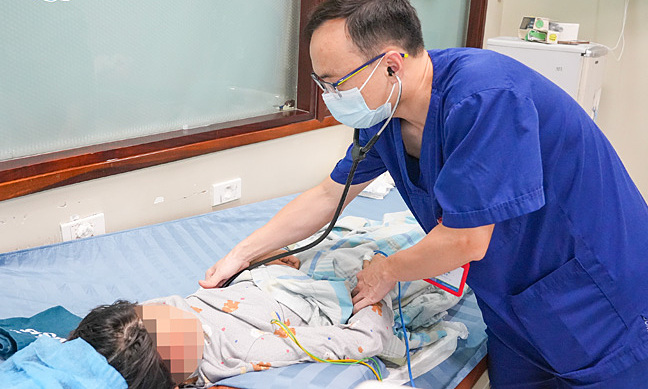 |
A pediatric patient receiving treatment for myocarditis at the hospital. *Photo courtesy of the hospital*. |
A few days prior, an eleven-year-old girl from Hanoi experienced nausea and vomiting ten times in one day, along with dull abdominal pain around her navel. The child had no fever or diarrhea and was otherwise active. These symptoms led her family to suspect a digestive disorder, so they administered digestive enzymes and antiemetics at home.
However, the child's symptoms did not improve. The following day, her abdominal pain worsened, she vomited another five to six times with yellow fluid, and became exhausted with pale skin. The patient was admitted to the Emergency and Poison Control Department on 7/2, diagnosed with severe myocarditis.
Upon admission, the child was conscious, responsive, with no obvious respiratory failure. However, specialized tests and an echocardiogram revealed severe myocardial damage, diffuse myocardial motion disorder, and very high cardiac enzymes. These findings indicated a high risk of arrhythmia and cardiogenic shock. Drawing on experience from numerous severe myocarditis cases, doctors recognized that waiting for clear signs of collapse could cause the patient to lose the "golden time" for intervention. Therefore, they proactively intervened, initiating early intensive resuscitation measures.
The patient was intubated, a central venous line was established, and vasopressors were administered. The ECMO system was activated, reducing the burden on the severely damaged myocardium and creating conditions for the child's heart to recover.
After seven days of treatment, the child's condition is progressing well. She has been weaned off ECMO, is breathing independently, and is conscious. Her hemodynamic parameters, heart function, and overall condition are gradually improving. If her progress remains favorable, the child could be discharged in a few days, with a prognosis for full recovery and no sequelae.
Additionally, a thirteen-year-old boy from Hanoi was admitted on 12/2 with severe myocarditis. The child had a completely healthy medical history. Three days before admission, he experienced severe vomiting, but no cough or fever. His condition rapidly deteriorated with symptoms of arrhythmia and respiratory failure. Doctors intervened with ECMO promptly that night to save the child's life. Currently, the patient's condition is temporarily stable and continues to be closely monitored.
"Severe myocarditis progresses rapidly; many children who are still conscious can experience heart failure and circulatory arrest within just a few hours," explained Master, Doctor of Specialty II Ngo Tien Dong from the Department of Medical Intensive Care. He added that this necessitates the decision to initiate early treatment and deploy ECMO immediately when a high risk is predicted, rather than waiting for the child to go into cardiogenic shock or hemodynamic collapse.
Myocarditis is an inflammatory condition that damages heart muscle cells, severely affecting the heart's function in children. The causes of the disease are diverse, mostly due to viruses, intoxication, autoimmune diseases, and MIS-C syndrome. For these three children, the exact cause of acute myocarditis is still unknown.
The symptoms of acute myocarditis are often atypical. About half of children with acute myocarditis may exhibit viral infection symptoms a few weeks before disease onset. Subsequently, children develop symptoms similar to other common illnesses, such as fatigue, abdominal pain, nausea, vomiting, diarrhea, fever, or cough. If a child also experiences rapid breathing, chest pain, difficulty breathing, a rapid heart rate, or pale lips and skin, they should be taken to the hospital for prompt medical examination and treatment.
Annually, the Department of Medical Intensive Care admits 20 to 40 cases of pediatric myocarditis. Previously, the mortality rate for children with myocarditis was very high. Today, with inter-departmental and inter-hospital collaboration and the application of ECMO technology, many children are being saved. The survival rate for children with myocarditis supported by ECMO at the National Children's Hospital is about 60%, comparable to developed countries.
Le Nga