On 12/12, Dr. Nguyen Thang Nhat Tue, Head of the Emergency Department at Gia An 115 Hospital, reported that their team received a dispatch from Emergency Center 115 to a ward medical station. Upon arrival, the child had already suffered cardiac arrest, respiratory arrest, dilated pupils, and lacked reflexes. Doctors performed aggressive cardiopulmonary resuscitation for over one hour, but the child could not be saved.
The child had choked during a meal at a daycare facility. Adults then transported her to two different medical stations. Dr. Tue noted that the child missed the "golden hour" for survival due to incorrect initial management.
"We did everything we could, but the most agonizing aspect is that in the first few minutes after the accident, no one knew how to administer proper first aid," Dr. Tue stated. He stressed that moving the patient through multiple locations without initial assessment or on-site first aid worsened the child's condition.
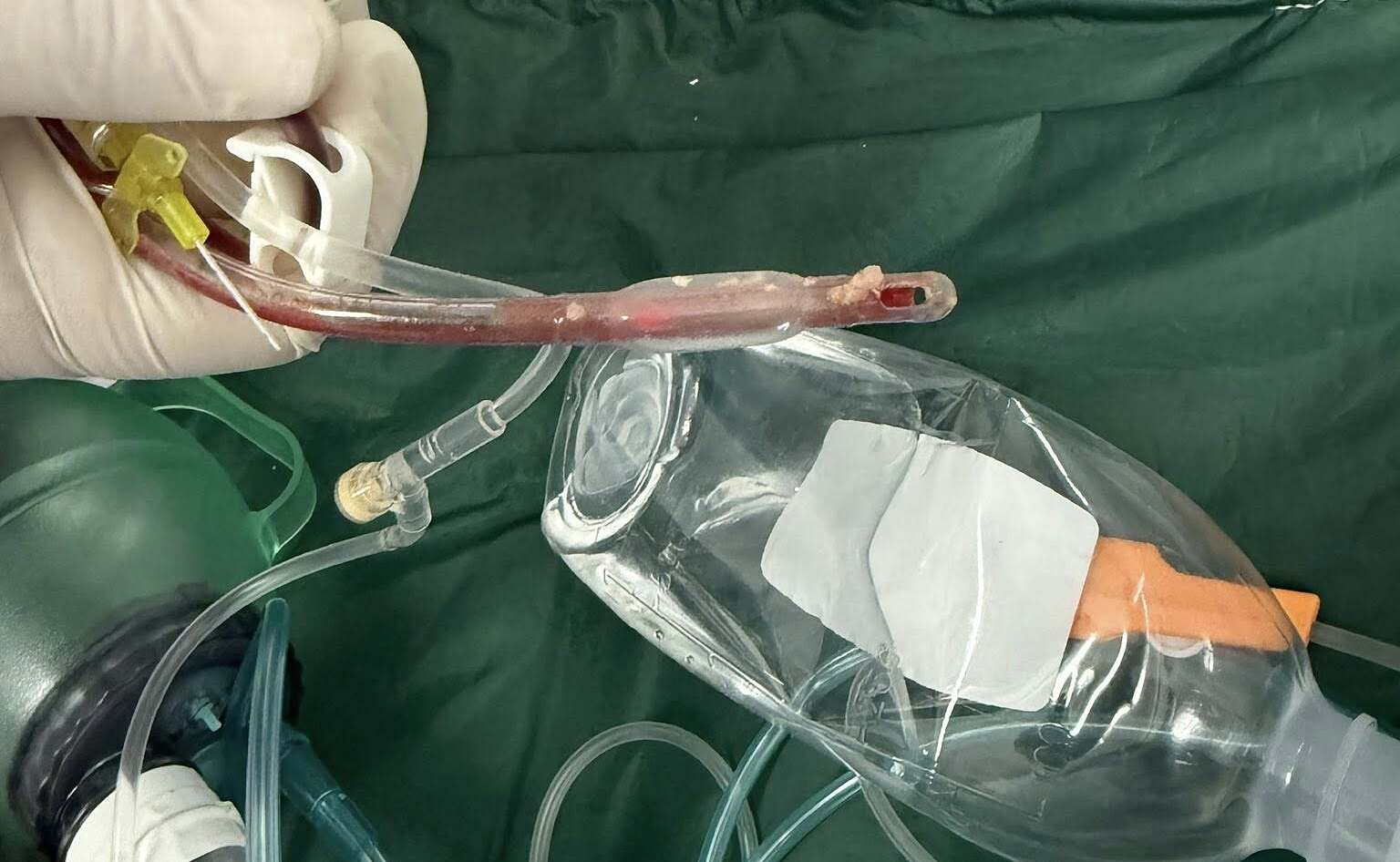 |
Food stuck in the endotracheal tube after cardiopulmonary resuscitation failed. *Photo: Doctor provided* |
Choking on food or foreign objects is a common yet dangerous accident for young children, especially during mealtimes. Typical signs include a child eating, then suddenly coughing weakly or silently, clutching their throat, leaning forward, turning blue, and being unable to cry or speak. Within seconds, the victim may become unresponsive and lose consciousness.
To prevent such tragic deaths, parents and teachers must master first aid principles. If a child is choking, adults must immediately call 115 for guidance from a medical dispatcher. Absolutely do not give the child water, force them to eat more, use fingers to clear their throat, or invert their body. Back blows are also prohibited if the child is crying, as their cough reflex is still effective; incorrect intervention can push the foreign object deeper into the airway.
The correct procedure depends on the child's age. For children under one year old, the rescuer should perform the back blows-chest thrusts procedure. Place the child face down on your forearm, with their head lower than their body, firmly supporting their jaw. Use the heel of your hand to deliver five back blows between their shoulder blades. Then, turn the child face up and use two fingers to deliver five chest thrusts on the lower one-third of the sternum. Repeat this cycle until the foreign object is dislodged or the child cries again.
For children over one year old, adults should apply the Heimlich maneuver. Have the child stand slightly bent forward and deliver five strong back blows. If the foreign object is not dislodged, the rescuer should stand behind the child, wrap their arms around their abdomen, make a fist with one hand and place it between the navel and the bottom of the sternum, then grasp that fist with the other hand and deliver five sharp upward and inward thrusts.
If a child turns blue, experiences cardiac arrest, or stops breathing, those present must immediately perform cardiopulmonary resuscitation and continue until medical personnel arrive.
Dr. Tue advises educational facilities to regularly train teachers and caregivers in foreign object choking first aid and cardiopulmonary resuscitation. Medical station staff should consistently update their pediatric emergency protocols for timely assistance. Even after a foreign object is removed, the child still requires hospital observation for airway damage for the next 24 hours.
Le Phuong