The unified 113 hotline is expected to begin receiving, classifying, and coordinating all emergency situations, including pre-hospital medical emergencies, starting from Q3. This single emergency number will be implemented across the country.
Currently, these hotlines operate separately for specific tasks. The 115 hotline is used for medical emergencies, 114 for fire and rescue services, and 113 for security assistance. Consolidating these services under one unified number is expected to make it easier for people to contact authorities in times of need and simplify operational management for functional agencies.
"The unification of the 113 hotline is expected to help people remember it easily, shorten response times, and enhance the efficiency of handling emergency situations nationwide," said Lieutenant Colonel Pham Huu Phuc, Deputy Chief of Office of the Ministry of Public Security (MPS), at a workshop on 17/4, where feedback was gathered for the 2026-2030 pre-hospital emergency system development project.
Under the proposed roadmap, once integrated, 113 calls will be routed to a command center, then forwarded to relevant local functional units. The system is designed with a multi-layered backup mechanism to ensure continuous 24/7 operation. For medical emergencies, call center operators, combined with artificial intelligence (AI), will quickly transfer information to the appropriate emergency facility.
According to the Ministry of Public Security's proposal, the integration of these hotlines will be implemented in two phases. Phase one involves integrating 113, 114, and 115 into a single 113 number for nationwide use, located at the police command information centers in 34 provinces and cities. Phase two, following 6 months to one year of implementing the 113 model in these 34 provincial and city police command information centers, will include an initial review and evaluation to plan the establishment of a national 113 center. Phase two may also explore integrating the 111 and 117 hotlines, based on feedback from the Ministry of Science and Technology (MOST).
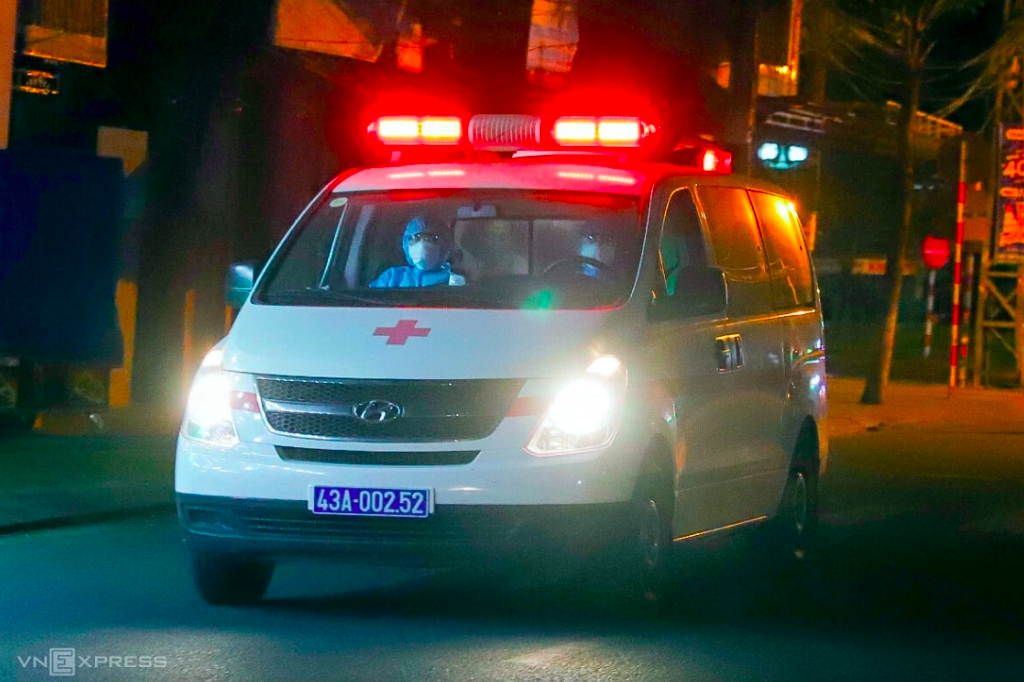 |
Ambulances move on a Da Nang street. Photo: Nguyen Dong
At the workshop, Deputy Minister of Health (MOH) Tran Van Thuan emphasized the critical role of pre-hospital emergency care as the initial link in saving patients' lives. He stated that every minute, decision, and coordination effort can make the difference between survival and lasting disability, or between recovery and irreparable loss. Therefore, developing a robust pre-hospital emergency system is a professional and humanitarian imperative, serving as a measure of the healthcare sector's organizational capacity and the overall public health protection system.
Each year, Vietnam records approximately 222,000 stroke cases, but most patients do not receive timely emergency care. Only about 23,2% of patients arrive at medical facilities within the "golden hour" of the first 4,5 hours, and only about 20% are transported by a professional emergency system. "Beyond strokes, emergency situations such as traffic accidents, drowning incidents, fires, poisoning, or natural disasters all demand a pre-hospital emergency system that responds quickly, is well-organized, and coordinates more effectively," the Deputy Minister noted, adding that this represents a significant gap that needs to be addressed in the national project.
Under the 2026-2030 implementation plan, Vietnam aims to equip at least one ambulance per 100,000 residents. The plan also includes expanding first aid training for various groups, including police, flight attendants, students, and the general public. Previously, six pilot localities were equipped with 85 international-standard ambulances, each containing approximately 380 modern medical devices.
Currently, Vietnam's ambulance ratio is about 0,2 vehicles per 100,000 residents, which is considerably lower than that of developed countries in the region. Pre-hospital emergency capabilities remain fragmented, lacking seamless connection between dispatch, transport, and initial treatment. The Ministry of Health is proposing to combine medical forces with fire and rescue services to shorten response times to incident scenes. The healthcare sector plans to deploy emergency teams within a 3 km radius in urban areas and a 6 km radius in rural areas. Additionally, an artificial intelligence (AI) application system will support call reception, patient triage, electronic health record access, and priority traffic coordination for ambulances.