Nipple discharge is a symptom that often concerns women. Its color and nature guide a doctor's initial assessment. Red or brown discharge necessitates thorough investigation. For the patient, who reports frequent itching, soreness, and nipple discharge, an off-white or yellow discharge may indicate localized inflammation from a papilloma in the milk duct, and is rarely a sign of malignancy.
Paget's disease, a form of breast cancer, may manifest with skin redness, itching in the areola and nipple area, scaly skin peeling, and yellow discharge from the affected sites. Should these symptoms appear, it is advisable to visit a medical facility for examination, to rule out malignancy and receive guidance on proper breast hygiene.
 |
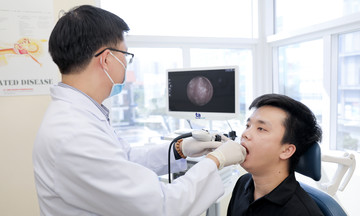
Doctor Minh examines a patient. Illustration photo: Tam Anh General Hospital |
Doctors typically do not recommend clinical examinations, ultrasounds, or breast x-rays for women aged 25, due to dense breast tissue. Breast x-rays are generally advised for women aged 40 and above, combined with breast ultrasounds, for early breast cancer detection. Nevertheless, earlier screening is crucial for women at high risk of breast cancer. This includes individuals with a direct family history (mother, sister) of breast cancer, carriers of cancer-causing gene like BRCA1 or BRCA2, or those with a personal history of cancer or previous radiation therapy to the chest. The appropriate screening method should always be determined and prescribed by oncology or imaging specialists.
Early detection significantly improves curability. Common breast cancer screening methods include clinical examination, breast x-ray, and breast ultrasound. Based on individual risk, doctors might advise advanced imaging techniques such as 2D breast x-ray, digital tomosynthesis, or dual-energy breast x-ray, all designed to improve lesion detection.
Integrated digital breast x-ray systems offer the capability to perform all these techniques, shortening examination times and significantly reducing x-ray dosage, thus ensuring greater safety for patients. For women at high risk, magnetic resonance imaging (MRI) is another screening option, though it requires close consultation and monitoring by a doctor.
Dr. Le Nguyet Minh
Head of High-Tech Unit for Breast Diagnosis and Intervention
Tam Anh General Hospital, Hanoi
| Readers can submit questions about cancer here for doctors to answer |