Answer:
A simulation CT scan is a crucial step in preparing for radiation therapy. Depending on the doctor's orders, patients may or may not require a contrast agent. In cases where a more thorough examination of tumor lesions, metastatic lymph nodes, and blood vessels is necessary, patients may need to drink a small amount or have an iodine-based contrast agent injected directly into a vein.
The purpose of using a contrast agent is to enhance tissue and vascular contrast as the tumor and metastatic lymph nodes absorb the agent. This allows radiation oncologists and medical physicists to clearly differentiate the boundaries of tumors and lymph nodes from large vessels and the heart, distinguishing abnormal areas from surrounding structures. This contributes to improving treatment quality and reducing side effects for patients.
 |
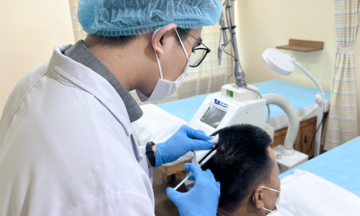
Doctor Loc consults a woman. Photo: Tam Anh General Hospital |
Before a simulation CT scan with a contrast agent, doctors and technicians check patient information such as medical history, allergy history, previous contrast agent injections or oral intake, and any reactions experienced. If a patient has kidney disease, diabetes, or other conditions and is taking medication, the doctor will advise them to stop or change their medication during the intravenous contrast agent injection period.
Oral contrast agents are typically prescribed for simulation CT scans of the abdomen or pelvis. Patients drink a small amount of the contrast agent to highlight the digestive tract (stomach, small intestine, colon) to differentiate between healthy bowel and pathological lesions. Before the simulation CT scan, an intravenous line is inserted in your arm. As the agent enters your body, you may experience a metallic taste in your mouth, a warm sensation spreading throughout your body, or a feeling similar to urination, but these sensations are usually fleeting and disappear after a few minutes.
After the scan, patients are monitored for at least 30 minutes at the hospital to prevent delayed reactions such as mild or severe allergic reactions (anaphylactic shock). Following this, the technician or nurse removes the intravenous line and bandages the injection site, also providing instructions on any necessary post-injection medications.
Doctor CKI Nguyen Huy Loc
Department of Radiation Oncology, Oncology Center
Tam Anh General Hospital TP HCM
| Readers can submit questions about cancer here for doctor consultation. |