Dr. Bach Thi Chinh, Medical Director of the VNVC Vaccination System, advises that despite Vietnam eliminating polio, people should not be complacent. The polio virus has three types: 1, 2, and 3. While types 2 and 3 have been globally eradicated, wild poliovirus type 1 (WPV1) is still circulating worldwide, primarily in Afghanistan and Pakistan.
In late august, Laos reported a case positive for vaccine-derived poliovirus type 1. The World Health Organization (WHO) warned that Laos could be a source of regional transmission, assessing the risk of polio entering Vietnam. On 12/12, the Ministry of Health held an urgent meeting, requesting localities to review vaccination histories and administer catch-up vaccinations for children.
According to Dr. Chinh, most polio cases are asymptomatic or very mild, spreading through feces during the incubation period. The virus persists in water and feces for several weeks or three months at 0-4 degrees C, and is destroyed at 56 degrees C in 30 minutes. The virus adapts well to environmental changes, mutates easily, and can cause outbreaks when community immunity declines.
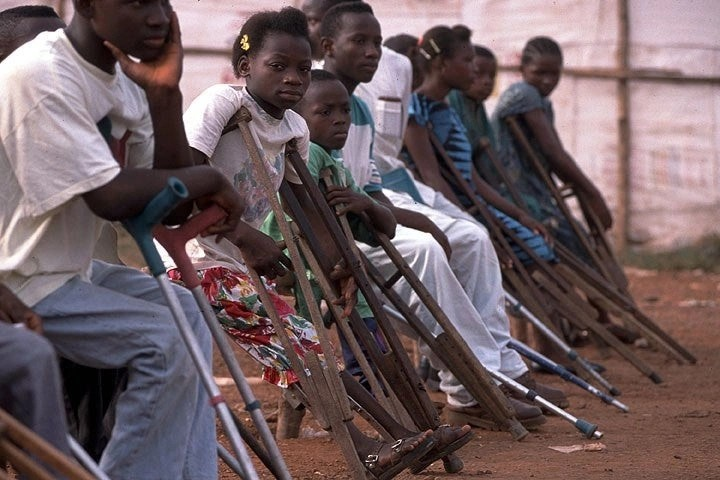 |
Children with polio, most using crutches, in Freetown, Sierra Leone. Photo: polioeradicationorg |
Dr. Truong Huu Khanh, Vice President of the Ho Chi Minh City Infectious Disease Association, explained that polio can spread via the fecal-oral route. The virus can exist in water, carried by floodwaters, wastewater, and contaminated food, entering the human body through ingestion or dirty hands. Furthermore, over 500,000 people cross the Vietnam-Laos border annually for tourism, labor, and trade, potentially facilitating the virus's entry.
Upon entering the human body, the polio virus multiplies in the intestines before attacking the nervous system, causing spinal polio, bulbar polio, or encephalitic polio. Spinal polio is the most common form, leading to flaccid paralysis of the limbs. Bulbar polio affects cranial nerves, causing respiratory and heart failure, while encephalitic polio is rare. Statistics show that about one in 200 infections progresses to permanent paralysis, primarily in the legs; the meningitis form can cause respiratory muscle paralysis, with a 5-10% risk of death.
There is no specific treatment for polio, but it is preventable through vaccination. Vietnam uses two types of vaccines: oral polio vaccine (OPV) protecting against virus types 1 and 3, and inactivated polio vaccine (IPV) protecting against all three virus types: 1, 2, and 3. The Expanded Program on Immunization includes a polio vaccination schedule: three OPV doses at two, three, and four months of age, and two IPV doses at five and nine months.
 |
Infants receiving the 6-in-1 vaccine, which includes a polio component, at the VNVC Vaccination System. Photo: An Nhien |
Additionally, private vaccination services offer a 6-in-1 vaccine that protects against polio, diphtheria, pertussis, tetanus, hepatitis B, and Hib diseases. This vaccine requires three basic doses at two, three, and four months of age, followed by a booster dose at 16-18 months, offering up to 99% effectiveness. After the doses administered before two years of age, children can receive one dose of a polio-containing vaccine at four to six years old to reinforce immunity. Children who have not completed their vaccination schedule or whose families are unsure of their vaccination history can visit a vaccination facility for a doctor to determine an appropriate schedule.
Beyond vaccination, it is essential to maintain hygiene in homes and classrooms, ensure children eat cooked food and drink boiled water, and teach children to wash their hands frequently. If an infection is suspected, families should isolate the child and seek early medical attention.
Phan Binh