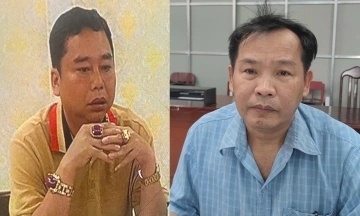
A land use rights dispute between Phong, 63, and his neighbor Tan, 70, both residents of Dai Phuc commune, is scheduled for an appellate hearing at the Thai Nguyen Provincial People's Court on 23/9. The hearing follows an appeal filed by Phong.
In the initial trial in 6, the conflict between the two neighbors was determined to stem from a 183 sqm plot of land situated between their homes.
According to Phong's statement, his parents pioneered the 4,500 sqm plot in 1965 and gave it to him in 1986 when he married.
In 1998, Phong's household received a land use rights certificate for their plot, which bordered Tan's property. Phong stated, "At that time, Tan's family often walked through my family's tea rows."
In 2019, Phong's family cut down some tea rows and built a surrounding fence. In late 2024, Phong stated in his petition, "While I was away, Tan's family poured concrete onto the path adjacent to my family's fence."
Phong asserted that his land use rights certificate was correctly issued and that the path was within his property. He requested the court to order Tan to return the land and remove the constructed path.
Tan's family, however, maintained that their 6,000 sqm plot was pioneered by his parents in 1970 and given to him in 1978. At that time, no other families lived in the area, and a path already existed. Since then, his family has used this path for travel, transporting materials, and for life events and production, without any disputes.
In 1994, Ly, Tan's wife, received a land use rights certificate for this 6,000 sqm plot, which included 1,740 sqm of residential land. In 2009, the couple's certificate was re-issued under the household's name.
In 2005, Tan's family poured concrete on a section of the path, approximately 1,5 m wide, as they lacked the resources to do more at the time. This work did not lead to any disputes with Phong's family.
Later, when Tan's family repaired the path, Phong obstructed them, claiming the land belonged to his property as per his land use rights certificate.
Tan argued that the path had existed since his family moved into their separate home in 1978 and that it was the only access to their house. He stated that pouring concrete was merely to reinforce the existing path, not to create a new one.
Tan's family requested the commune People's Committee to resolve the issue. However, on the cadastral map, the path leading to Tan's house was recorded within Phong's land use rights certificate.
Tan therefore requested the court to recognize the concreted path as a common path for both families and to annul the 183 sqm of land that had been granted to his neighbor in their land use rights certificate.
One demands land, the other has no access
The head of Dong Noi hamlet confirmed that local residents have historically used the path Tan concreted. Verification records also showed that besides the disputed path, Tan's family had no other access to their home.
Phong's side argued that Tan's family could open another route, connecting to a path through another neighbor's land.
However, during the on-site inspection, authorities found that this alternative route encountered fences, trees, high embankments, or deep ponds, rendering it inconvenient and unsafe for use as a path.
The court panel determined that resolving the dispute required considering not only the land use rights certificate but also the origin, management history, land use, and the actual existence of the path.
The court established that Tan's family had resided on the plot since 1978. The disputed path existed from the time Tan's family pioneered and used the land. It was also the only access to their home.
The court also noted that Phong admitted Tan's family had previously walked through the tea rows on his land. Phong also confirmed that in 2005, Tan's family concreted a section of the path, and at that time, Phong's family raised no objections.
According to the court panel, these details indicated that Phong was aware of the path's existence and Tan's family's long-term use of it.
Land without access impedes residents' lives
The 183 sqm disputed land was included in Phong's land use rights certificate issued in 1998.
The court determined that this was the sole access to Tan's house, yet the local authorities granted this section to Phong's household. This situation did not ensure the proper area and boundaries of land use.
The court cited, "According to the 1993 Land Law, a rural residential plot without a designated access path does not ensure the daily lives of the people, nor does it ensure convenience for production and social management."
Based on these findings, the court rejected Phong's request and accepted Tan's proposal to annul a portion of Phong's land use rights certificate.
The court ruled that the 183 sqm area is a common path for both houses.
Tan's family agreed to pay Phong's family 70 million VND, which the court acknowledged as a voluntary settlement.
Tan filed an appeal. The Thai Nguyen Provincial People's Court is scheduled to hear the appellate case on 23/9.
Thanh Lam