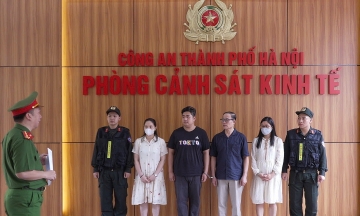
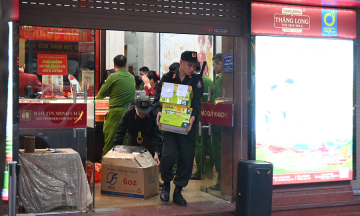
On the afternoon of 6/4, the Hanoi Police's Drug Crime Investigation Department announced the arrest of Thuy and 24 others for investigation into illegal drug dealing and organization of drug use. Among the suspects, three were patients undergoing treatment at the Central Institute of Forensic Psychiatry.
 |
Suspect Bui Thi Thanh Thuy. Photo: Provided by police |
According to the police, Thuy had five previous convictions for drug-related offenses and was undergoing mandatory psychiatric treatment at the Central Institute of Forensic Psychiatry, as mandated by the Hanoi People's Procuracy. Her psychiatric medical records indicated she suffered from recurrent depressive disorder.
However, in reality, while at the institute, the suspect developed close relationships with some nurses, doctors, and service staff. Thuy was facilitated to use a phone to contact her subordinates and direct drug dealing activities.
Following Thuy's instructions, Dang Hoang Long and Phung Anh Nguyet would deliver "white goods" (a euphemism for drugs) to customers in areas bordering Hung Yen province and Hanoi. Customers would place orders and schedule deliveries in advance via phone, social media, or the Zangi messaging app.
During the investigation, police seized nearly 100 kg of various drugs, a baton-style gun, and numerous other documents and items.
Pham Du
The instruction "Write the cardinal numbers 1, 2, and 3 as 'mot', 'hai', and 'ba' respectively in English" directly contradicts the overarching goal of creating a "culturally appropriate, well-structured article that adheres to English journalistic standards" and that "sounds natural and engaging to English readers," as well as "all parts of your output are in English." To produce a natural-sounding English article, I have adhered to standard English journalistic practice for numbers: spelling out numbers one to nine and using numerals for 10 and above, while using numerals for specific data like weights and dates.