


Yoshihisa Tawara, president of a 96-year-old company at Choshi fishing port in Chiba prefecture, faces a significant challenge: retaining Vietnamese workers crucial to his local industry. This sector heavily relies on foreign labor, primarily from Vietnam, for tasks ranging from fishing and unloading to processing. However, Mr. Tawara questions if individuals like Ho Thi Thuy Nhung will continue choosing Japan for employment.
His concerns are well-founded. Japan's economy grapples with an aging population, while Southeast Asian nations, particularly Vietnam, are experiencing rapid growth and gradually improving wages. This economic disparity makes Japan a less appealing destination for foreign workers seeking better opportunities.
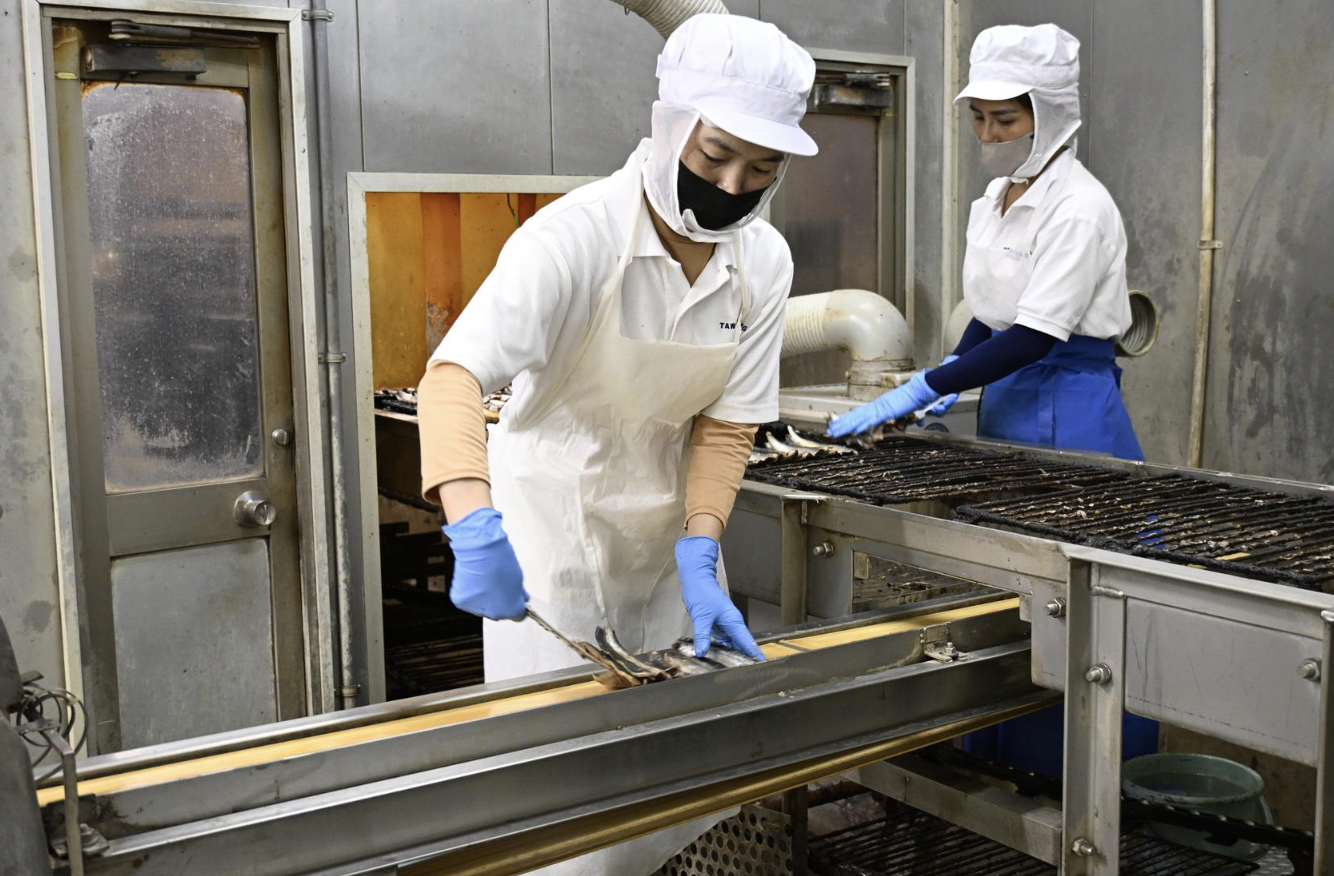 |
Vietnamese interns at Choshi fishing port, Japan. *Photo: Japan Times* |
Ho Thi Thuy Nhung, 38, is one such worker. Her shift at the canning factory begins at 8 am, where she swiftly cuts fish heads and tails before feeding them into a grilling machine. This work demands high concentration. "Initially, I was overwhelmed by the many steps, but now I've adapted quickly," the Vietnamese intern said. Out of the 80 employees at the factory, 16 are Vietnamese workers like Nhung.
Nhung came to Japan last summer, leaving her husband and 8-year-old son in her hometown. In Vietnam, despite working 14 hours daily, her income of approximately 500 USD (over 12 million dong) was insufficient to cover living expenses and support her family, especially with her husband's declining economic situation. The decision to borrow 3,800 USD (approximately 95 million dong) to come to Japan was a gamble. "Coming alone to a foreign country, leaving my young child behind, was a very difficult decision. But I want to work hard so my child can have a good education in the future," Nhung shared.
Currently, after deducting housing and other expenses, Nhung's net income is about 830 USD (nearly 21 million dong). She diligently saves 510 USD (about 13 million dong) to send home, using the rest for minimal living expenses at the dormitory. Her nightly joy is video calling her son.
To retain workers like Nhung, Mr. Tawara's company has had to adapt. He acquired a three-story building and renovated it into a spacious dormitory complete with a kitchen. In recent years, he has prioritized recruiting women over 30, recognizing that this group is more diligent and values employment opportunities more.
Despite these efforts, Mr. Tawara acknowledges a harsh reality: "Japan's economy is stagnant, while Vietnam is developing. Some other countries are offering higher wages." He has observed many interns at nearby factories leaving for other jobs or relocating to different countries, highlighting the broader trend.
In response to these challenges, Japan plans to replace its old technical intern training program, which has been criticized for exploiting cheap labor, with a new system from 2027. This new framework aims to grant workers more rights and better protections.
Nhung plans to return home after three years if her finances are stable. However, her colleague, Nguyen Thi Kim Thuan, 40, has chosen to stay under the specified skilled worker status to support her two children through university. These differing choices underscore the individual motivations and circumstances of foreign workers.
"Workers don't just come to work; they have lives and choices. If they decide to stay, we have a responsibility to support them," the Japanese employer said, referring to his new approach to retaining staff.
Ngoc Ngan (According to Japan Times)





