Many cooks habitually rely on precise recipe measurements. Their kitchens often resemble laboratories, where every gram of seasoning is meticulously weighed.
Chef Vu Nhat Thong, founder of Eric Vu Cooking Class, explains that recipes serve as guides for beginners. True culinary creativity, he notes, doesn't stem from arbitrary seasoning but from understanding each cooking step's underlying principles.
To move beyond recipe dependence, Thong advises cooks to grasp the "why" behind cooking actions. Sauteing garlic before stir-frying vegetables, for example, uses high oil temperatures to release aromatic sulfur compounds. Searing meat at high heat triggers the Maillard reaction, forming a brown crust and locking in moisture. Incorporating acids like lemon or vinegar into salads (goi) not only "cooks" ingredients slightly but also balances rich, savory notes.
Discussing the principle of osmosis in marinating, Thong explains that salting meat before cooking initially draws out moisture. The salt then dissolves and re-enters the meat, helping it retain juices during cooking. Likewise, allowing meat to "rest" after grilling or frying lets muscle fibers relax and redistribute their internal liquids, preventing the steak from releasing too much moisture when sliced.
Emulsification, a key process for sauces, blends incompatible liquids like oil and water. By adding an ingredient such as egg yolk, mustard, or crushed garlic, cooks can bind oil and water molecules, creating a stable, thick mixture.
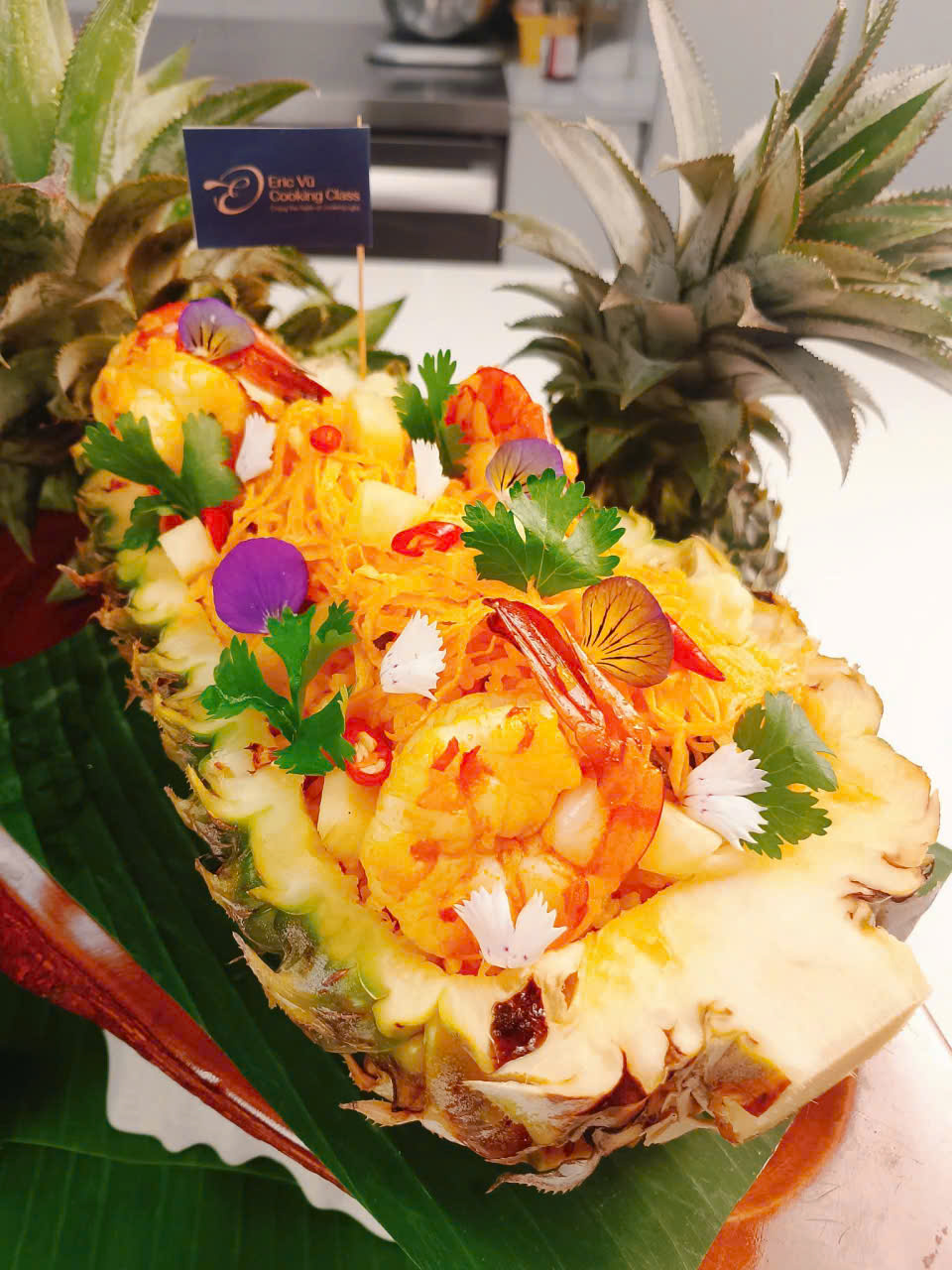 |
Mastering cooking techniques allows you to transform refrigerator leftovers into delicious meals. *Eric Vu Cooking Class*
With a solid grasp of these principles, cooks can effectively utilize the five basic tastes: salty, sweet, sour, bitter, and umami (savory). Salt provides a foundational base, sweetness mellows intensity, sourness adds freshness, and bitterness contributes depth.
The expert advises continuous tasting and adjustment, rather than rigid adherence to measurements.
Thong categorizes cooking creativity into three levels:
Replacing equivalent ingredients: Substituting basil for marjoram or pork for chicken to explore new flavors while preserving the dish's original texture.
Incorporating new ingredients: Adding different elements to create a highlight, such as including pineapple in a braised fish dish.
Free combination: Leveraging leftover refrigerator ingredients, guided by an understanding of the five tastes and chemical principles, to invent entirely new dishes.
"Mastering fundamental knowledge empowers individuals to cook proactively in their own kitchens", Thong states.
Bao Nhien