The event was recently held within the framework of the "Heritage Footprints" project. It was co-organized by the Vietnam Science and Technology Enterprise Startup Fund (SVF), An Binh Commercial Joint Stock Bank (ABBank), and the Hue Department of Science and Technology. Experts believe Hue has an opportunity to leverage its indigenous values as a driver for sustainable economic and cultural growth.
Cultural and historical researcher Tran Quang Duc, author of the book Nghin Nam Ao Mu, highlighted Hue's unique position as a living cultural treasure, shaped by its history and geography. According to him, its secluded geography and minimal population shifts have allowed for the preservation of numerous traditional customs and craft villages. Hue also served as the capital for nearly 500 years, fostering a "royal preservation" spirit that prioritized safeguarding imperial essence.
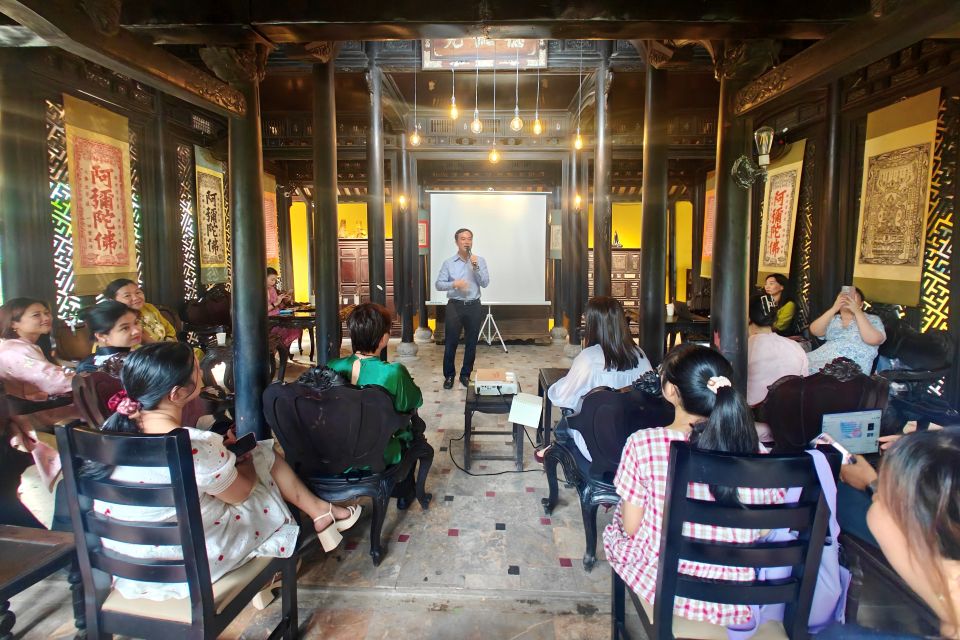 |
The workshop took place at Ngu Ha Vien, Hue City. *Photo: Organizers*. |
Despite its rich heritage, Hue's craft villages struggle to adapt to modern markets, risking decline due to rigid preservation. This intact preservation, however, poses challenges for many craft villages to adapt to market changes, leading to slow innovation in designs and business models, and risking their decline. Mr. Duc believes that for heritage to continue having a new life, a "shared narrative" that blends tradition with contemporary spirit is needed, rather than simply maintaining the status quo. "Preserving tradition is not about keeping the ashes, but about keeping the flame," he stated.
The workshop emphasized the critical role of entrepreneurs in revitalizing heritage, asserting that sustainable growth requires collaboration between artisans and business leaders. Building on analyses of current preservation challenges and the need for innovation, many workshop participants highlighted the decisive role of entrepreneurs in bringing economic vitality to heritage. Pham Duy Hieu, General Director of ABBank and Chairman of the SVF Management Council, noted that craft village development is sustainable only through collaboration between artisans – the keepers of tradition – and entrepreneurs – those who create new models and expand markets.
Mr. Hieu proposed a four-step framework for modernizing heritage, emphasizing collaboration to ensure both preservation and market competitiveness. He outlined a four-step journey to integrate heritage into modern life: the preservation efforts of artisans; the involvement of entrepreneurs with business models leveraging technology and e-commerce; awakening the intangible value of products through cultural and historical narratives; and spreading the spirit of heritage and cultural values into various aspects of life. This collaboration among artisans, experts, and entrepreneurs will enable craft villages to both retain their traditional essence and create competitive products.
 |
Pham Duy Hieu shared insights at the workshop. *Photo: Organizers*. |
The "Heritage Footprints" project, a joint initiative, leverages heritage values to empower artisans and ensure the sustainable development of craft villages. This collaborative effort by ABBank, SVF, and the Hue Department of Science and Technology, utilizes heritage values as creative inspiration. This initiative aims to help artisans secure stable orders, fostering sustainable vitality for craft villages and contributing to the growth of cultural industries.
Nguyen Nha Quyen, SVF's Chief Operating Officer, stated the project's goal is to foster cultural entrepreneurs who can adapt Vietnamese identity to modern markets, with Hue chosen for its unique heritage and governmental support. According to her, the project aims to cultivate a generation of cultural entrepreneurs who can leverage Vietnamese identity to offer products and services that meet modern market demands. Hue was chosen as the starting location due to its rich cultural history, diverse tangible and intangible heritage, and strong government commitment.
The "Heritage Footprints" program is structured around four key activities to empower artisans and ensure the commercial viability of their crafts: First, enhancing awareness and innovative thinking for artisans and successor generations. Second, providing training and mentorship in production, management, and commercialization. Third, connecting resources among businesses, artisans, and regulatory agencies. Fourth, offering financial support and market expansion for viable projects.
Experts stress that craft village revitalization demands creating new value for young consumers and integrating with the cultural industry, moving beyond simple preservation. According to experts, the revitalization of craft villages requires more than mere preservation; it necessitates creating new value that resonates with young consumers and integrates into the cultural industry ecosystem.
Lan Anh