Son Si-woo vividly recalls the moment his mother abruptly unplugged his computer during an online interview for a professional gamer position. "She said playing games made my character worse and that I was addicted," the 27-year-old remembers.
The turning point came when Son won an amateur tournament with a prize of 2 million won (over 36 million VND). He gave all the money to his parents. "From then on, they began to have some faith," he said.
Nearly a decade later, Son – known by his gamer tag Lehends – is a champion of multiple League of Legends (LoL) tournaments. He currently plays for Nongshim RedForce, a professional team sponsored by one of South Korea's largest food corporations.
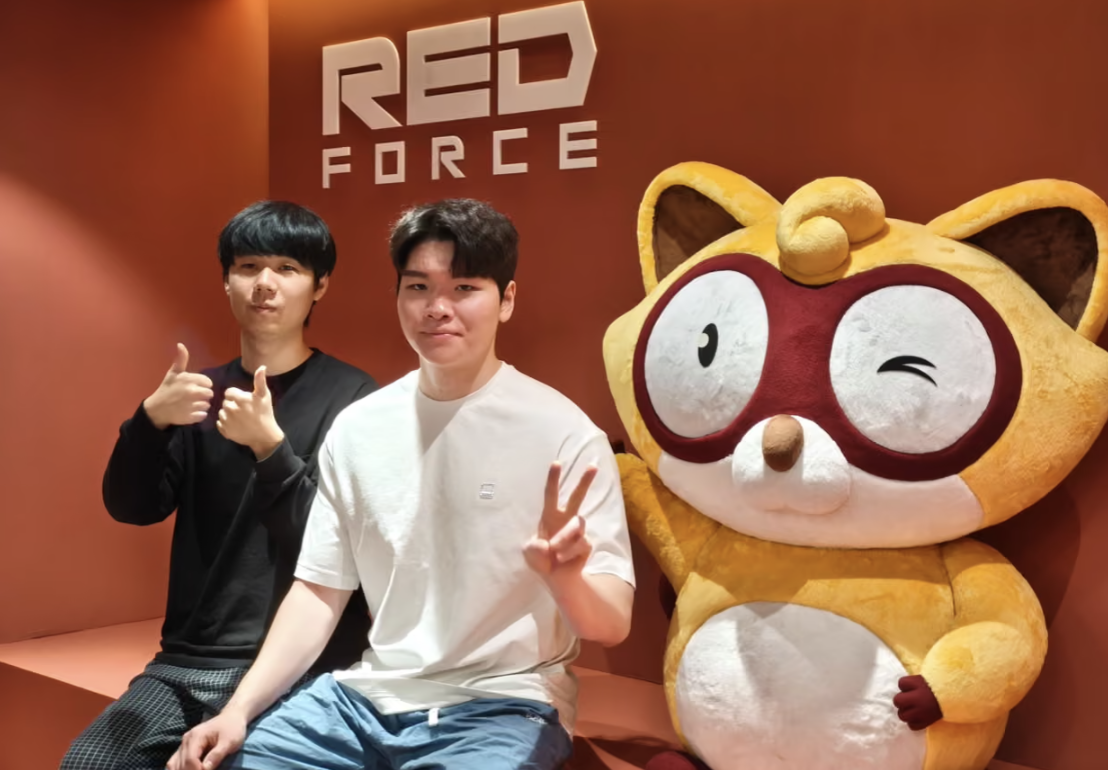 |
Lehends (left) and Kingen (right) are professional players for Nongshim RedForce. *Photo: Raphael Rashid*
Son's career mirrors South Korean society's transformation in its perception of video games. Last October, South Korean President Lee Jae-myung publicly declared that "video games are not an addictive substance." This marks a significant shift from 2013, when lawmakers attempted to classify games among the "four main addictive categories," alongside drugs, gambling, and alcohol.
Economic data supports this change. From 2019 to 2023, South Korea's domestic gaming market grew by 47%, reaching a value of nearly 23,000 billion won (approximately 16,5 billion USD). Game exports account for nearly two-thirds of total digital content exports, surpassing other well-known cultural sectors such as K-pop and cinema. In this ecosystem, esports plays a pivotal role, shaping how games are promoted and consumed, even though its direct value constituted a smaller portion (approximately 257 billion won in 2023). South Korea currently ranks fourth globally in game market share, after the US, China, and Japan.
South Korea, a nation that once imposed a "Shutdown Law" prohibiting children from playing games after midnight, now recognizes gaming as a legitimate profession. This transformation began in the late 1990s with the boom of PC bangs (internet cafes). Today, approximately 7,800 PC bangs remain active, but the aspirations of young people have become far more professional.
At the Nongshim Esports academy in Guro district, Seoul, the training atmosphere is as intense as any Olympic athlete training facility. Young trainees focus intently on screens in absolute silence, under the strict supervision of coaches. Along the corridors are rows of gleaming trophies. The academy provides its own dormitory and a cafeteria with a nutritionist overseeing every meal.
Roh Hyun-jun, 22, decided to defer his mechanical engineering studies to pursue this path. "University is just a backup plan. I want to feel the solidarity when a team of five works towards a common goal to win," Roh said.
However, the cost of this dream is not cheap. Tuition fees here are approximately 500,000 won (nearly 10 million VND) for 20 hours of coaching per month. Evans Oh, CEO of Nongshim Esports, revealed an extremely high attrition rate: only 1-2% of trainees succeed in becoming professional players or finding related employment. Since 2018, the academy has produced only 42 professionals.
In return, superstars can earn six-figure salaries (in USD), not including prize money and lucrative endorsement deals.
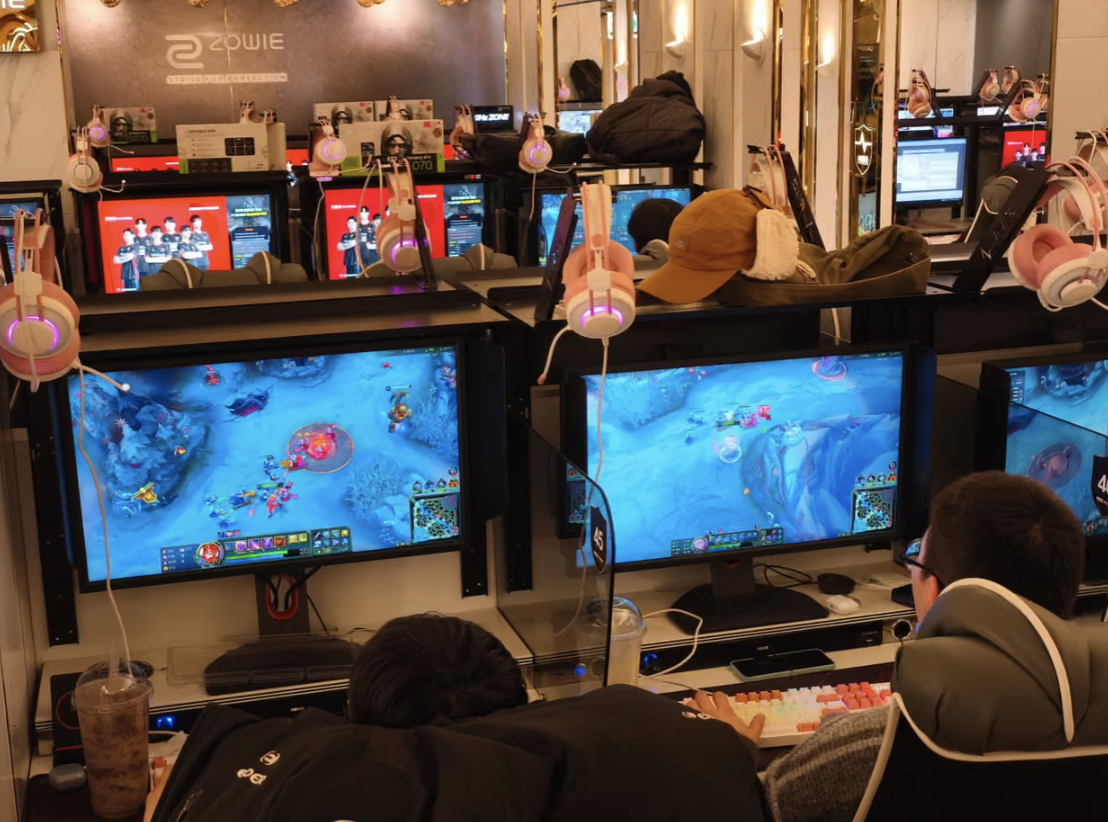 |
Gamers at an internet cafe in Guro district, western Seoul. *Photo: Raphael Rashid*
Despite the allure, the glory is often short-lived. Aiden Lee, Secretary General of the LCK tournament, stated that Korean gamers train for over 16 hours daily. Their careers typically end before age 30 – a timeframe further constrained by mandatory military service for men. "If you are not good enough, you have to quit early. That's the nature of this market," admitted Hwang Sung-hoon, 25, Lehends' teammate.
Aiden Lee, Secretary General of the League of Legends Champions Korea (LCK), explained that Korean teams have won 10 out of 15 world championships due to their highly competitive environment. "Korean gamers can train for over 16 hours daily. Their focus is on another level," he said.
While supporting growth, the government maintains protective measures. Currently, there are seven 'healing' centers nationwide that collaborate with hospitals to counsel young people overly immersed in gaming. Standard contracts also limit the training hours of young players to ensure healthy competition.
Nevertheless, the appeal of a professional gaming career remains strong. In a survey by the South Korean Ministry of Education, "professional gamer" ranked fifth on the list of dream jobs for male elementary school students.
For young individuals like Roh, the determination remains unchanged: "I want to leave my name as one of the most famous gamers."
Minh Phuong (Source: The Guardian)