The incident was reported by Wakayama city on 21/11. Earlier this month, the man picked unfamiliar mushrooms in the mountainous region of Shimokitayama, Nara province. Unable to consult an expert, he used an AI app on his phone for identification. The app's result stated the mushrooms were "shiitake or oyster mushrooms, which are edible."
Trusting the AI's response, he grilled and ate the mushrooms. Just 30 minutes later, he began to vomit and experienced severe abdominal pain, leading to an emergency hospital visit. Fortunately, the patient recovered after intensive treatment.
 |
This mushroom was identified by AI as shiitake or oyster mushroom, but it is actually poisonous. *Photo: Yahoo* |
The provincial Natural History Museum and the city's Hygiene Research Institute examined leftover mushroom samples. They identified the species as Tsukiyotake (scientific name *Omphalotus japonicus*), a highly poisonous mushroom common in Japan.
Tsukiyotake closely resembles shiitake and oyster mushrooms and is responsible for many food poisoning incidents. Typical identifying features include a ridge at the base and black spots inside the stem when cut lengthwise. However, many individual Tsukiyotake mushrooms lack these black spots, making visual distinction difficult even for experienced foragers.
Crucially, the toxins in Tsukiyotake are heat-stable and are not destroyed by grilling or thorough cooking.
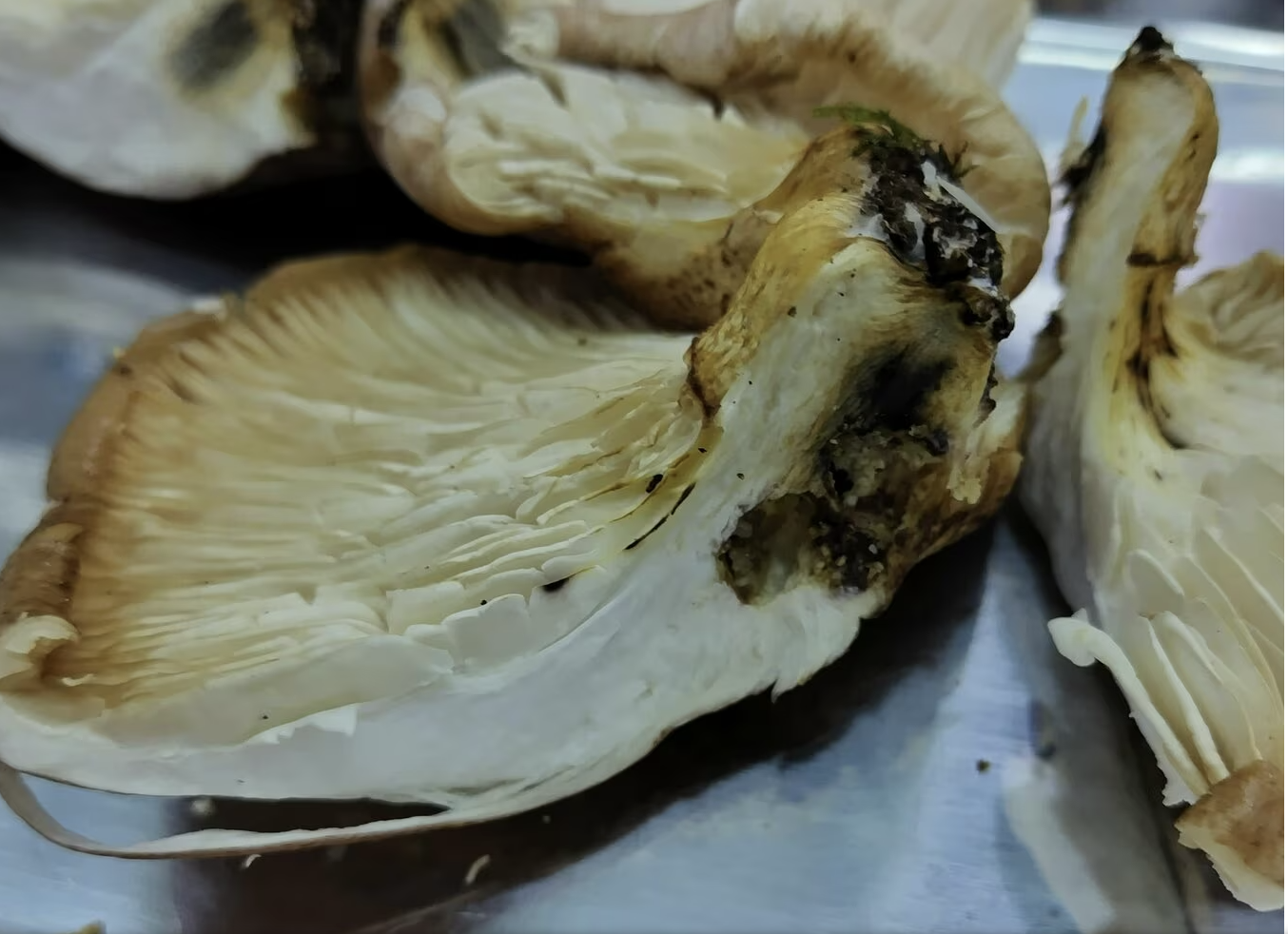 |
Inside this poisonous mushroom, black marks are often found near the base. *Photo: Yahoo* |
A representative from Wakayama city's Life Health Department warned that using AI or pictorial guidebooks to identify wild mushrooms is very dangerous due to their imperfect accuracy.
"When it comes to wild mushrooms, if you are not 100% certain, people must adhere to the principle: Do not pick, do not eat, do not sell, and do not give to others," the representative advised.
Bao Nhien (According to Yahoo)