On the evening of 23/7, Hong Wang, 35, a professor at the Courant Institute of Mathematical Sciences at New York University, US, and the Institut des Hautes Etudes Scientifiques (IHES) in France, became one of four individuals to win the Fields Medal. She is the third female mathematician in the world to receive the award, often dubbed the "Nobel of Mathematics." In its history, fewer than 70 individuals have been honored with the medal.
Hong Wang received the award for resolving the Kakeya Conjecture in three-dimensional space, a problem that has challenged mathematicians for over a century.
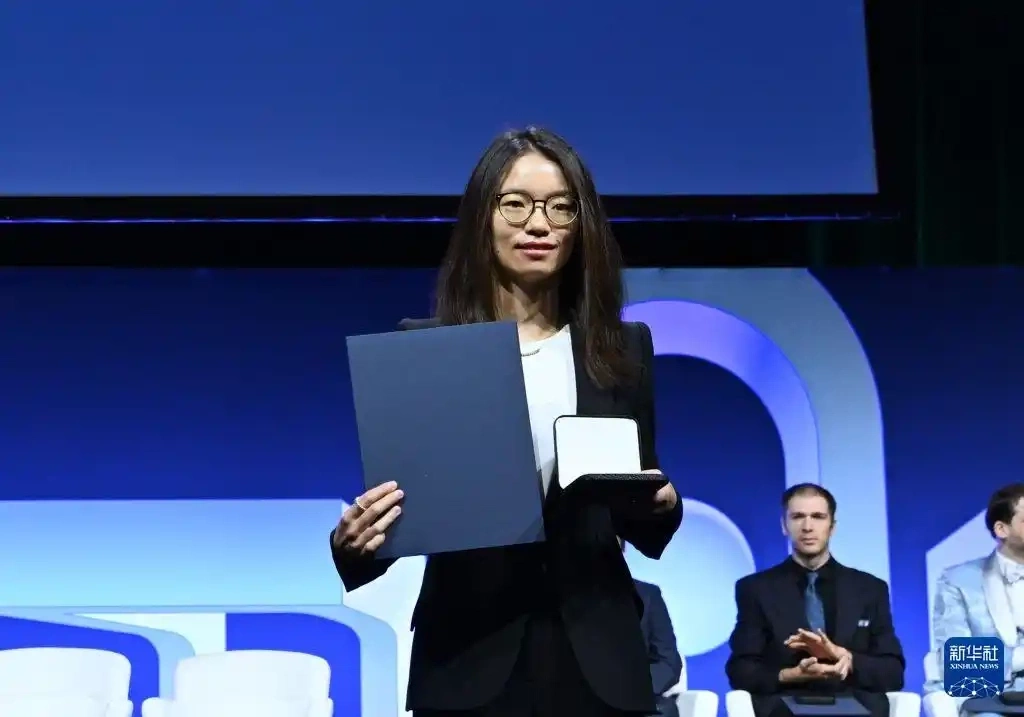 |
Hong Wang at the prestigious Fields Medal award ceremony on 23/7. *Photo: Chinese Marriage and Family Magazine* |
Hong Wang grew up in Guilin, Guangxi, China. Her father, Wang Yingwen, taught mathematics, and her mother, Xiao Runluan, was an English teacher.
"Mathematics is how I understand the world," Wang stated. She recalled her first childhood math problem: "On a plane, there are seven points. If three points form a line, how many lines can be found?" Discovering the answer independently made mathematics her favorite intellectual game.
Hong Wang's childhood was not filled with test preparation books. Her parents encouraged her to lead a normal life, taking walks, watching television, or playing sports. She read Greek mythology, Harry Potter, and The Lord of the Rings. Her parents did not impose academic pressure or interfere with her reading choices.
At four years old, Wang suffered a scald burn on her arm, requiring a lengthy hospital stay and skin graft surgery. Her parents encouraged her to self-study and read. As a result, she entered second grade at five years old.
In 2007, at 16, Wang was admitted to Peking University. When neighbors offered congratulations, her mother remarked, "Getting into Peking University isn't success. Life is long; one exam shouldn't decide everything."
As the university only admitted one mathematics student from Guangxi, she enrolled in Earth and Space Sciences. By self-studying the mathematics curriculum from her first year, she passed the entrance exam to transfer to the mathematics department in her second year.
After graduating in 2011, she moved to France to earn an engineering degree from Ecole Polytechnique and a master's degree from Paris-Sud University. In 2019, she completed her doctorate at the Massachusetts Institute of Technology (MIT).
Hong Wang's academic path was not entirely smooth. During her master's studies, she felt disoriented, temporarily setting aside mathematics to pursue architecture and intern at a design office. Faced with her daughter's decision, Wang's parents provided space for her to experiment. "Rest if you're tired, study a bit more if you're not," her mother advised.
Her parents' understanding and respect for her autonomy helped Hong Wang realize, after a detour, that mathematics—a field allowing for the free construction of logic—was her greatest passion. From then on, she dedicated herself fully to research.
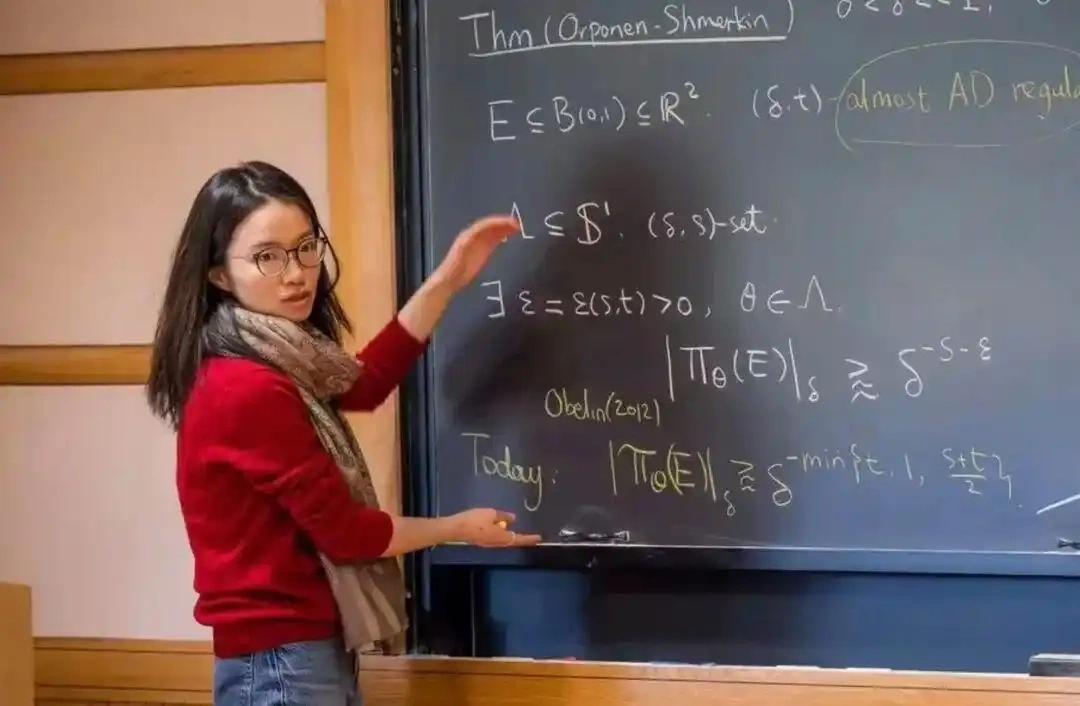 |
Hong Wang was a "child prodigy," entering second grade at five years old and Peking University at 16. *Photo: Marriage and Family Magazine* |
In 2022, she received the Maryam Mirzakhani New Frontiers Prize, followed by the Salem Prize in 2025. In September 2025, she became a permanent professor at IHES. In June 2026, she was appointed Professor at New York University.
Her parents largely declined interviews. Mr. Wang Yingwen once turned down a job transfer opportunity at a district government agency to dedicate more time to caring for his daughter.
During the Fields Medal ceremony, Hong Wang's introductory video featured images of the Guilin landscape. She mentioned always making time to return home and take walks with her parents. The professor stated that her family's non-interference and unconditional acceptance were the foundations that enabled her scientific achievements.
Bao Nhien (According to Chinese Marriage and Family Magazine)