Pork skin is mainly composed of collagen, a protein that forms a dense, interconnected network with high water retention. This property makes the skin both pliable and moisture-rich.
When exposed to heat, collagen contracts. Without proper moisture control, the skin quickly becomes chewy and hard, forming an impermeable barrier that traps steam. This prevents the skin from crisping, even at high temperatures.
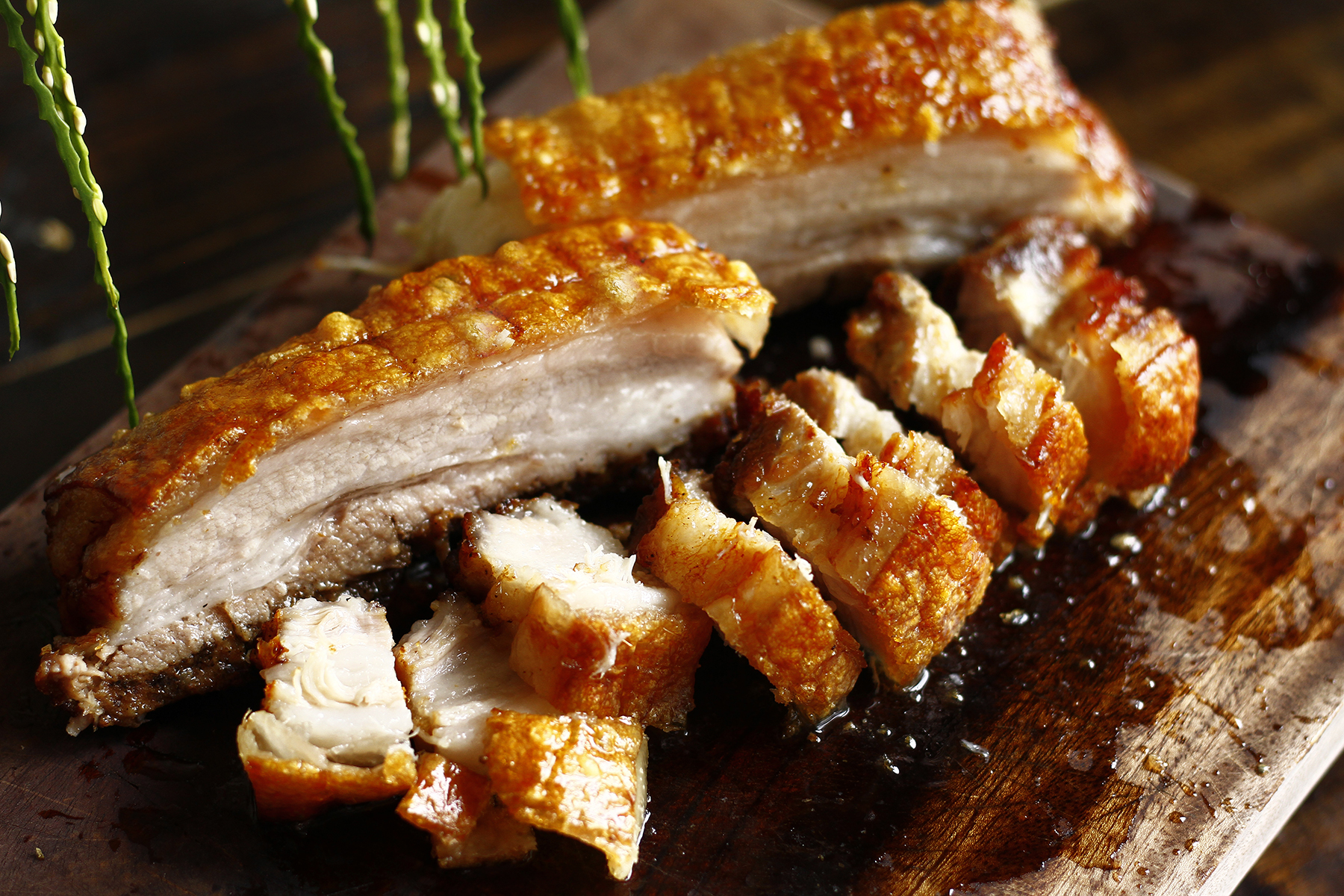 |
Roasted pork belly with crispy, "popped" skin. *Photo: Bui Thuy* |
Key techniques for perfectly crispy skin
To achieve crispy skin, the collagen layer must be weakened, allowing steam to escape. Three common preparation steps correspond to three distinct mechanisms:
**Pricking the skin creates steam vents**: Tiny punctures act as conduits for steam to escape when heated. Denser, shallower holes distribute pressure more evenly, helping the skin crisp uniformly. Piercing too deep into the fat layer, however, causes rendered fat to block these vents, resulting in soft skin.
**Brushing with vinegar weakens collagen bonds**: Acetic acid in vinegar subtly affects the skin's surface, breaking down some of the collagen network's bonds. This process reduces the outermost layer's elasticity, making it more prone to crisping, separating, and puffing up when heated.
**Sprinkling salt draws moisture from the surface**: Salt creates a concentration gradient, which helps extract residual water from the skin. A drier surface allows the temperature to rise more quickly, promoting thorough and vigorous vaporization. The drier the skin, the greater its potential for crisping.
The mechanism of crispy skin: Internal pressure
After these preparatory steps, the skin becomes drier and weaker. The remaining water beneath the collagen layer then plays a crucial role.
When temperatures exceed 200°C, this residual water rapidly converts to steam. The sudden volume expansion generates intense internal pressure, causing the skin to puff up into small bubbles.
Heat further dries these bubbles, setting their structure and creating the characteristic porous, crispy skin with its distinct crackle.
Three principles for success
**Blanching to "set" the skin**: Briefly immersing the skin side down in hot water for a few minutes initiates collagen denaturation, resulting in a tauter, flatter surface. This crucial step prepares the skin for more effective pricking and subsequent roasting.
**Thoroughly dry before roasting**: Moisture is the primary impediment. If the skin remains wet, water absorbs heat, slowing the surface temperature rise. Therefore, air-dry or refrigerate the skin for several hours until it is completely dry.
**Roast in two stages for heat control**: The first stage uses moderate heat to cook the meat and render fat. The second stage increases to high heat, concentrating on the skin's surface to activate vaporization and achieve the desired crisping.
Achieving crispy roasted pork belly is not about a single trick, but rather the result of simultaneously controlling moisture, skin structure, and heat. Understanding these mechanisms empowers home cooks to precisely adjust each step, moving beyond reliance on oven luck or rigid recipes.
Bui Thuy