For the past five years, Ridhwan Danial, 29, from Singapore, has lived on the road. He works 16 hours a day, six days a week, as a delivery driver.
An income of 6,000-7,000 SGD per month is a dream for many. However, for Ridhwan, it has become a "golden handcuff". He tried to apply for office jobs but was rejected because his old qualifications were no longer relevant, or he received offers with salaries significantly lower than his current earnings.
"If I don't drive, I won't have enough money for my business administration university tuition next year", Ridhwan said, adding that he is forced to see this as a temporary stepping stone, even though he knows it is eroding his future.
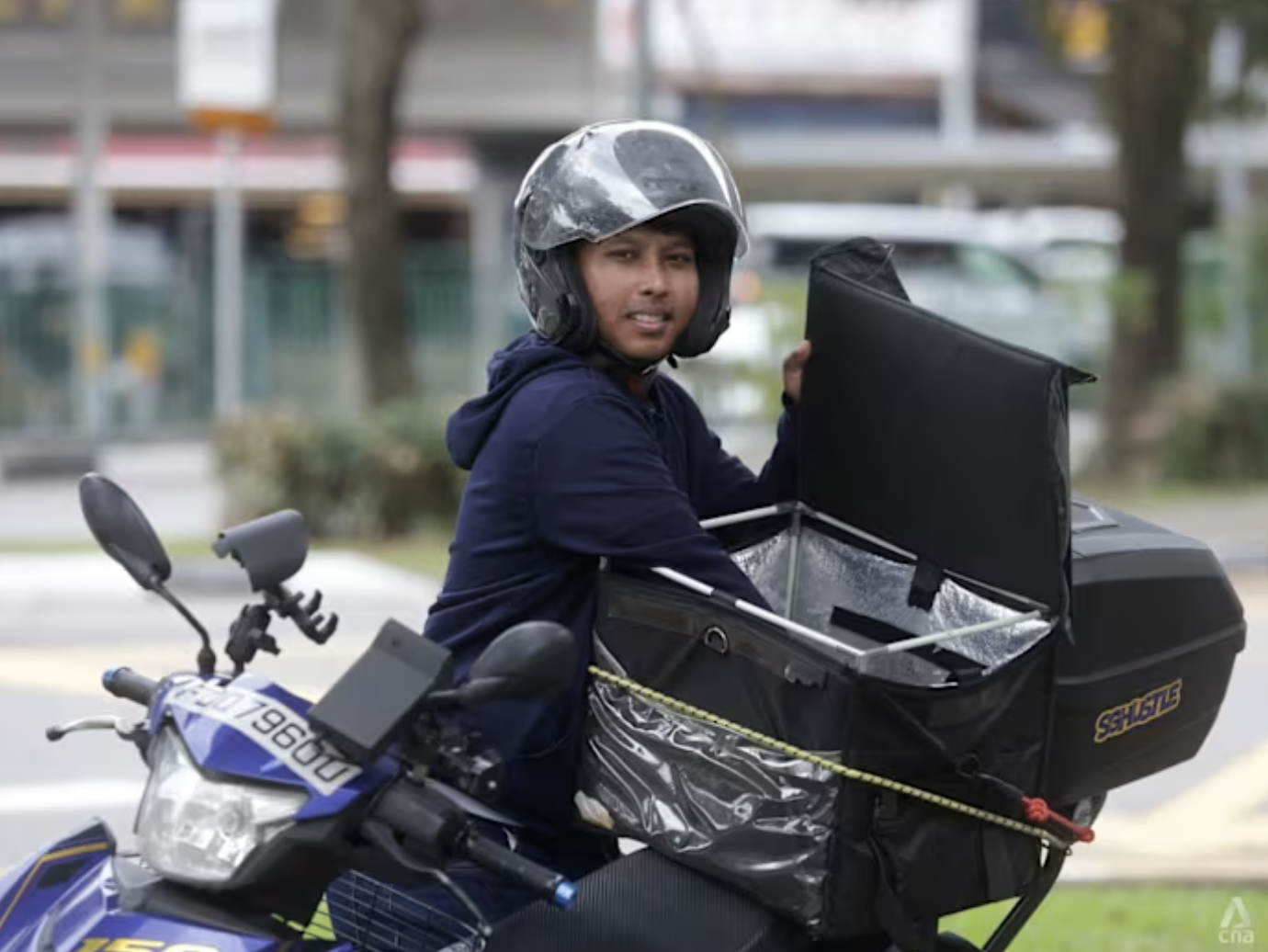 |
Ridhwan Danial, 29, a delivery driver, stands outside a Beauty World store on 9/12. Photo: CNA/Ooi Boon Keong |
Ridhwan Danial, 29, a delivery driver, stands outside a Beauty World store on 9/12. Photo: CNA/Ooi Boon Keong
The lure of freedom often disguises a deeper trap. A recent report from Singapore's Ministry of Manpower (MOM) indicated that the number of platform workers, including delivery drivers and ride-hailing drivers, is projected to reach 71,600 by 2025. This group is becoming younger due to low entry barriers and the appeal of immediate, weekly payments.
However, researchers from the National University of Singapore (NUS) warn that this perceived freedom is a "meal-to-meal" trap. Unlike traditional employment with clear career paths, gig workers can only "move horizontally"—switching between different apps without advancing their status or skills. Dr. Li Ding of Nanyang Technological University (NTU), who once sparked discussion by working as a delivery driver after earning a master's degree, observed that Gen Z today prefers diversifying income streams over committing to one company. This trend, combined with a challenging economic landscape where nearly 60% of Singaporean businesses are expected to pause recruitment until 2026, further pushes young people into gig work for their livelihoods.
The most significant cost of prolonged full-time gig work is the erosion of office-based skills. Sociologist Mathew Mathews noted that platform workers often lack an environment to develop teamwork, reporting skills, or the ability to manage key performance indicator (KPI) pressure from superiors.
"Many employers view candidates who spend years as gig workers as a disadvantage, suggesting a lack of competitiveness or difficulty integrating into company culture", Mr. Mathew stated.
For individuals with fewer qualifications, like Azlyiana Mad Azmi, 29, the opportunities are even narrower. As a mother of three young children, she chose food delivery for its flexibility, allowing her to care for her autistic child. However, the physical exhaustion from her deliveries leaves her with no energy to pursue further education or transition to a different career.
 |
The flexibility and autonomy of digital platform work remain key attractions for many young workers. Photo: CNA/Ooi Boon Keong |
The flexibility and autonomy of digital platform work remain key attractions for many young workers. Photo: CNA/Ooi Boon Keong
Singapore has recognized this risk and passed the Platform Workers Act 2024, which mandates social security contributions for young workers. Skill training programs have also been introduced, though many workers remain reluctant to participate, fearing a reduction in income if they take time off from driving to study.
Despite these challenges, experts affirm that it is never too late to change course. Huang Yiyao, 45, exemplifies a successful escape from this trap. He utilized breaks between deliveries to self-study data analysis and has since become a human resources manager.
"The issue is not whether gig work is good or bad. What matters is that young people understand what they are trading off, instead of seeing it as an easy way out only to get stuck forever", an NUS expert emphasized.
Minh Phuong (According to CNA)