South Korean society once viewed adults who were overly attached to their mothers as lacking independence. However, this perception is changing. A growing number of young people are now identifying as "eommisae," a term combining "eomma" (mother) with the slang suffix "-misae," which signifies an obsession.
Instead of perceiving this as a negative label, young people use the term to express appreciation for family.
This trend is spreading on social media, with many sharing moments of shopping, traveling, or dining with their mothers. On Instagram and YouTube, numerous accounts state they prefer spending time with their mothers over socializing with friends.
The popularity of "eommisae" is partly due to economic pressures. Rising housing prices, a competitive labor market, and unstable incomes are forcing many to delay moving out.
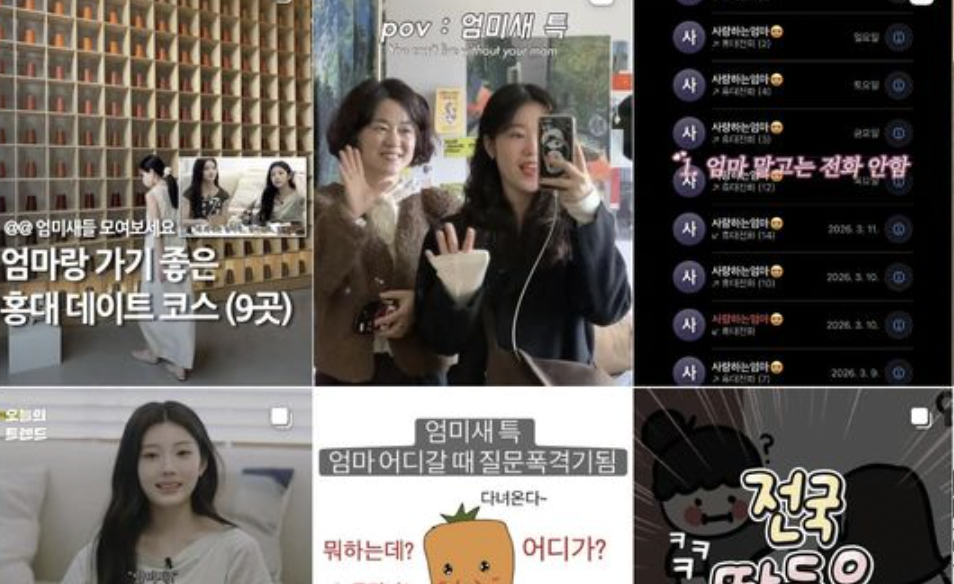 |
Social media posts featuring the #eommisae hashtag. *Photo: Korea Times* |
A 2024 survey by the Office for Government Policy Coordination of South Korea revealed that 54,4% of people aged 19-34 still live with their parents, an increase from 46% in 2000. Among them, 56,6% cited financial difficulties as the primary reason. Only 38% planned to move out soon.
Data from the Organization for Economic Cooperation and Development (OECD) in 2022 indicated that 81% of South Koreans in their 20s live with their parents, a figure higher than the average of 50% across OECD countries. Increasing living costs are prolonging the process of financial independence for young people.
Beyond economic factors, "eommisae" also reflects a shift in relationship building. With shrinking social circles and challenges in finding partners, many prioritize stable family relationships.
This trend runs parallel with young people choosing singlehood. A 2022 survey by the Korea Association for Population, Health, and Welfare recorded that 65,5% of unmarried individuals aged 19-34 did not have a romantic partner. Of these, 70% stated this was a deliberate choice.
Ngoc Ngan (Source: Korea Times)