City People's Committee Chairman Vu Dai Thang recently signed Decision No. 2636 on 25/5, approving Hanoi's multi-purpose urban area project. The project aims to develop multi-purpose urban areas evenly distributed across 8 directions of the city, linked to 9 development axes identified in the Capital Master Plan's 100-year vision.
These urban areas prioritize locations near main transport corridors and public transport hubs. They will address diverse housing needs, including: social housing, resettlement housing for major projects being implemented, public housing, rental housing, and a reasonable proportion of commercial housing.
The multi-purpose urban areas are envisioned as sustainable living and working spaces, capable of creating and sustaining livelihoods for residents. These areas will feature full commercial, service, clean production, urban logistics, and public service functions. This ensures residents can access daily activities, education (preschool, primary, vocational training facilities), healthcare (hospitals, clinics), and cultural-sports facilities within the urban area.
The city encourages strategic investors with strong financial capacity, experience, and the ability to develop synchronized infrastructure to participate in these multi-purpose urban areas, ensuring compliance with the project's requirements, principles, and management mechanisms.
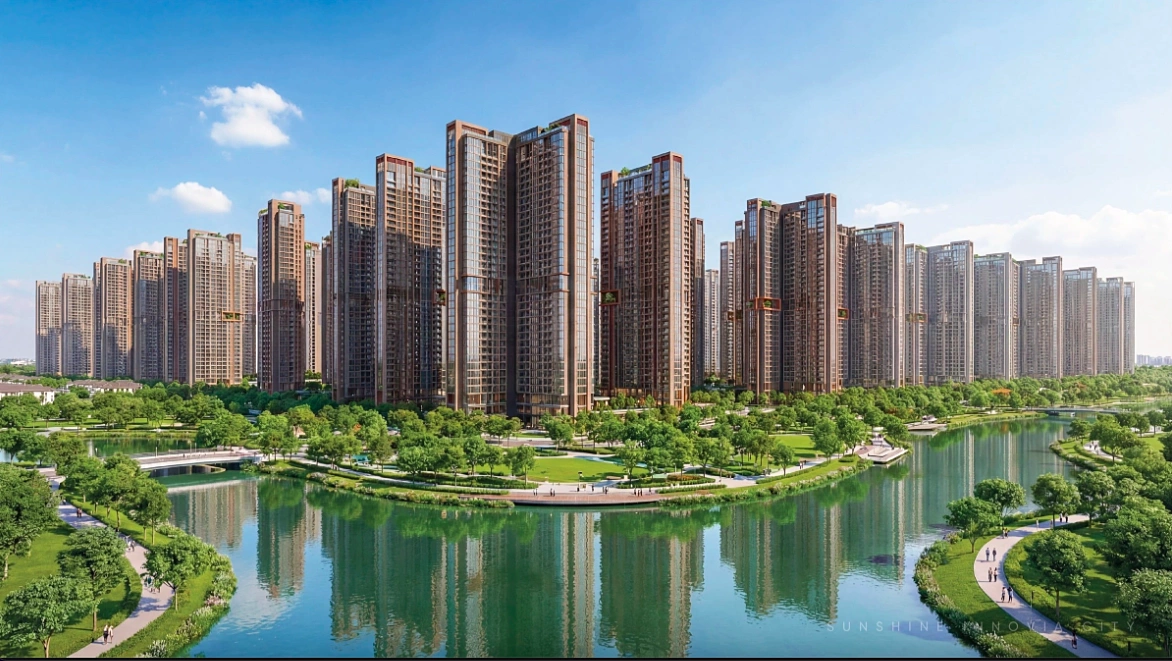 |
An artist's impression of Bac Thang Long Urban City, spanning nearly 700 ha in the Dong Anh - Me Linh area. *Handico* |
The housing structure within these urban areas prioritizes urban regeneration in the city center, inner-city population decentralization, and resettlement for major land clearance projects. This approach also ensures social welfare, synchronized urban development, and balanced investment resources.
Specifically, commercial housing in multi-purpose urban areas can be traded according to regulations. Developers must disclose quality standards and selling prices, ensure on-schedule delivery and committed quality, and fulfill warranty and maintenance obligations. Buyers or lease-purchasers of commercial housing cannot resell the property for three years from the date of full payment. Should they wish to sell within this three-year period, they may only sell it back to the project developer at a price not exceeding the original purchase price in the sales contract.
Social housing is managed, sold, rented, or lease-purchased according to specified beneficiaries, conditions, and procedures. Resettlement housing is allocated based on approved compensation, support, and resettlement plans. Once the project's resettlement housing units are eligible for future sale, the project developer will directly sign sales contracts with eligible resettled individuals, as per the list approved by the competent authority.
If, after 12 months from the date of project acceptance and handover, resettlement apartments remain unallocated or unclaimed according to the approved compensation plan, the investor may propose converting these unused units into social housing for sale, rent, or lease-purchase.
According to city estimates, the total housing development demand for the 2021-2030 phase is approximately 195-255 million sq m of floor area. After meeting the demand for social housing (about 18 million sq m) and self-built housing by residents (about 45 million sq m), an additional 132-192 million sq m of commercial and resettlement housing floor area will be needed within multi-purpose urban development projects.
The project roadmap indicates that in Q2/2026, the city will draft and approve the multi-purpose urban area project, initiating implementation in several areas. By 2030, the city expects two to three urban areas to be operational, allowing for an evaluation of the project's performance as a basis for further expansion of the model throughout the area.
In early February, Hanoi commenced two multi-purpose urban area projects. The first project, Bac Thang Long Urban City, spans nearly 700 ha and is located in Phuc Thinh and Thien Loc communes (formerly part of Dong Anh district) and Me Linh commune (formerly part of Me Linh district). Its location between Ring Road 3 (directly connecting Thang Long Bridge) and Ring Road 3.5 (connecting Thuong Cat Bridge) is strategic, with implementation scheduled until 2032.
The second project is a multi-purpose urban area in Thu Lam and Dong Anh communes, developed by Song Hong Future Group Joint Stock Company. This area is approximately 18 km from Bac Thang Long Urban City, near the Hanoi - Thai Nguyen Expressway, and spans about 696 ha.
By Vo Hai