On 4/6, Da Nang's Department of Construction submitted a report to the City People's Committee, seeking approval to adjust the planned location of the North-South high-speed railway passenger station.
The proposal recommends moving the station from its current site in Hoa Khanh ward to the intersection of National Highway 14B and the Da Nang - Quang Ngai Expressway (Km706+300) in Ba Na commune. This new location is about 5 km southeast of the previously designated area.
The Department of Construction clarified that this revised plan emerged after the city's economic development zone expanded. The primary goals are to boost investment efficiency and enable the creation of urban areas following the Transit-Oriented Development (TOD) model, which integrates urban growth with public transportation infrastructure.
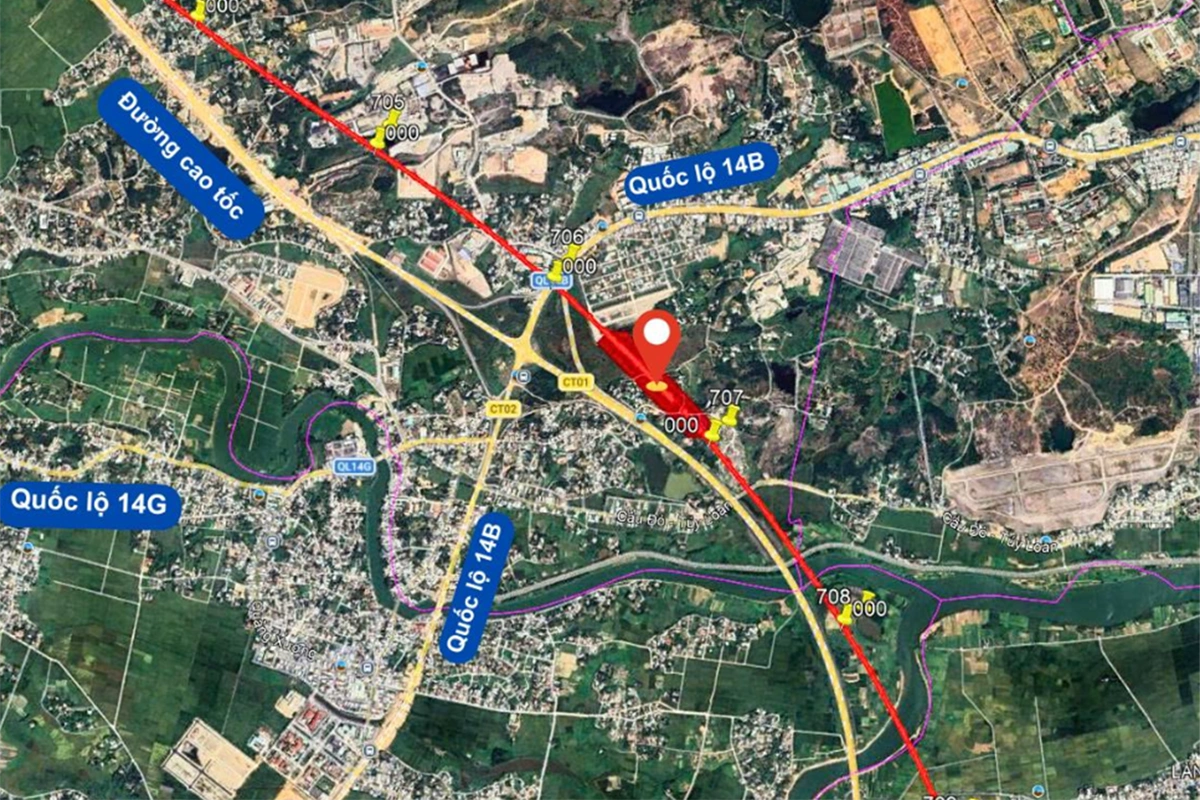 |
Proposed location for the new passenger station. *Photo: Department of Construction* |
The original plan positioned the passenger station north of the Ba Na - Suoi Mo road intersection with the North-South expressway. However, this site presents significant challenges: its steep, hilly terrain would demand extensive excavation and filling, leading to complex engineering, higher investment costs, and a prolonged project timeline. Moreover, the surrounding land is restricted by natural geography and existing projects, making it difficult to develop large-scale mixed-use urban areas or logistics hubs. Connectivity to the city center and airport is also suboptimal due to considerable distances.
In contrast, Ba Na commune offers a more favorable terrain, characterized by relatively flat land, low hills, and rice fields, simplifying construction and reducing land-leveling expenses. Strategically, this location sits at the junction of key transportation arteries: National Highway 14B, National Highway 14G, and the North-South expressway. This provides direct connectivity for passengers to the city center and airport via National Highway 14B and the Thang Long road, which runs along the Cam Le river.
According to the Department of Construction, the new area also provides a sufficiently large land fund to establish a multi-functional, compact urban area within an 800-1,000 m radius of the station. This would act as a catalyst for development in the city's west-southwest region. Furthermore, it presents ideal conditions for creating a logistics center that integrates rail, air, and industrial zones, while also strengthening links with Hoi An.
Specialized agencies have assessed the proposed new site to be approximately 46 km from Chan May station and 61 km from Tam Ky station. This distribution is considered more balanced compared to the current plan, which places the station 40 km and 67 km respectively from these two points.
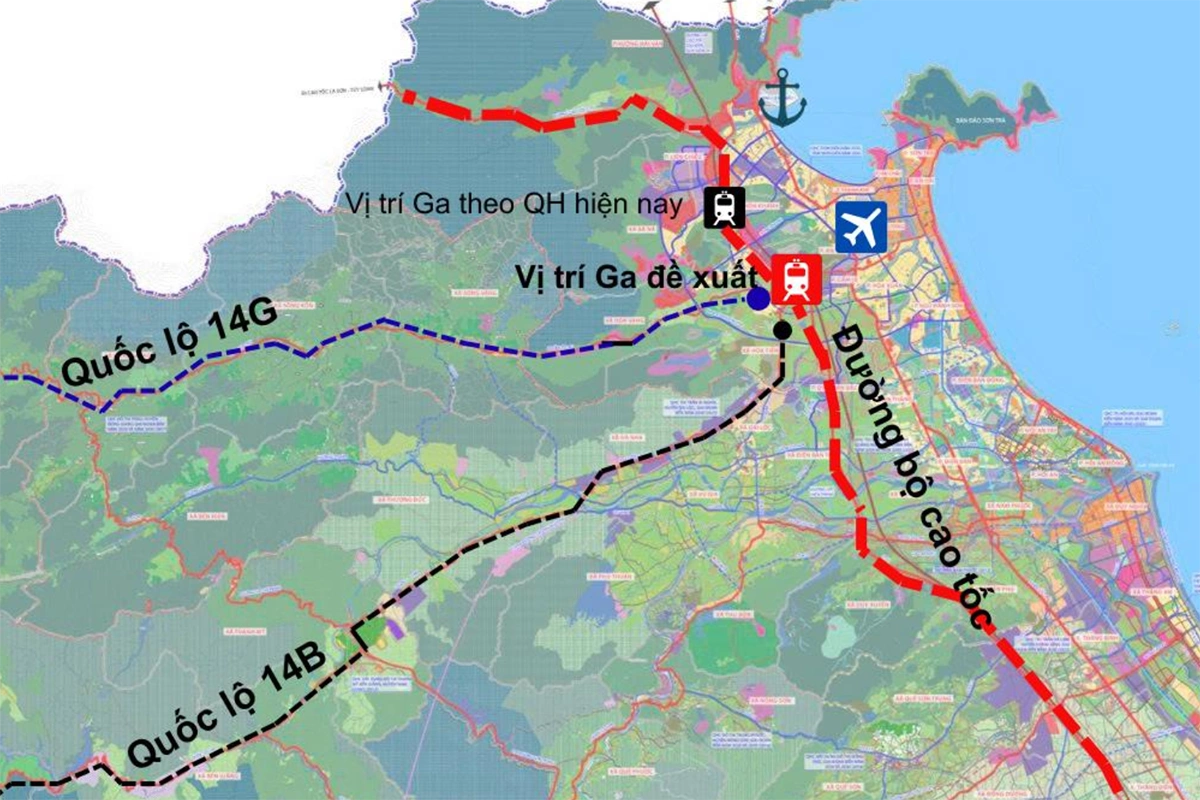 |
The new station location is about 5 km southeast of the old station. *Photo: Department of Construction* |
The proposal to relocate the station has garnered consensus from the People's Committee of Ba Na commune, the People's Committee of Cam Le ward, and the Department of Agriculture and Environment. Da Nang is also advancing several connecting infrastructure projects, including undergrounding the Le Thanh Nghi - Cach Mang Thang Tam - Thang Long intersection, expanding Hoa Xuan bridge, and exploring an MRT line along Thang Long road to mitigate future traffic congestion.
The Department of Construction has recommended that the City People's Committee approve the principle of this adjustment. This approval would pave the way for reporting to the City Party Committee Standing Board and seeking endorsement from the Ministry of Construction, ultimately serving as the basis for updating the city's general plan.
The North-South high-speed railway, spanning about 1,541 km, will link Hanoi with Ho Chi Minh City, with an estimated total investment exceeding 67 billion USD. The project is expected to break ground in December 2026 and reach completion in 2035. The section traversing Da Nang is 116,42 km long, passing through 24 communes and wards. For this segment, the city plans to acquire 866 hectares of land and allocate nearly 19.6 trillion VND for the construction of 34 resettlement areas and 13 cemeteries.
Nguyen Dong