


According to a decision issued by the HCMC People's Committee on 6/1, the design competition will be open to all qualified participants. Architectural, planning, and bridge-road transportation companies or consortia with sufficient capacity, reputation, and experience are eligible to participate. Following the results, Ho Chi Minh City will select the optimal design, announce it, and award prizes.
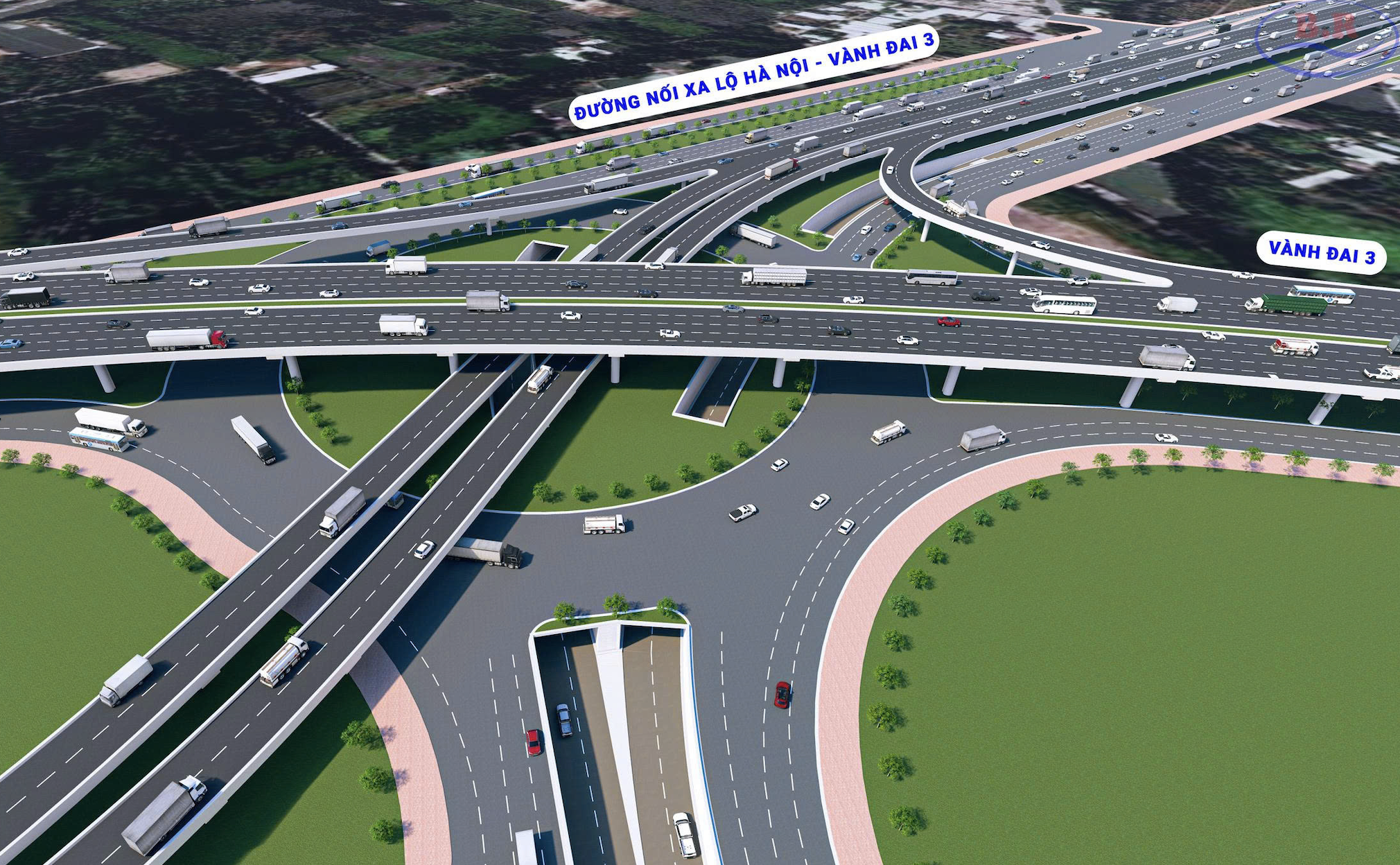 |
Perspective of the Go Cong interchange on Beltway 3. *Photo: HCMC Department of Construction*
The city mandates that the architectural plan must first effectively address traffic organization and regional connectivity challenges. The interchange and the branch connecting to Hanoi Highway need to ensure reasonable traffic distribution from all directions, creating smooth flow between the main Beltway 3 and its parallel road.
In addition to technical aspects, the architectural plan must comply with approved planning, ensuring safety, modernity, aesthetic appeal, and harmony with the surrounding urban landscape. The design should also incorporate lighting and architectural decoration solutions to create an urban highlight, while prioritizing safety and operational efficiency.
The investment policy for the complete Go Cong interchange on Beltway 3 and its connecting branch to Hanoi Highway was approved by the HCMC People's Council during its 8/2025 session. The project spans approximately 5.9 km, encompassing the Go Cong interchange on Beltway 3 and the connecting road from the interchange to the Station 2 area on Hanoi Highway (formerly Thu Duc City).
The Go Cong interchange is situated between Beltway 3 and Nguyen Xien road, featuring a four-level design combined with a round island. Key components include ramps (N1-N4), each with two lanes. An underpass on the Hanoi Highway connecting Long Phuoc to Dong Nai 2 Bridge will be developed in a later phase.
On Beltway 3, the project will add a four-lane elevated bridge, increasing the complete scale to eight lanes as per the master plan. Additionally, the project includes constructing multiple overpasses, storm and wastewater drainage systems, underpasses, sidewalks, green spaces, and lighting.
The project is expected to commence in 2027 and be completed by Q4/2028. Once operational, the interchange will help regulate traffic flow, alleviate pressure on adjacent routes, and enhance the operational capacity of Beltway 3 and Hanoi Highway.
*By Giang Anh*


