On 3/3, workers began removing the first roof tiles, neatly stacking them on the ground. Despite heavy rain in Hue today, workers continued to remove the concrete layer above, marking wooden components for further dismantling tomorrow.
 |
Roof tiles of the ruong house at Empress Dowager Tu Du's tomb have been dismantled. Photo: Vo Thanh
The dismantling of the ruong house at Empress Dowager Tu Du's tomb is expected to take approximately 5 days, according to the Hue Monuments Conservation Center. This process is being carried out step-by-step to avoid affecting existing structures in the area.
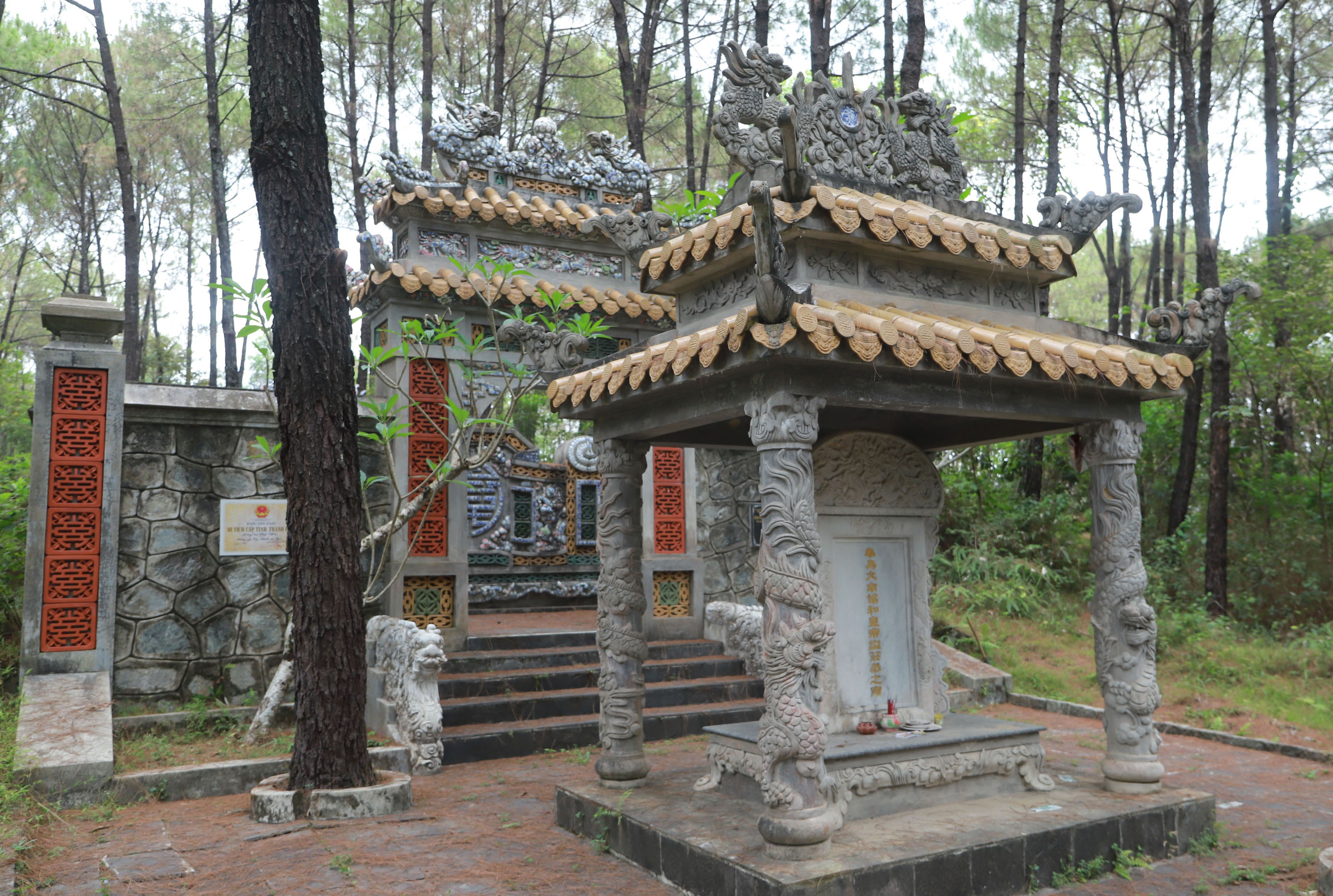
The ruong house and a new three-arched gate (tam quan) were constructed without proper approval during the restoration of Empress Dowager Tu Du's tomb. The tomb is situated within the grounds of Emperor Thieu Tri's tomb in Cu Chanh village, Thuy Xuan ward. The restoration, which took place from 2023 to 2024, saw the Conservation Center erect a ruong house approximately 35 square meters in area and 6 meters tall at the tomb site. Additionally, a new tam quan was built at the entrance to Emperor Thieu Tri's tomb, adjacent to protection zone one (the central heritage area). These structures were not included in the planning documents and had not received approval from the competent authorities.
The Conservation Center explained that the outdoor worship space at the tomb was rudimentary, susceptible to weather, and did not meet the needs for spiritual activities. The unit agreed with the sponsor to install a traditional "hoang oc" house (ruong house) to provide a space for veneration and ritual practices for the empress dowager.
 |
Empress Dowager Tu Du's tomb, wife of Emperor Thieu Tri, after restoration, without the illegally built ruong house. Photo: Vo Thanh
Meanwhile, the Department of Culture and Sports of Hue City stated that Empress Dowager Tu Du's tomb, situated within Emperor Thieu Tri's tomb complex, is a crucial component of the Hue Imperial City heritage complex—a world cultural heritage site. All activities involving restoration, embellishment, or new construction here must comply with the Law on Cultural Heritage.
The People's Committee of Hue City (UBND Hue City) subsequently permitted the temporary retention of the ruong house at Empress Dowager Tu Du's tomb. This was to serve the veneration needs of locals and tourists during Binh Ngo Tet (Lunar New Year). Afterward, UBND Hue City required the Hue Monuments Conservation Center to dismantle the structure, restore the site, and maintain the original state of the relic before 3/3.
Empress Dowager Tu Du (1810-1901), whose birth name was Pham Thi Hang, was the eldest daughter of Pham Dang Hung, Duc Quoc Cong and Minister of Rites. She was originally Emperor Thieu Tri's imperial concubine and the biological mother of Emperor Tu Duc. She lived through eight Nguyen Dynasty reigns: Thieu Tri, Tu Duc, Duc Duc, Hiep Hoa, Kien Phuc, Ham Nghi, Dong Khanh, and Thanh Thai.
Vo Thanh