On 10/12, the National Assembly passed the revised Law on Drug Prevention and Control. This law stipulates that illegal drug users must appear when summoned or requested by communal police. If they change their place of residence, they must inform the police at their previous location and report to the police at their new residence within 24 hours. Communal police are responsible for compiling a list of illegal drug users residing in their area and must notify the receiving police station within 24 hours when an individual moves, ensuring continued monitoring.
Families of illegal drug users are tasked with managing and preventing further drug use and behaviors that could disrupt public order. They must provide necessary information to the communal police and cooperate in facilitating drug tests when requested by competent authorities.
 |
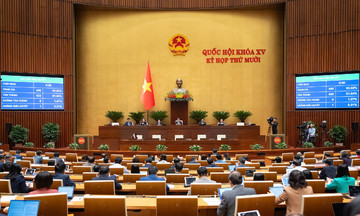
The National Assembly votes to approve laws and resolutions at the morning session on 10/12. *Photo: National Assembly Media*
The law also authorizes communal police chiefs to implement electronic monitoring for individuals undergoing voluntary drug addiction treatment at home or within the community, or those receiving replacement therapy. Individuals under post-treatment management may also be fitted with electronic monitoring devices.
Monitored individuals are prohibited from unauthorized removal, destruction, or interference with the device's operation. Any damage to the device must be immediately reported to the communal police. The government will issue detailed regulations concerning device types, application conditions, monitoring duration, procedural steps, and actions to be taken in case of violations.
Public facilities are established to provide addiction treatment for individuals aged 18 and older. Reform schools and other qualified facilities are authorized to organize treatment for those aged 12 to under 18. Private addiction treatment facilities may admit individuals aged 12 and older.
The law sets the initial addiction treatment period at 24 months, with a second period lasting 36 months. The treatment process encompasses several stages: reception and classification; detoxification, management of mental disorders; education, counseling, behavioral and personality rehabilitation; labor therapy, vocational training, and preparation for community reintegration. Treatment is available in two forms: voluntary and compulsory.
The revised Law on Drug Prevention and Control will come into effect on 1/7/2026.
Vu Tuan