Under the new law, the national education diploma system includes: high school diplomas, vocational high school diplomas, intermediate diplomas, college diplomas, bachelor's degrees, master's degrees, doctoral degrees, and specialized training program diplomas for certain specific industries and fields.
Compared to current regulations, the law has eliminated the issuance of junior high school diplomas. Instead, students who complete the primary and junior high school education programs and meet the conditions stipulated by the Minister of Education and Training will receive confirmation of program completion on their academic transcripts from their school principal.
Students who complete the high school program, are eligible to take the exam, and meet the requirements will be granted a high school diploma. Those who do not take the exam or fail to meet the requirements will receive a certificate of completion for the general education program, which can be used to register for a diploma exam later or to pursue vocational education.
The law stipulates that diplomas and certificates issued by educational institutions across all types and forms of training within the national education system hold equal legal value, regardless of whether they are public or private. Diplomas and certificates will be issued in either paper or digital format to promote digital transformation in education.
The Minister of Education and Training will unify the management of diplomas and certificates throughout the entire system to ensure consistency and transparency. Separately, diplomas for specialized postgraduate training programs in health fields, such as resident doctors and specialist doctors, will be guided and managed by the Ministry of Health according to the provisions of the Law on Higher Education.
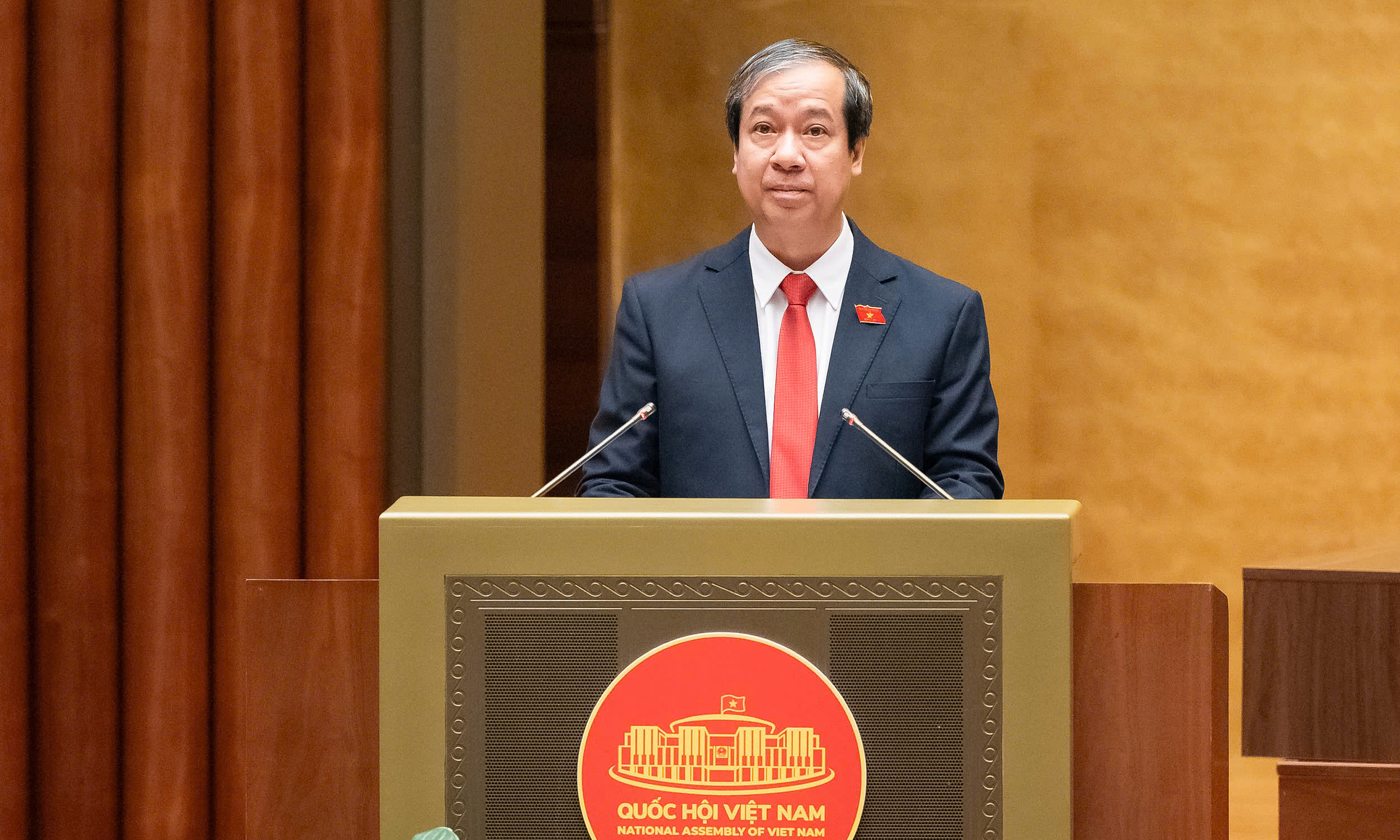 |
Minister of Education and Training Nguyen Kim Son presented the reception and explanation report before the National Assembly passed the Law, on the morning of 10/12. *Photo: Hoang Phong*
Public school tuition exemption, termination of school councils' operations
Regarding the mandatory foundation, the law continues to define primary and junior high school education as compulsory, while the State implements universal preschool education for children aged three to six.
A significant new point is the exemption of tuition fees for all general education students in public educational institutions nationwide. The Government will decide on the free provision of textbooks for students. The Minister of Education and Training will determine a unified set of general education textbooks for nationwide use and will establish a national council to evaluate textbooks for each subject and educational activity.
The amended law also terminates the operations of school councils for public preschool and general education institutions, transferring all governance authority to the principal under the new model. Professional incentive allowances for non-teacher educational support staff are also added.
A national scholarship fund will be established, prioritizing support for postgraduate students, those in basic sciences, engineering, technology, and fields where the State needs to encourage the development of high-quality human resources.
The law also includes transitional provisions: junior high school diplomas issued before the law takes effect will retain their legal validity; educational records and procedures submitted before the law takes effect will continue to be processed under the old regulations.
The law amending and supplementing several articles of the Education Law will take effect from 1/1/2026, with some provisions applicable from 1/7/2026.