The National Center for Hydro-Meteorological Forecasting announced that at 22:00 on 3/6, a tropical depression was located about 270 km east of the Hoang Sa special administrative region. It had a maximum wind speed of 49 km/h, level 6, gusting to level 8, and was moving northeast at 15 km/h.
Forecasts indicate that over the next 24-36 hours, the tropical depression will continue moving northeast at approximately 10 km/h, heading out of the South China Sea towards Taiwan (China). It is not expected to move towards mainland Vietnam.
Due to the tropical depression, the eastern part of the northern South China Sea is experiencing winds of level 6, gusting to level 8, and waves 2-4 m high. Vessels operating in dangerous areas may also be affected by thunderstorms and whirlwinds.
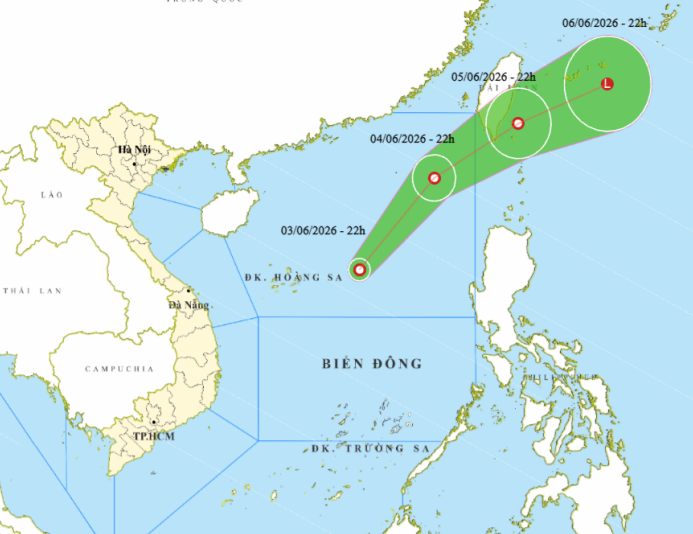 |
Forecast track of the tropical depression at 22:00 on 3/6. Photo: NCHMF |
In mid-May, the National Center for Hydro-Meteorological Forecasting assessed that the ENSO phenomenon is likely to transition to an El Nino state from around June 2026 and last until early 2027. Under the influence of El Nino, the number of storms and tropical depressions in the South China Sea is forecast to be lower than the multi-year average; however, the risk of strong or very strong storms increases.
According to Hoang Phuc Lam, Deputy Director of the National Center for Hydro-Meteorological Forecasting, El Nino years typically have fewer storms than the average of 11-13 per year. However, storms forming in the Northwest Pacific, a region that generates many super typhoons, can still maintain very strong intensity upon entering the South China Sea. Additionally, prolonged periods of low disturbance at sea can create conditions for later storms to develop strongly or have more complex trajectories.
From June to August, the South China Sea is forecast to experience about 5 storms and tropical depressions, comparable to the multi-year average, with nearly two likely to directly impact mainland Vietnam. During the period from September to December, storm and tropical depression activity tends to be lower than the multi-year average.
Although the number of storms is reduced, meteorological agencies warn that the risk of extreme weather phenomena such as localized heavy rain, flash floods, and landslides remains high, especially in the mountainous areas of the Northern and Central regions.
In 2025, the South China Sea recorded 21 storms and tropical depressions, the highest since data collection began in 1961. Natural disasters resulted in 484 deaths and missing persons, with economic damage exceeding 104,700 billion VND, making it one of the most severely damaged years due to natural disasters in Vietnam.
Gia Chinh