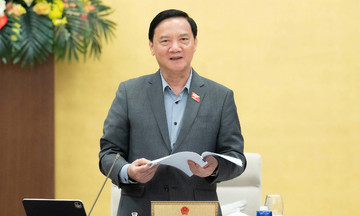
General Secretary To Lam emphasized the exceptional importance of the upcoming year, 2026, during a conference on 25/12. He chaired the meeting, which reviewed 2025 and outlined tasks for 2026 for the Central Steering Committee on Science, Technology, Innovation, and Digital Transformation. The year 2026 marks the first year of implementing the Resolution of the 14th Party Congress, carrying high expectations to realize the nation's two 100-year goals.
Early in the new term, the Central Committee will issue two strategic resolutions. One focuses on transforming the national development model, grounding it in science and technology. The other outlines strategic solutions for mobilizing resources to achieve double-digit growth. This underscores the foundational and central role of science, technology, innovation, and digital transformation. "This is no longer an option but a mandatory requirement for the country's rapid and sustainable development in the coming period", General Secretary To Lam stated.
General Secretary To Lam outlined the motto for 2026 as "breakthrough action, spreading results". He indicated that 2025 concludes the "kick-off, warm-up" phase, and 2026 will immediately transition to "acceleration". The success of this phase hinges on implementation capacity, disciplined action, and tangible outputs. Therefore, he urged each ministry, sector, and locality to shift from plan-based approaches to goal- and product-oriented work, ensuring thorough execution.
Party committees and leaders of ministries and localities must be accountable for progress and results. This accountability will be integrated into evaluation criteria and reward systems. Those responsible for delays will face consequences.
Key tasks requiring resource allocation include: concretizing the national digital master architecture and national data architecture; completing infrastructure; building platforms and databases; developing strategic technologies; and fostering high-tech human resources. Agencies must aggressively implement 11 strategic technology groups, while the entire population is encouraged to improve digital technology skills.
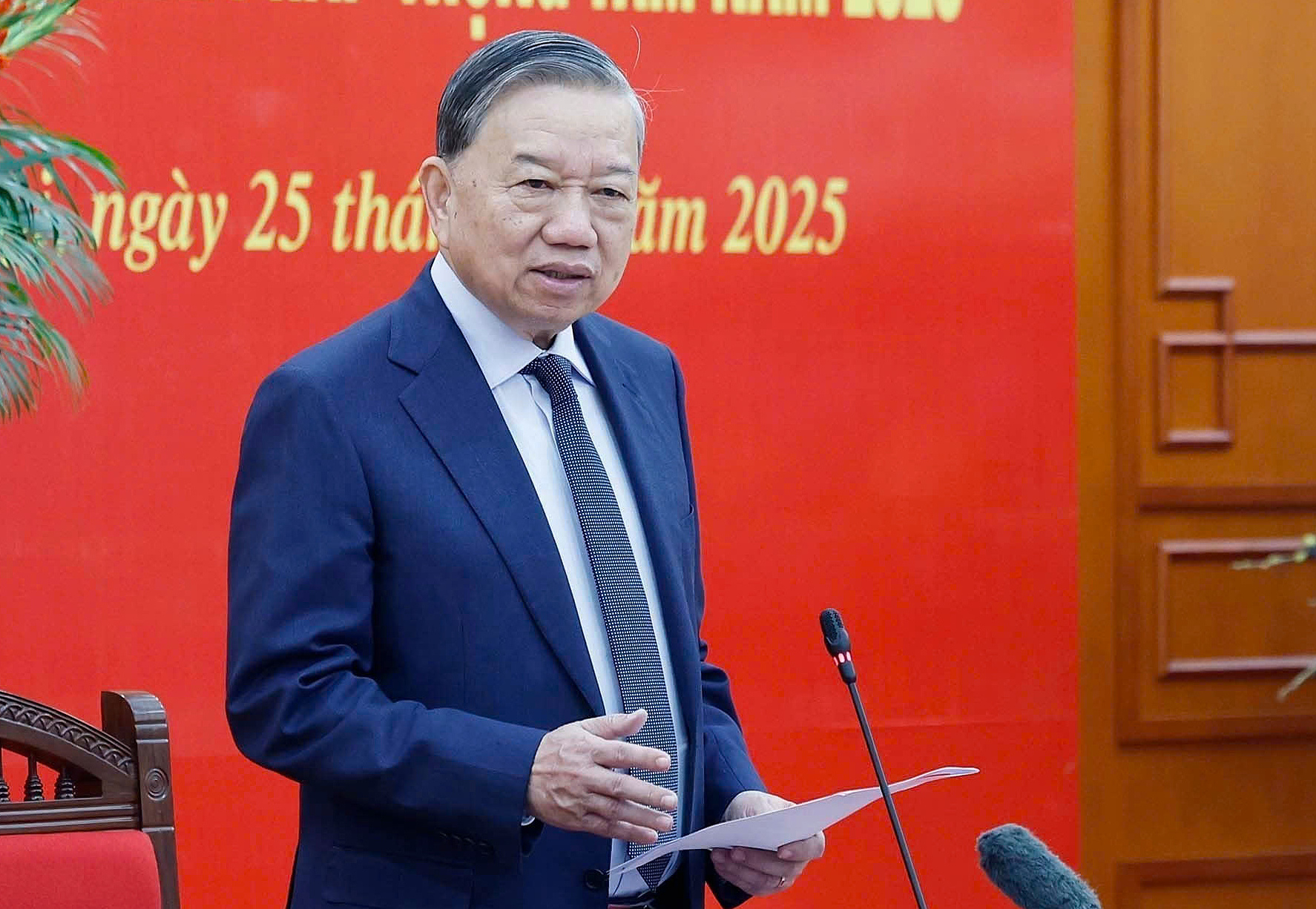 |
General Secretary To Lam spoke on 25/12. Photo: TTXVN |
General Secretary To Lam called for accelerating the development of specific applications and products to serve socio-economic development and citizens. He stressed that all policies, platforms, services, and utilities must prioritize service delivery, with citizen and business satisfaction as the primary measure of success. Digital transformation must align with administrative reform and streamlining the government apparatus, including cutting administrative procedures and providing online public services. It also involves fostering public sector innovation through decentralization, process standardization, and comprehensive digitalization.
The Party leader emphasized promoting science, technology, and innovation through strong links between the state, schools, and businesses. This collaboration will form the core of an innovation ecosystem. High-tech zones, innovation centers, and smart cities will receive prioritized development. General Secretary To Lam stated, "Mobilize social resources to make science, technology, innovation, and digital transformation key drivers of double-digit growth".
The State will play a constructive role, removing barriers, and acting as the first "customers" to order science, technology, innovation, and digital transformation products, services, and solutions. This initiative aims to create an initial market for research results, inventions, and new technology applications, motivating businesses, institutes, and universities.
General Secretary To Lam noted that significant investments for major goals must ensure efficiency. Without strict control, there is a risk of massive waste of financial, resource, human, and even opportunity costs.
The Party leader affirmed that Resolution 57 has opened a new era for the country, placing science, technology, innovation, and digital transformation at the center of the development strategy. In 2025, the institutional foundation was firmly established. The year 2026 must be a year of breakthrough action, shifting from foundation to results, from policy to products, and from ideas to tangible value for citizens and businesses.
He called on the entire political system to act immediately. Each individual, agency, and locality must clearly define responsibilities, mobilize resources, and implement decisively to turn goals into reality, contributing to the nation's rapid and sustainable development.
 |
Vo Thanh Hung, Deputy Chief of the Central Party Office, spoke on 25/12. Photo: Communist Party Portal |
Vo Thanh Hung, Deputy Chief of the Central Party Office, reported that digital transformation across the political system is stabilizing. By the end of 2025, the rate of online public service provision reached over 53%, with full-process online services at over 31% at the central level. The use of online public services by citizens and businesses increased, saving 4,100 billion dong. National digital infrastructure is developed, with internet speed ranking among the Top 20 globally. 5G coverage reached nearly 59% of the population, and National Data Center No. 1 was established.
The Prime Minister issued a list of 11 strategic technology groups and 35 strategic technology products. By the end of 2025, the country had nearly 79,000 technology businesses and 16 key laboratories. Higher education institutions established 184 laboratories with investments of 10 billion dong or more. Vietnam maintained its 44th position out of 139 in the Global Innovation Index, and the budget for science and technology is ensured at 3%.
At the conference, FPT Chairman Truong Gia Binh presented four major proposals to accelerate the implementation of Resolution 57 in the coming period:: boosting the development of technology platforms for digital government, considering AI as a foundational technology for national governance, security-defense, and digital economic development; forming a National Cybersecurity Defense Alliance to connect "Make in Vietnam" security products.
He also proposed that the State support a "public-private co-creation" model, pilot mechanisms, and breakthrough investments for new technology sectors, especially low-level economy, semiconductors, and railway infrastructure. This would enable domestic businesses to master the technologies for operating, controlling, and protecting critical infrastructure systems.
Regarding railway infrastructure, Truong Gia Binh stated that acquiring and mastering the technology for operating, controlling, and protecting these systems is vital. He said, "FPT has experience in mastering technology and operating systems, and wishes to participate more deeply with ministries, sectors, and localities to develop railway infrastructure, contributing to the country's long-term development."
Vu Tuan