Speaking at a meeting with Hanoi voters on May 4, General Secretary and President To Lam highlighted the significant pressure of 10th-grade entrance exams. He noted these exams are often more stressful than university entrance exams, causing anxiety for students, parents, and teachers alike. He questioned why such pressure persists when the national policy aims for universal education up to 12th grade, and exams should evaluate quality, not exclude students from schools.
According to the General Secretary and President, the direct cause of this pressure is a shortage of schools, classrooms, and teachers, which necessitates administrative solutions for student selection. Hanoi currently lacks approximately 1,000 schools. With a population exceeding 9 million, including over 3 million under 18 years old, students comprise nearly one-third of the population, placing immense strain on the education system.
He stated that Vietnam has 1,8 to 1,9 million public servants and civil employees nationwide. The education sector accounts for over 80%, approximately 1,5 million people, while healthcare makes up about 10%. However, he emphasized that staffing allocations need to be recalculated based on actual needs. For education, a principle could be established: each class of 25 to 30 students requires at least one teacher, allowing for the calculation of corresponding personnel requirements.
The General Secretary and President called for a comprehensive review of the entire system to ensure sufficient schools, classrooms, and teachers for students. He suggested that service activities, such as organizing school meals, should be outsourced to businesses. This would allow schools to focus on teaching, avoid potential risks, and reduce the burden on educators.
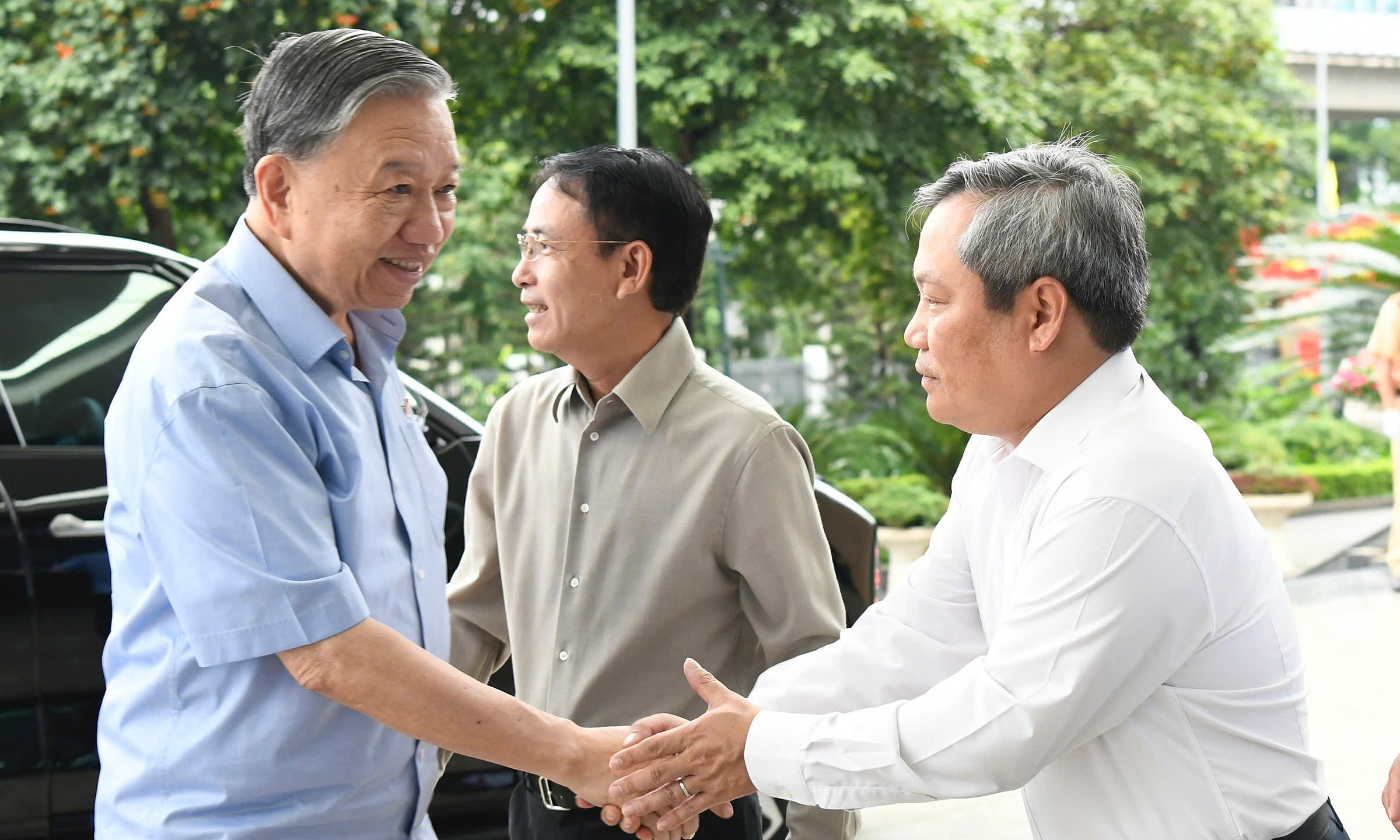 |
General Secretary and President To Lam and Chairman of the Hanoi People's Committee Vu Dai Thang. Photo: Hoang Phong |
He stressed that ensuring adequate learning conditions would reduce examination pressure. Students who do not meet requirements should receive additional training to improve, while talented students should be developed into high-quality human resources. This approach aims to avoid intense pressure during each exam season. Failure to guarantee educational opportunities could result in students leaving school after grade 9 or grade 10, leading to significant social consequences.
"Clear decentralization is needed for local authorities in school planning, using population data to forecast student numbers for proactive preparation," the General Secretary and President stated. "Teacher staffing must also be adjusted flexibly according to student fluctuations, rather than remaining fixed."
Regarding food around schools, he highlighted the issue of vendors selling cheap, low-quality, and even near-expired food items. Therefore, grassroots authorities need to strengthen management at the source to prevent such businesses from affecting student health, while also ensuring order and safety in school areas.
Each citizen needs a lifelong health record
In the healthcare sector, the General Secretary and President emphasized a key strategic shift towards primary healthcare, with grassroots medical facilities forming the foundation. He proposed developing a family doctor model and electronic health records linked to each citizen from birth. This would enable continuous monitoring of medical history, vaccinations, and treatment processes.
Results from pilot periodic health check-ups in some areas revealed that approximately 30% of residents were diagnosed with previously unknown conditions, including some serious illnesses. This underscores the importance of early screening and proactive primary healthcare.
To ensure effective implementation, agencies need to recalculate doctor-to-population ratios, possibly at levels such as one doctor per 500, 1,000, or 2,000 residents, tailored to local conditions. Concurrently, the healthcare system must prioritize care for the elderly, children, and vulnerable groups. It also needs to develop specialized fields like geriatrics and pediatrics to address specific pathological needs.
Furthermore, the General Secretary and President called for proactive control and eventual eradication of certain infectious diseases for which vaccines are available. This aims to prevent recurrent outbreaks that deplete resources. He also urged greater focus on non-communicable diseases such as cardiovascular issues, high blood pressure, and endocrine disorders.
Vo Hai