On the afternoon of 2/6, General Secretary and President To Lam chaired a working session with the Central Steering Committee to review one year of operating the overall organizational model of the political system and the two-tier local government model.
He emphasized that the review should not be limited to quantitative metrics, such as the number of units reduced, organizations restructured, headquarters managed, or tasks decentralized. Instead, it must assess the operational quality of the new model.
According to the Party and State leader, the report needs to clearly answer several questions: whether the apparatus is leaner, operates more smoothly, has clearer powers and responsibilities, better serves citizens and businesses, creates development momentum, and most importantly, enhances the performance, effectiveness, and efficiency of the political system's operations.
He acknowledged that the political system has undertaken a substantial volume of work, broad in scope and demanding in requirements. However, success in the organizational restructuring phase does not automatically translate to success in the operational phase. "From now on, the central requirement is to shift from completing organizational arrangement to operating the apparatus effectively, from stabilizing organizations to enhancing governance quality, and from decentralizing tasks to ensuring implementation capacity," the General Secretary and President stressed.
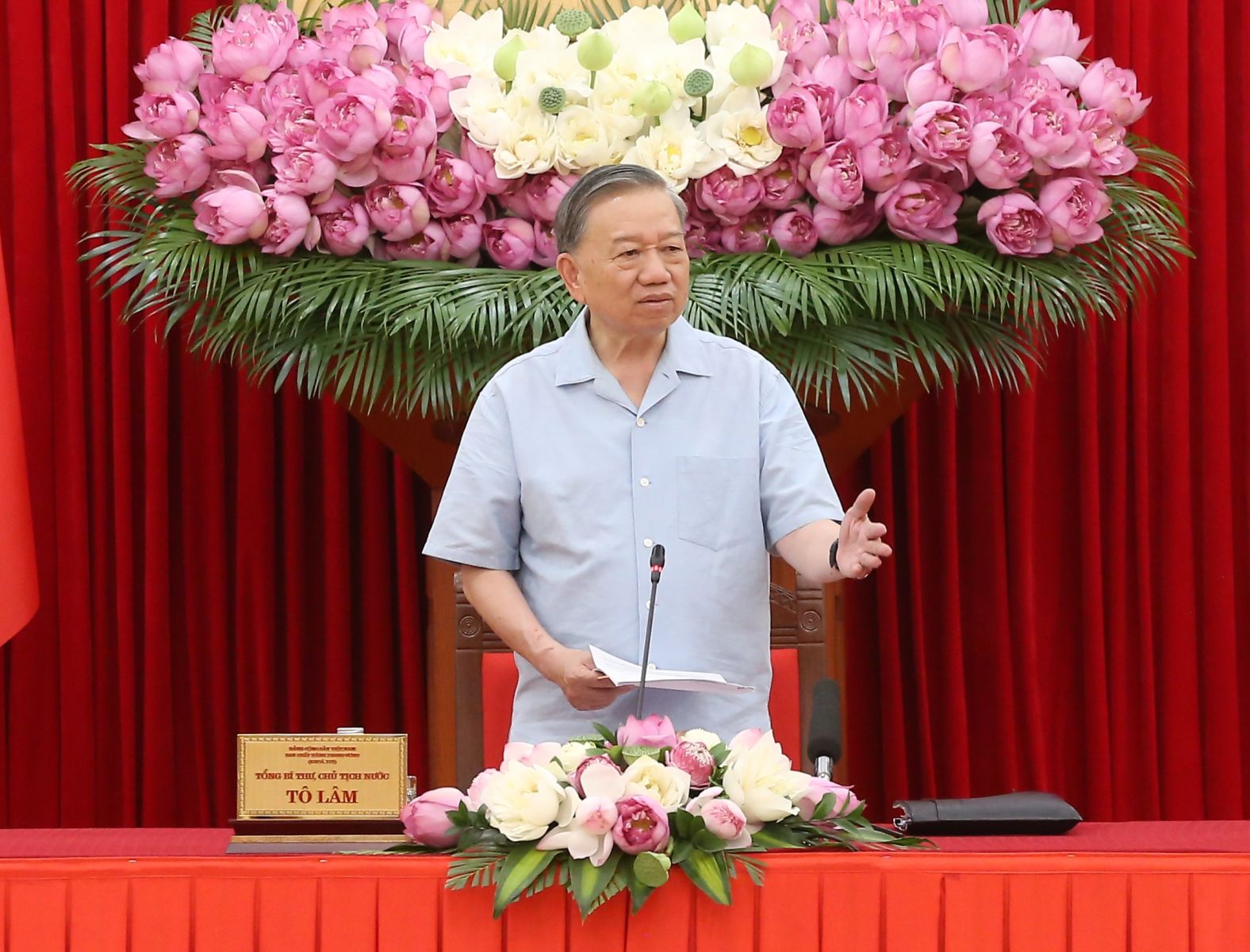 |
General Secretary and President To Lam speaking at the working session reviewing one year of operating the overall organizational model of the political system and the three-tier local government model, on the afternoon of 2/6. Photo: Communist Party Information Portal
Addressing issues that need further clarification during the review, the General Secretary and President urged a direct examination of major existing bottlenecks. Regarding institutions and operational mechanisms, he noted that some regulations and guiding procedures have been issued but are not fully synchronized or keeping pace with the new model's requirements.
Regarding decentralization and devolution of power, the General Secretary and President demanded that it be linked with resources. Granting authority must be accompanied by assigning responsibility, finances, human resources, data, and implementation tools. If tasks are assigned without ensuring the conditions for execution, lower levels and local officials will face difficulties. Conversely, strong decentralization without sufficient inspection and oversight could lead to risks in exercising power, even fostering a hesitant mindset where officials are reluctant to act.
Concerning the two-tier local government model, the General Secretary and President observed that many tasks previously handled at the district level have been transferred to the commune level. However, the capacity of officials, infrastructure, facilities, financial resources, and professional support mechanisms vary unevenly across localities.
He also highlighted bottlenecks in digital transformation, data, and implementation capacity. These are crucial factors because even with correct policies, institutions, and models, weak implementation will lead to unsatisfactory results. Therefore, the report must identify areas performing well, areas facing challenges, weak levels, slow stages, and the accountability of leaders in each sector and locality.
Guiding the refinement of the review report, the General Secretary and President proposed further enhancing its generality, theoretical depth, practicality, and persuasiveness. The report should have a clear central thesis, focusing on evaluating the organizational restructuring in conjunction with improving the leadership, governance, and implementation capacity of the entire political system.
He requested the inclusion of content evaluating the innovation in the Party's leadership methods within the new model; the operational capacity of the two-tier local government, especially at the commune level; the effectiveness of decentralization and devolution of power linked to resources and power control; and the extent of digital transformation and data-driven governance. Concurrently, he called for research to develop a set of criteria for assessing the performance, effectiveness, and efficiency of the new model's operation, and to continue reviewing functions and tasks for appropriate adjustments.
The General Secretary and President emphasized that this organizational restructuring is of strategic importance for the nation's long-term development. The goal is not merely to reduce the number of units but to build a stronger, more smoothly operating, more accountable, and more efficient apparatus that better serves the people. It also aims to lay the foundation for a modern national governance model, meeting the demands of rapid and sustainable development in the new era.
Vu Tuan