On 3/6, the Steering Committee for Searching, Gathering, and Identifying Martyrs' Remains of Quang Ngai Province announced that exploration and excavation would commence in Dak Cam ward and Kon Tum City from 5/6.
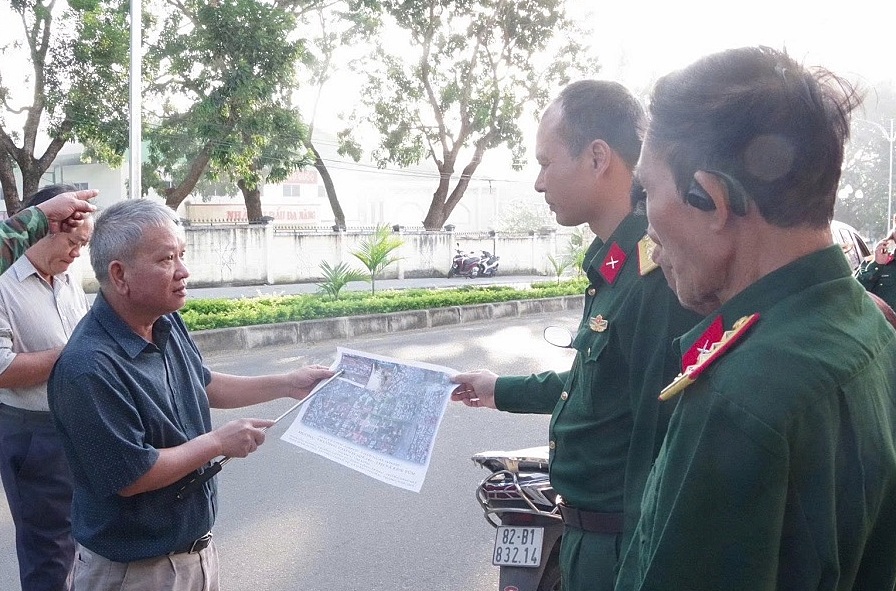 |
The military and experts surveyed the Truong Chinh street area (formerly Kon Tum), where a mass grave of martyrs is expected to be excavated. Photo: Quang Ngai Provincial Military Command
Before excavation, the entire suspected area will undergo a ground-penetrating radar survey to detect anomalies or foreign objects beneath the surface.
Once suspected locations are identified, excavators will remove surface soil layers. If biological signs or artifacts related to martyrs are found, combat engineers and Team K53 will switch to manual excavation to ensure no remains are missed.
The initial search will focus on a vacant plot spanning about 900 square meters at the northeast corner of Dak Cam ward Martyrs' Cemetery and a section of Truong Chinh street from house numbers 206 to 282. This area has minimal underground structures, allowing easy machinery access.
In the subsequent phase, authorities will expand the search to suspected grave trenches along both sides of Truong Chinh street. The northern section extends over 300 meters from the Truong Dang Que intersection to Dinh Cong Trang, while the southern section spans about 125 meters from the Truong Dang Que intersection to Le Hong Phong. This urban area contains extensive underground infrastructure, including electricity, telecommunications, water supply, drainage, and trees.
Associate Professor, Doctor Tran Tan Van, former director of the Institute of Geological and Mineral Sciences, stated that ground-penetrating radar is widely used in irrigation, geology, and archaeology.
This equipment generates subsurface cross-sections, helping detect foreign objects such as martyrs' relics, weapons, metal pipes, or changes in soil structure. "This method is suitable for detecting martyrs' graves and associated artifacts", Van said.
The search began in 2021, when Bob Connor, a former US airbase police sergeant at Bien Hoa, received information from a US veteran who fought in Kon Tum in 2/1968.
According to the veteran's account, following a battle, US forces buried 70-90 liberation soldiers in a drainage ditch located between Special Zone 24 and the MACV Kon Tum camp, now part of the Truong Chinh street area.
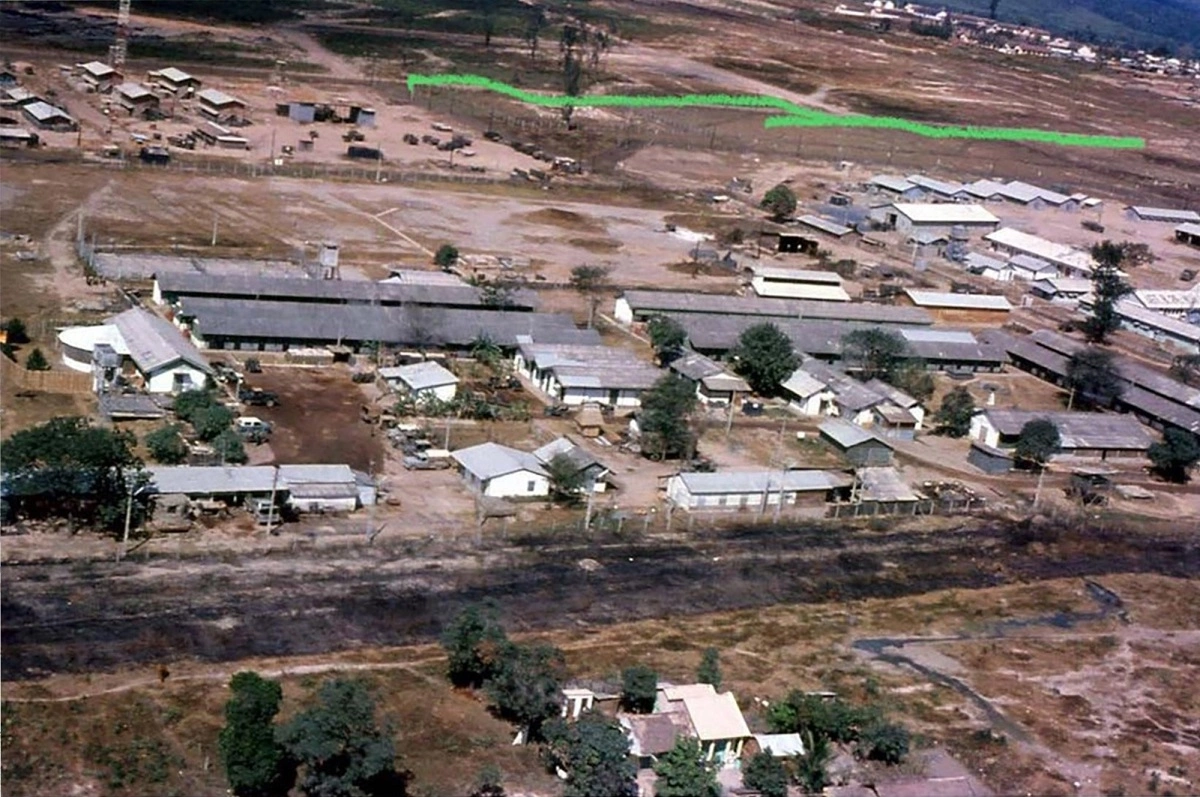 |
The MACV compound in Kon Tum, with Special Zone 24 on the right. The drainage ditch suspected as the burial site for the martyrs is behind the row of buildings (blue line). Photo: Provided by a US veteran
The witness also provided two photos: one depicting the burial of soldiers near the roadside drainage ditch, and another panoramic view of Special Zone 24 with the burial pit marked by a blue pen stroke.
Using these materials, Bob Connor collaborated with architect Nguyen Xuan Thang from Ho Chi Minh City to gather additional records, satellite images, and witness testimonies to pinpoint the suspected mass grave area.
In late May, the Steering Committee for Searching, Gathering, and Identifying Martyrs' Remains of Quang Ngai Province, in coordination with the Steering Committee of Military Region 5, organized a workshop to verify the information. Expert units concluded that the evidence for the mass grave is credible and unanimously agreed to proceed with the search and recovery efforts.
Initial records suggest the martyrs are believed to belong to Regiment 24A of the B3 Front, Commando Battalion 406, and Infantry Battalion 304, having fallen during the 1968 Spring Tet Offensive and Uprising.
Pham Linh