This marks the second time the city's People's Council has delayed consideration of the low-emission zone proposal. Previously, at its session on 11/5, the body decided not to review the proposal due to incomplete information and documentation.
Tran The Cuong, Permanent Vice Chairman of the Hanoi People's Council, stated that these policies significantly impact social life. Therefore, they have undergone extensive consultation with experts, scientists, and multiple verifications. Despite incorporating much feedback into the draft, the People's Council believes further thorough assessment and input from residents, businesses, and related organizations are necessary to ensure feasibility, fairness, and practical suitability.
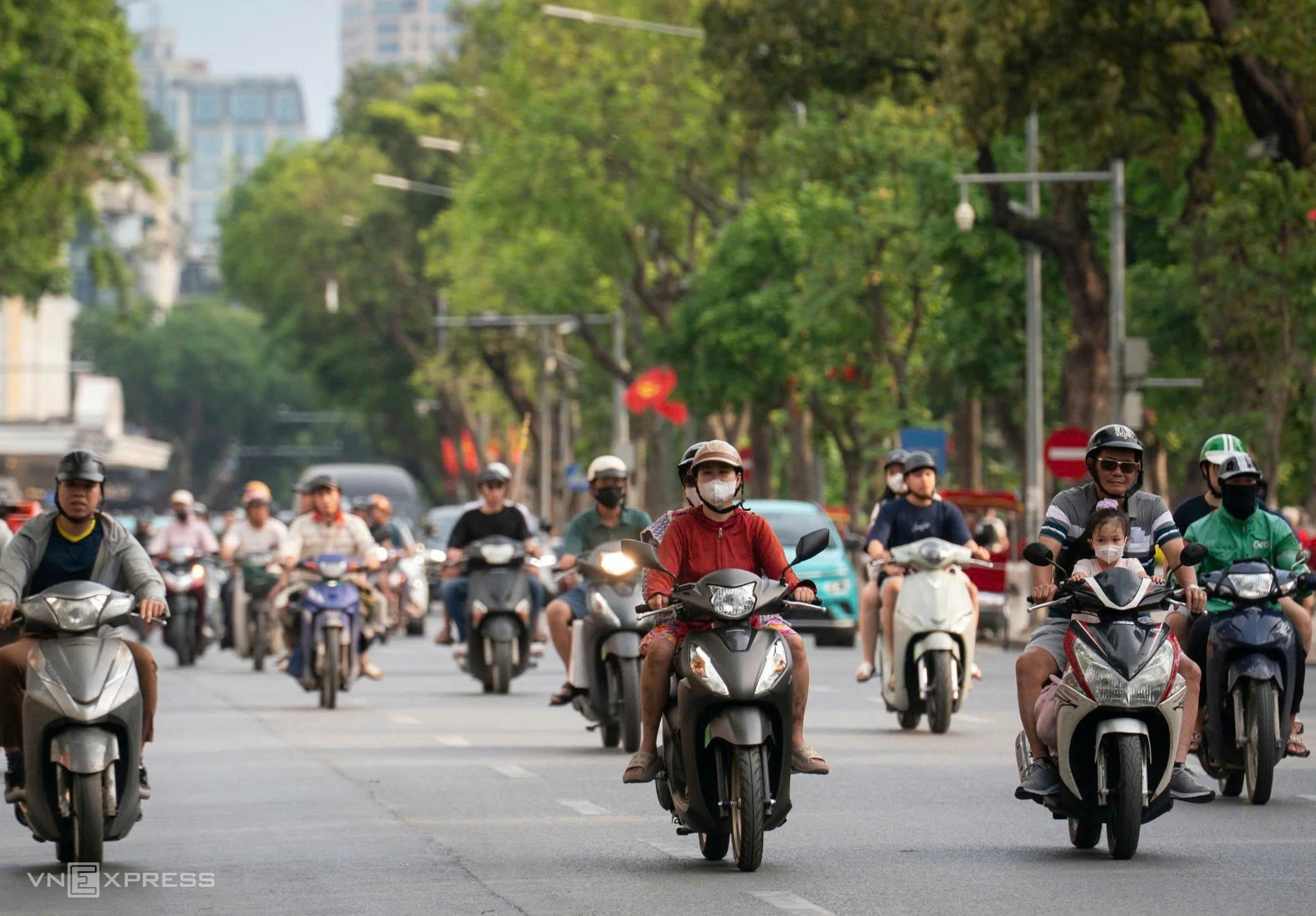 |
People using motorbikes on Dinh Tien Hoang street, Hoan Kiem ward, in early May. Photo: Hoang Giang
According to the submission from the Hanoi People's Committee, the implementation roadmap for the low-emission zone remains consistent with the previous draft. The pilot phase will run from 1/7 until the end of 2026 in Hoan Kiem ward. In 2027, it will expand to Cua Nam ward. From 2028 until the end of 2029, the proposal will be implemented across the entire area inside Ring Road 1.
In the revised draft, Hanoi proposes a change in measures for ride-hailing motorbikes using gasoline during the pilot phase, from 1/7 to 31/12/2026. Instead of banning circulation, the city will encourage restricted activity. The city also plans to allocate about 6,422 billion dong to implement support policies for the 2026-2030 period.
Alongside the low-emission zone proposal, the city submitted a resolution on supporting the transition of transportation vehicles from fossil fuels to clean energy. The initial draft proposed direct financial aid for residents with permanent or continuous temporary residence of two years or more within Ring Road 1. The maximum support was 5 million dong for general residents, 15 million dong for near-poor households, and 20 million dong for poor households.
However, the verification report from the Science, Technology and Environment Committee of the Hanoi People's Council requested clarification on the funding sources, budget balancing capacity, and an assessment of the suitability of changing from "banning circulation" to "encouraging restricted activity" for ride-hailing motorbikes. The Committee suggested that this content needs review to ensure consistency with Resolution 57 of the city's People's Council, which stipulates that fossil fuel-powered motorbikes operating on ride-hailing platforms are not permitted to circulate in low-emission zones.
Responding to the verification feedback, the Hanoi People's Committee stated it has removed the proposal for direct financial support for residents within Ring Road 1. It also eliminated the general policy of supporting fees and charges for vehicle conversion. The current draft focuses on assisting vulnerable groups, such as poor households, through loan policies, interest rate support, and encouraging the use of public passenger transport. The total estimated cost after adjustment decreased from 6,422 billion dong to more than 1,045 billion dong.
Regarding the proposal to shift from "banning circulation" to "encouraging restricted activity," the Hanoi People's Committee affirmed this is not a change in the policy approved by the People's Council but rather a solution for the pilot phase. The city will focus on public awareness campaigns, reviewing vehicle data, coordinating with ride-hailing platforms to adjust navigation algorithms, encouraging the use of clean energy vehicles, and evaluating actual impacts before fully implementing measures according to the roadmap.
The Department of Agriculture and Environment, the lead agency in developing the proposal, confirmed it has incorporated feedback from associations and businesses. This ensures feasibility and minimizes abrupt impacts on transport operations, workers' livelihoods, and residents' travel needs in the pilot area.
The Hanoi People's Committee stated that establishing a low-emission zone aims to implement Resolution 57 of the city's People's Council. This initiative comes as Hanoi's air quality has deteriorated at times, especially in central areas. Research results from 2023-2025 indicate that traffic is a major source of fine dust emissions. Currently, the city has about 6,9 million motorbikes, with approximately 450,000 vehicles within Ring Road 1.
Vo Hai