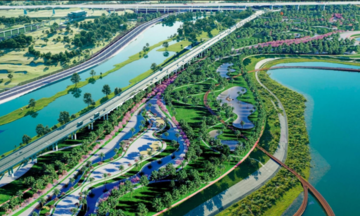
On 27/1, the Hanoi People's Council approved the main contents of the capital's Master Plan. This plan integrates the previously approved Capital Plan and General Capital Plan, aiming to resolve overlaps resulting from old plans being formulated under two different legal systems, processes, and timeframes.
Based on Resolution 258 of the National Assembly, issued on 11/12/2025, Hanoi is authorized to establish a single Master Plan. This plan will concretize national and regional planning while integrating the contents of the two previous plans. From this foundation, the city has developed a new proposal with a long-term vision extending to 2100.
Under the new orientation, the capital's space is established as a unified urban whole, developing according to a multi-polar, multi-center urban cluster model. The entire urban area features nine development poles linked to nine major centers, separated by green corridors, green belts, green wedges, rivers, and lakes, and connected by a system of ring roads and radial transportation routes.
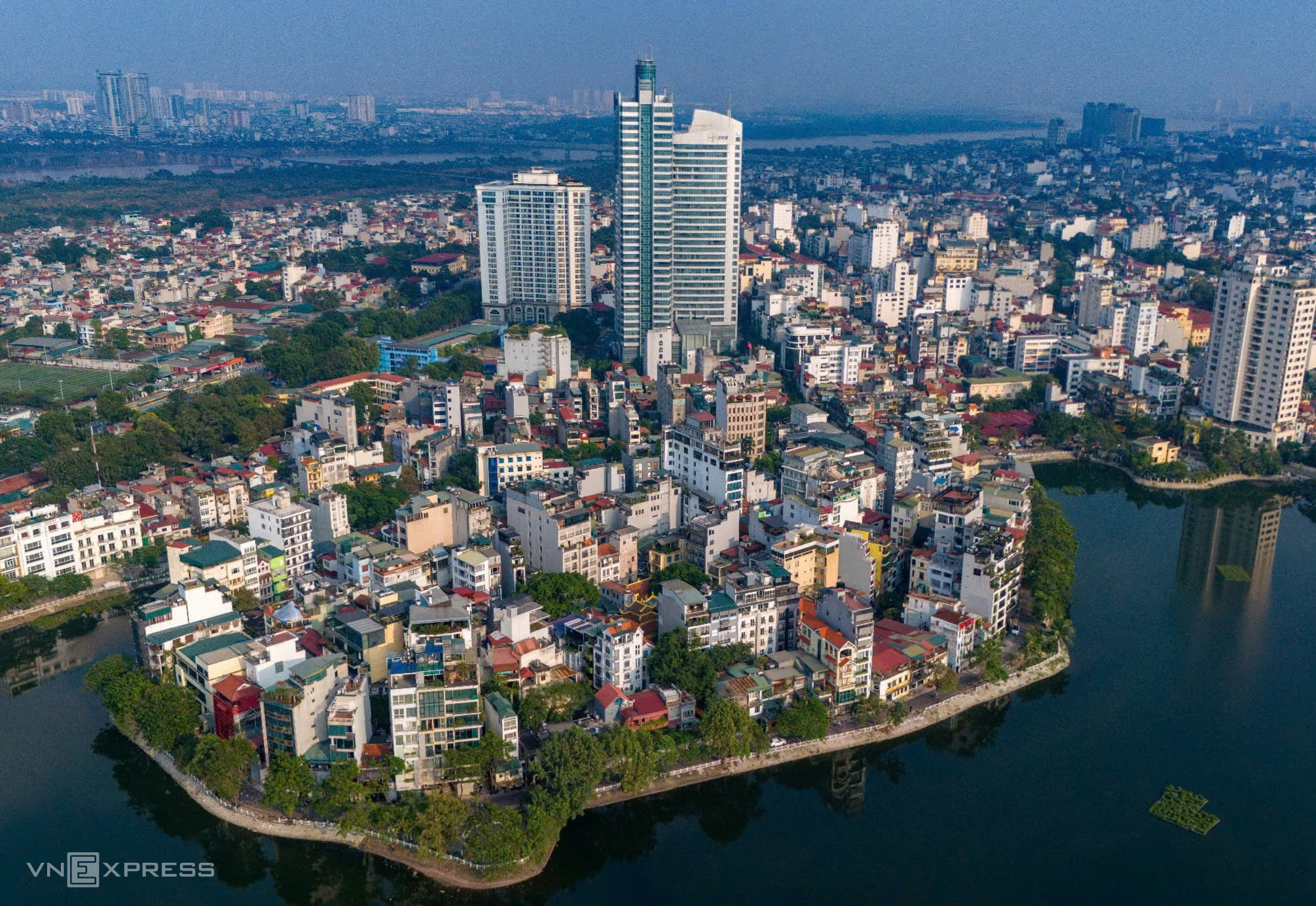 |
A view of Hanoi from the Truc Bach Lake area. Photo: Giang Huy |
The nine development poles include: the central urban area on the Red River's right bank, serving as an expanded historical core and forming a cultural, historical, political, and Olympic urban space. The northern pole, encompassing Dong Anh, Me Linh, and Soc Son, is oriented towards international services, trade, finance, and logistics, connected to Noi Bai International Airport and high-tech industries.
The eastern pole, comprising Gia Lam and Long Bien, functions as the eastern gateway, developing modern trade, services, and logistics linked to National Highway 5 and the Hanoi - Hai Phong expressway. The southern pole, in Thuong Tin and Phu Xuyen, is designated for industry, logistics, and a multi-modal transport hub, connected to a second airport south of Hanoi and the high-speed railway.
The Van Dinh and Dai Nghia area will develop as an ecological urban space with riverine landscapes, integrated with heritage and religious sites. The southwestern pole, in Xuan Mai and Chuong My, is oriented towards education, training, healthcare, and ecological resorts.
The western pole, at Hoa Lac, will serve as a science and technology, innovation, and education hub, centered around Hoa Lac High-Tech Park and Vietnam National University, Hanoi. The northwestern pole, covering Son Tay and Ba Vi, is a cultural and historical urban area, focusing on tourism and resorts, while also fulfilling national defense and security tasks. The Red River space is identified as a special landscape pole, combining finance, trade, services, and tourism.
Underground space development
A new aspect of the plan involves organizing urban space vertically to efficiently utilize land and reduce pressure on the core area. Underground space will be layered to accommodate technical infrastructure, parking lots, commercial centers, underground plazas, and public facilities.
Deeper layers are reserved for underground transportation systems, urban railways, technical infrastructure, and flood control structures. The deepest layer will serve strategic infrastructure related to security and defense, along with underground urban railway lines.
The ground level is prioritized for public spaces, green areas, water features, pedestrian zones, and heritage preservation. Above ground, the city aims to develop high-density building complexes at transit-oriented development (TOD) points and along ring roads, connected by a system of pedestrian bridges.
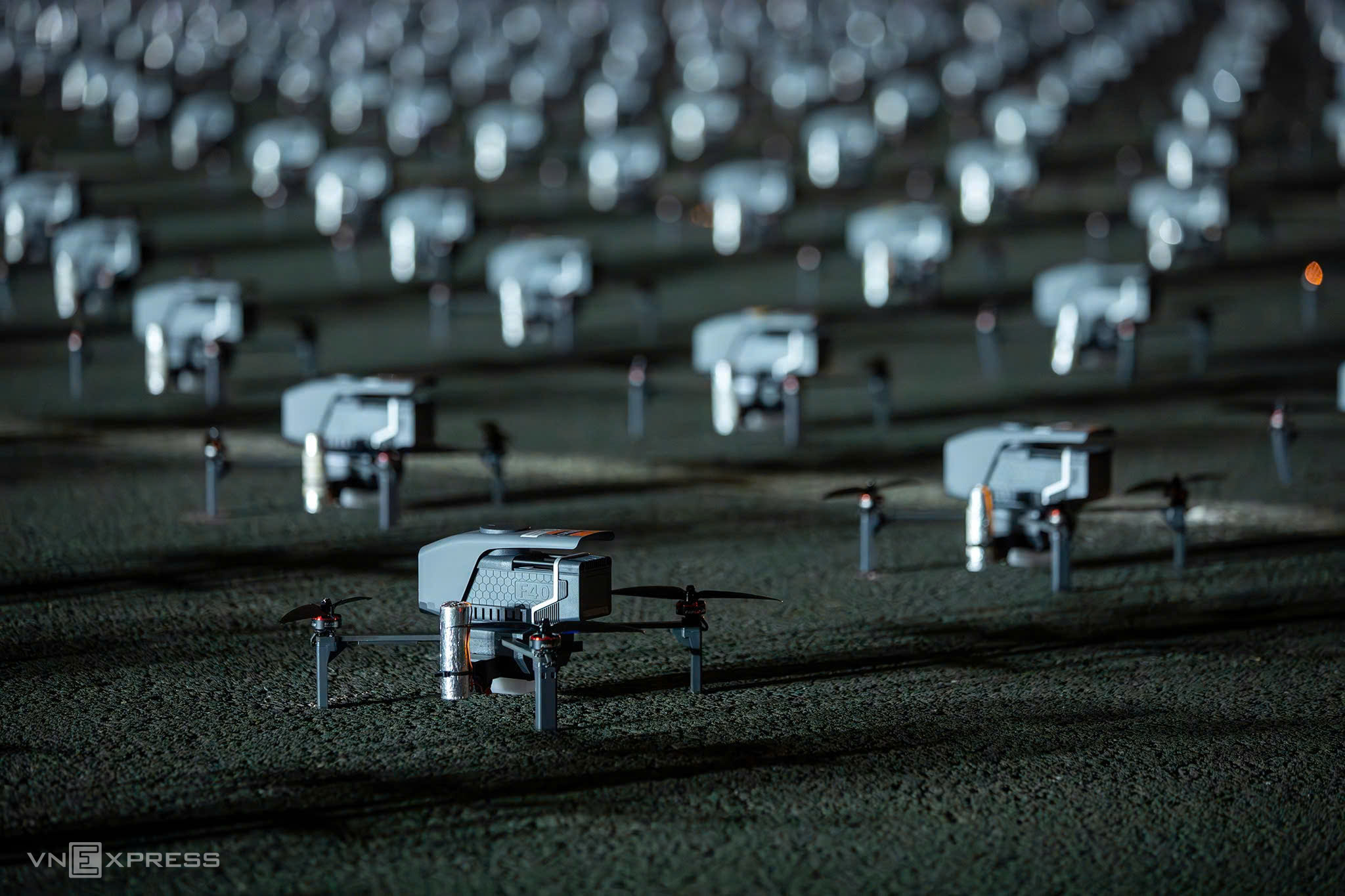 |
Unmanned aerial vehicles (drones) at a performance on Ho Tay in 1/2024. Photo: Giang Huy |
The plan also explores space for low-altitude flying vehicles to serve urban transportation, logistics, and tourism. Higher airspace is designated for aviation management, telecommunications, meteorology, and national defense.
During the 2026-2035 period, Hanoi anticipates mobilizing approximately 14.5 trillion VND in total social investment. The gross regional domestic product (GRDP) is projected to increase by an average of 11.25% per year, reaching a GRDP scale of about 203 billion USD, with per capita income around 19,350 USD.
For the 2036-2045 period, total social investment is estimated at about 50.34 trillion VND. GRDP is expected to continue growing by an average of 11.25% per year, with its scale reaching approximately 670 billion USD and per capita income around 44,300 USD.
Following approval by the Hanoi People's Council, the plan will undergo further refinement before being submitted to competent authorities for review and approval as stipulated.
Vo Hai