


At 9h on 13/1, the air quality monitoring station of the Environment Agency (Ministry of Agriculture and Environment), located at the gate of Hanoi University of Science and Technology on Giai Phong street, recorded an air quality index (AQI) of 225, classified as very unhealthy, warning of serious health impacts.
The station at Nhan Chinh park on Khuat Duy Tien street recorded an AQI of 179; the station on Nguyen Van Cu street did not display data.
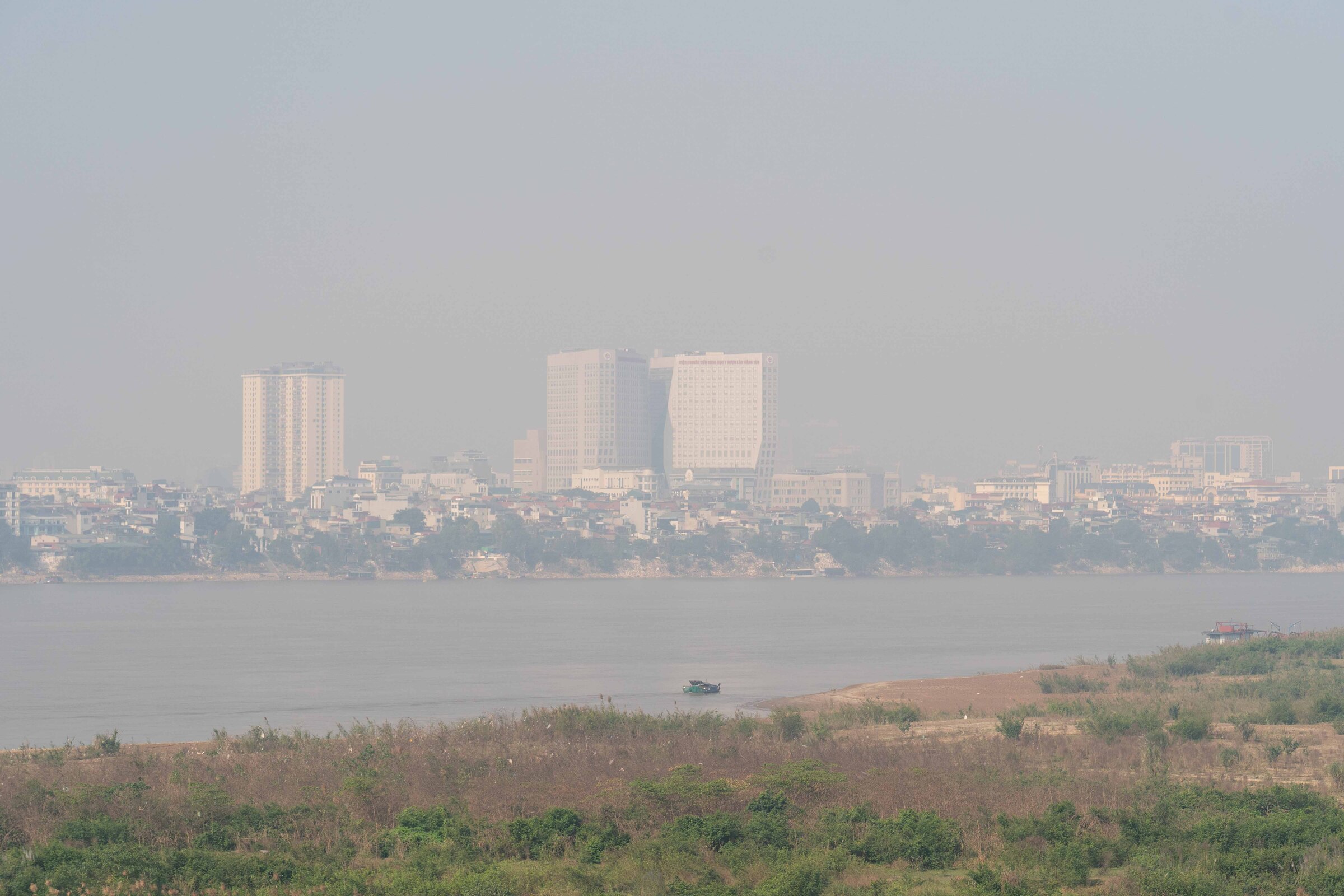 |
Hanoi's inner city covered in a hazy layer of air pollution. *Hoang Giang* |
IQAir, a specialized air quality monitoring platform, ranked Hanoi as the second most polluted city globally, with an overall index of 270, trailing Delhi (India) at 420. This system also showed several locations with hazardous AQI levels: Ho Tay at 565, Xuan Tao at 431, Quan Thanh at 424, Hoan Kiem at 380, Hoang Quoc Viet at 310, and Lo Duc at 306.
Beyond Hanoi, very unhealthy air quality was also recorded at Thai Binh bridge (Hung Yen) with an index of 210, the former Thai Nguyen city (Thai Nguyen) at 206, and five other monitoring stations in Bac Ninh and Phu Tho with unhealthy AQI levels.
Previously, Hanoi's air quality remained at moderate to poor levels for several days as continuous cold air strengthened, facilitating dust dispersion. However, from 9/1, as the cold air stabilized and significant day-night temperature differences created temperature inversions, pollution levels began to rise.
AQI, or air quality index, reflects pollution levels and their impact on human health; the higher the index, the greater the risk of adverse effects. According to authorities, current air pollution is primarily due to fine particulate matter PM2.5.
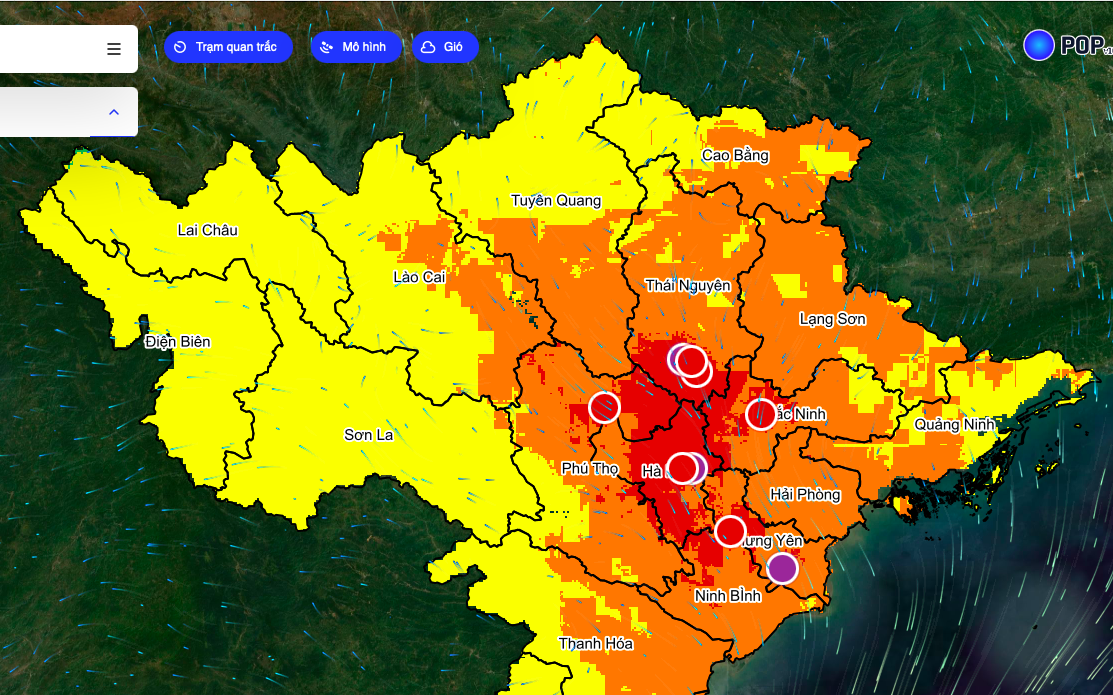 |
Pollution levels in northern provinces and cities. *Vietnamair* |
The Environment Agency predicts Hanoi's air quality will remain very unhealthy through today. The air quality forecasting system of Vietnam National University, Hanoi, anticipates that air pollution in Hanoi will gradually decrease from now until 19/1.
Deputy Minister of Agriculture and Environment Phung Duc Tien stated that the Ministry is coordinating with sectors and localities to implement urgent measures to reduce air pollution. Since September, the Environment Agency has established a monitoring mechanism and reports weekly progress on air pollution control to the Government.
Additionally, the monitoring network is being enhanced through the installation of rapid sensor devices in Hanoi and neighboring provinces. This system of monitoring stations provides forecasts and early warnings two to three days in advance, allowing residents to take preventive measures. The Ministry also deploys unmanned aerial vehicles to monitor waste and straw burning activities.
Furthermore, during severe air pollution episodes, the Ministry of Agriculture and Environment has directed localities to immediately activate emergency measures such as: intensifying road washing, implementing 100% control of construction sites, and strictly prohibiting open burning. Large corporations are also urged to review their operations and are encouraged to reduce capacity on days with unhealthy air quality.
 |
Gia Chinh


