


The Ho Chi Minh City Party Committee's Executive Board approved the policy to adjust the planning for the sea-crossing road project connecting Can Gio and Ba Ria - Vung Tau regions via a public-private partnership (BT Contract) at its third conference on the morning of 7/1.
According to Tran Luu Quang, Secretary of the Ho Chi Minh City Party Committee, travel from central Ho Chi Minh City to the Ba Ria - Vung Tau area primarily relies on the Long Thanh - Dau Giay expressway through Dong Nai. Following administrative boundary adjustments and mergers, this route experiences frequent congestion, is lengthy, and makes travel times unpredictable.
 |
Secretary Tran Luu Quang delivers concluding remarks at the conference, on the morning of 7/1. Photo: An Phuong |
Secretary Tran Luu Quang delivers concluding remarks at the conference, on the morning of 7/1. Photo: An Phuong
Considering this reality, Ho Chi Minh City initiated studies for a direct connection between the city and Vung Tau. Land-based routes from the Nha Be area were deemed problematic due to planning constraints, land clearance issues, and incompatibility with Ho Chi Minh City's maritime urban development orientation, especially in the Can Gio area.
Quang stated that the distance from Can Gio to Bai Truoc and Bai Sau (Vung Tau City) is only about 13-14 km. Based on this, Ho Chi Minh City leaders consulted with strategic investors, who agreed on a plan to construct a six-lane sea-crossing road, starting from the Can Gio reclaimed urban area.
The preliminary plan comprises two components: an elevated bridge section over the sea and an underwater tunnel beneath the seabed in the navigation channel, utilizing technology similar to the Thu Thiem Tunnel. The project will create two artificial islands on either side of the navigation channel to facilitate construction, replacing a previous proposal for a high bridge approximately 60 meters tall.
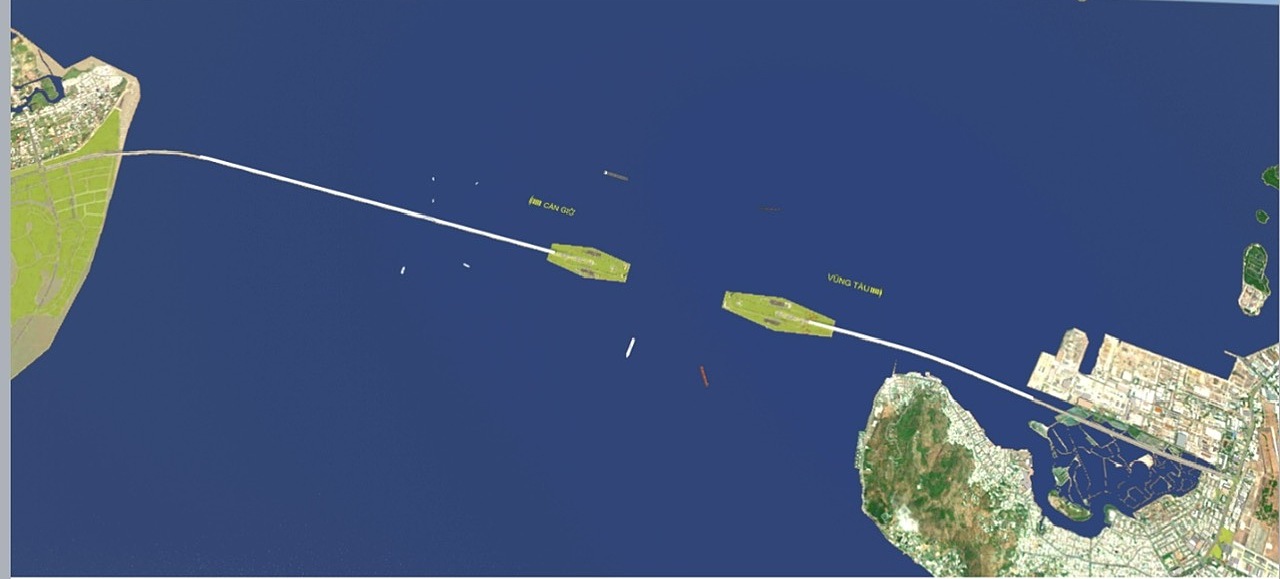 |
Proposed design for the Can Gio - Vung Tau sea-crossing road with an underwater tunnel section similar to the Thu Thiem Tunnel. Photo: Ho Chi Minh City Department of Construction |
Proposed design for the Can Gio - Vung Tau sea-crossing road with an underwater tunnel section similar to the Thu Thiem Tunnel. Photo: Ho Chi Minh City Department of Construction
According to initial investor estimates, the project's construction will take about three years. Once completed, automobile travel time from central Ho Chi Minh City to Vung Tau is expected to be reduced to approximately one hour.
In parallel with the sea-crossing road project, Ho Chi Minh City will continue to invest in synchronous infrastructure development in the Can Gio area. This includes widening Rung Sac Road, constructing a new Can Gio Bridge, and completing related connecting routes.
Previously, Nguyen Cong Vinh, Vice Chairman of the Ho Chi Minh City People's Committee, presented a report from the City Party Committee's Standing Board requesting approval for the project's planning adjustment under a public-private partnership model. According to Vinh, with Ho Chi Minh City's development space expanding after the mergers, the need to enhance intra-regional and inter-regional connectivity, especially for the maritime economy, has become urgent.
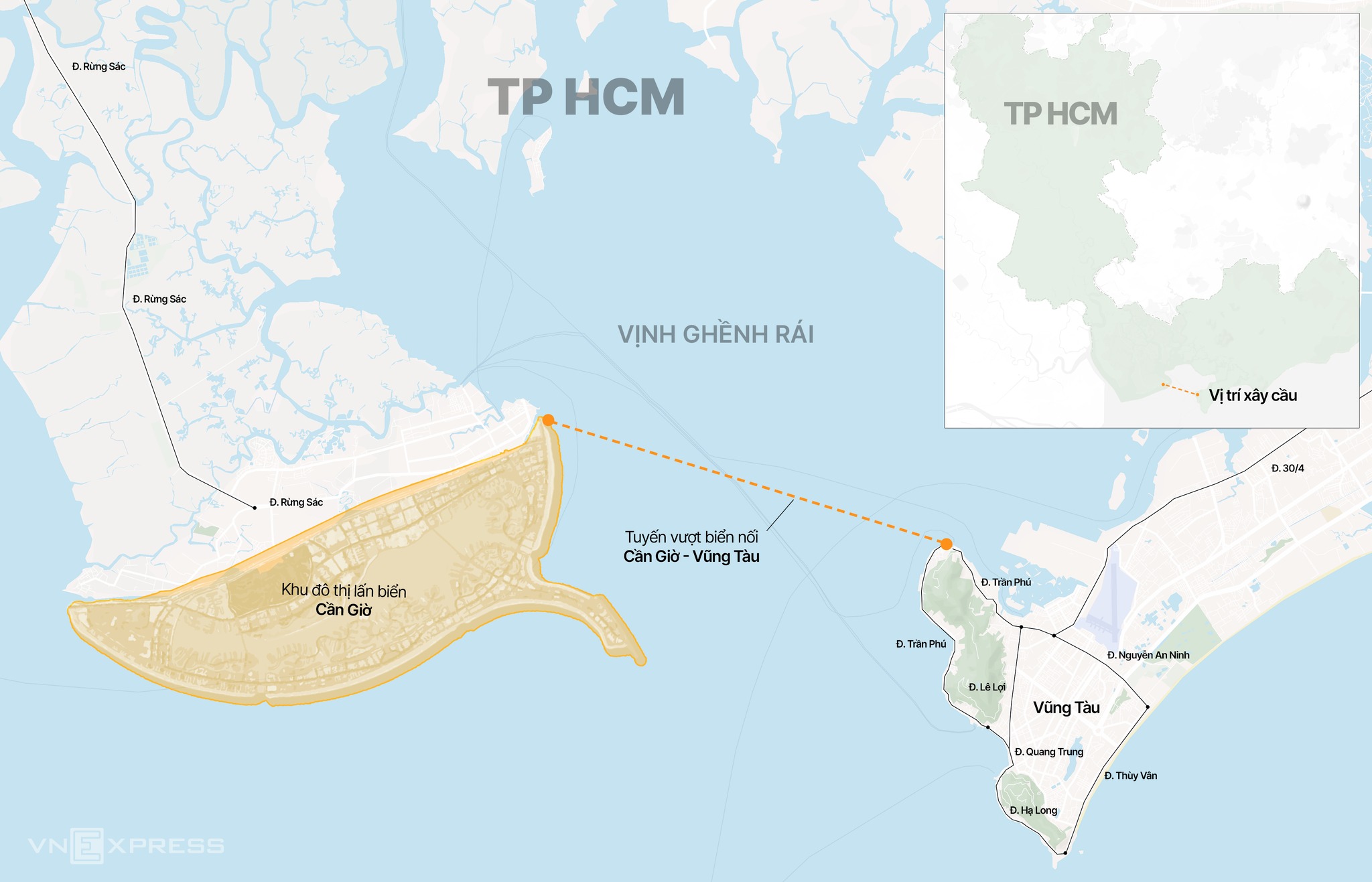 |
Proposed location of the Can Gio - Vung Tau sea-crossing road. Graphic: Tam Thao |
Proposed location of the Can Gio - Vung Tau sea-crossing road. Graphic: Tam Thao
The Can Gio and Ba Ria - Vung Tau regions possess significant potential in maritime economy, tourism, logistics, and seaport industry. However, they currently lack a direct road connection, with travel primarily relying on long detours or waterway transport.
Vingroup Group had previously proposed the Can Gio – Vung Tau sea-crossing route project, spanning over 14 km and comprising bridges, tunnels, and approach roads, with a total investment exceeding 104,000 billion dong. The route begins from Bien Dong 2 Road (Can Gio reclaimed urban area), connects to Mai Sao - Ben Dinh Road, and intersects 30/4 Road in Vung Tau.
The entire route includes approximately 3,1 km of tunnel, nearly 8 km of bridge, and about 3 km of approach roads, heading southeast and crossing Ghenh Rai Bay. The project requires about 137,5 hectares of land; the investor will provide all capital, with the State compensating through land funds under a BT (Build-Transfer) arrangement.
Le Tuyet


