On 6/6, Le Thanh Dung, Deputy Director of U Minh Ha National Park, announced that the degradation of the melaleuca forest has been observed in many areas over the past 10 years. While the park has not fully inventoried the affected area, initial assessments indicate approximately 300 hectares of forest are severely depleted.
According to Mr. Dung, a primary cause is the long-standing presence of some forest areas, with melaleuca trees entering a senescence stage, leading to their death and collapse. This condition is concentrated in low-lying areas within the strictly protected zone, where inundation persists for more than six months each year.
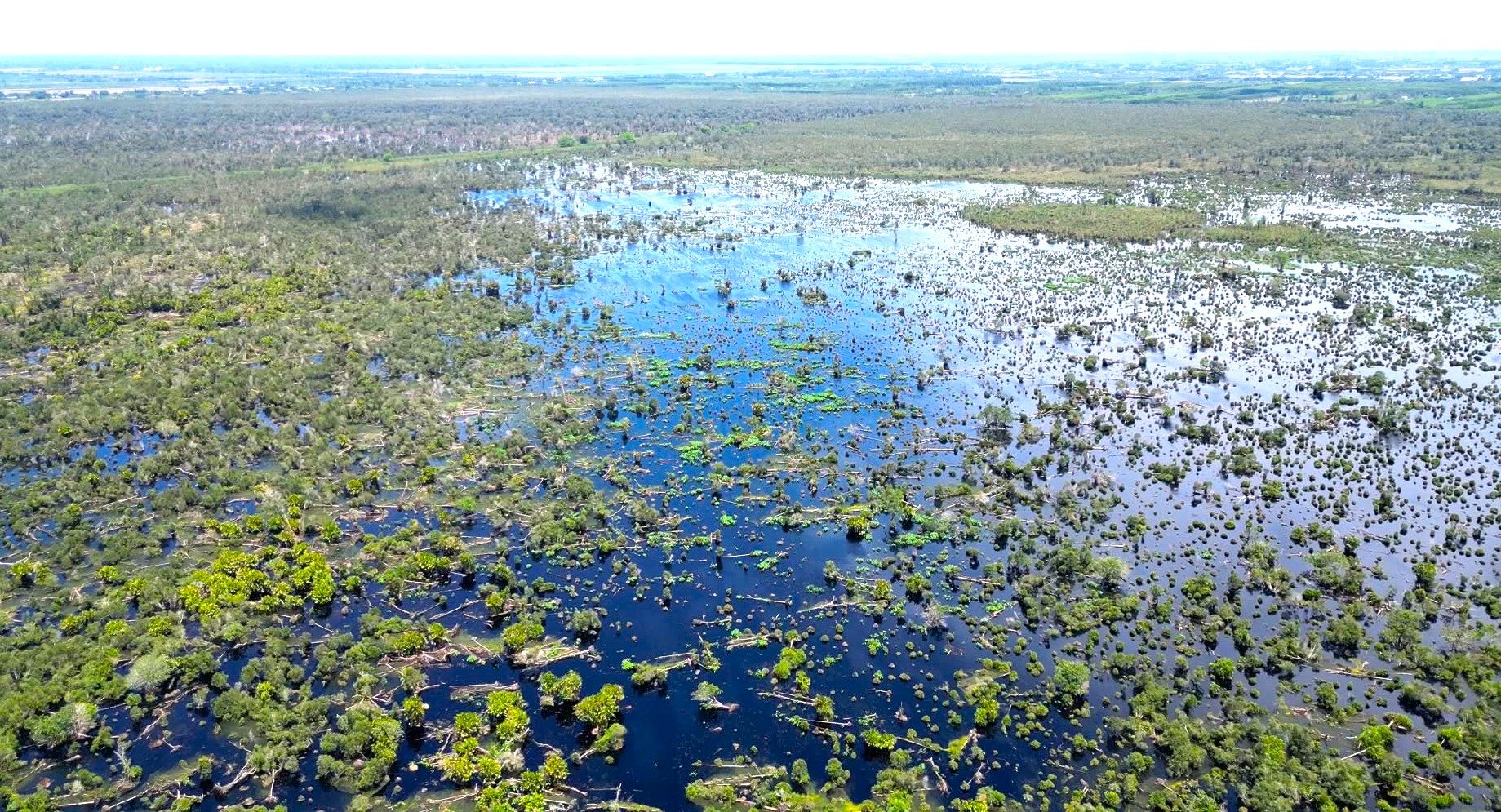 |
Area of depleted melaleuca forest. Photo: Chuc Ly |
Additionally, the characteristic red water of the U Minh region, formed from peat soil, also affects the forest's natural regeneration capacity. The dark water reduces the light necessary for photosynthesis, making it difficult for young melaleuca trees to grow.
"Over a long period, a peat layer 0,5-1,5 m thick forms under the forest canopy. During the dry season, this layer becomes porous and lacks cohesion, causing many large melaleuca trees to lose their anchorage and easily fall", Mr. Dung stated.
As the melaleuca forest degrades, many areas gradually transform into grasslands with vegetation primarily consisting of grass, sedges, reeds, and ferns. The affected areas are currently concentrated in sub-zones 1 and 4. If melaleuca trees cannot regenerate, these areas risk transforming into a different ecosystem.
To mitigate this situation, U Minh Ha National Park plans to propose that competent authorities research solutions for water regulation and balance, creating conditions for forest recovery. The park is also collaborating with specialized agencies and scientists to comprehensively assess the current state of peat and the melaleuca forest ecosystem.
U Minh Ha National Park is one of the three important wetland conservation areas in the Mekong Delta, and one of the three core zones of the Cape Ca Mau World Biosphere Reserve, recognized by UNESCO.
The park's core zone spans over 8,527 hectares, with more than 2,593 hectares designated as a conservation zone for the melaleuca forest ecosystem on peat soil, and over 5,190 hectares as a restoration and sustainable use zone for wetland ecosystems.
An Minh