


The Ministry of Construction recently decided to assign the investment preparation tasks for railway projects under its management. Consequently, the Thang Long Project Management Board, an entity within the Ministry of Construction, is now responsible for preparing the project's feasibility study report, taking over from the former Railway Project Management Board.
The Railway Project Management Board confirmed it has fully transferred all relevant documents, data, financial information, and research findings related to the high-speed railway project to the Thang Long Project Management Board.
Additionally, the Railway Project Management Board issued a written notice to local authorities, informing them of the change in the investor responsible for preparing the North-South high-speed railway project's feasibility study report.
The unit also requested provincial Party committees, provincial people's committees, city people's committees, and Vietnam Electricity (EVN) to adjust the members of the Site Clearance Steering Committee and its support team, replacing representatives from the Railway Project Management Board with those from the Thang Long Project Management Board to ensure coordinated implementation.
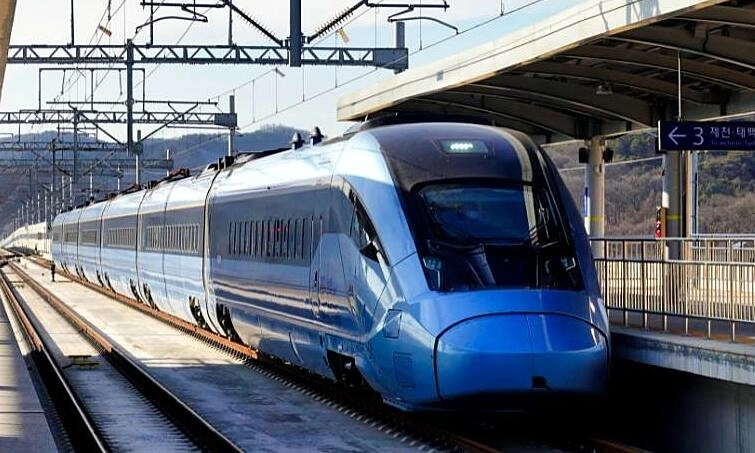 |
KTX high-speed train in Korea. Photo: KoreaRailway |
KTX high-speed train in Korea. Photo: KoreaRailway
To prepare for the project, in early January, the Ministry of Construction established a ministerial steering committee to implement the North-South high-speed railway project. Concurrently, specialized teams and expert groups were formed to research, prepare, and execute the project. The steering committee comprises 18 members, with Minister Tran Hong Minh serving as its head.
Recently, the government instructed the Ministry of Construction to direct the Railway Project Management Board to finalize the selection of an international consultant for the project's feasibility study report by January at the latest, and to submit the report to the government before 15/1.
The Ministry of Construction will lead and coordinate with the Ministry of Science and Technology, the Ministry of Foreign Affairs, and other relevant ministries and agencies. With the support of experts and consultants, they will review Vietnamese and international standards and regulations, international experience, and Vietnam's specific conditions to select the most suitable technology for the project, choosing from rail-based, magnetic levitation (maglev), or vacuum tube technologies.
The North-South high-speed railway project has a preliminary total investment of approximately 1,7 trieu ty dong, equivalent to 67 billion USD. The route spans 1,541 km, commencing at Ngoc Hoi station in Hanoi and concluding at Thu Thiem station in TP HCM, passing through 20 provinces and cities. It is designed as a double-track line with a 1,435 mm gauge, a design speed of 350 km/h, and will include 23 passenger stations and 5 cargo stations.
Anh Duy


