The Hoang Mai Medical Center project, phase one, was constructed in Quynh Mai ward. The former Hoang Mai Town People's Committee served as the investor, utilizing both central and local government budgets. Construction commenced in 2020, encompassing a 5-story treatment building designed for 100 beds, along with auxiliary facilities such as a courtyard, parking area, generator housing, fire pump system, and water tanks. The project was initially scheduled for completion in 4 years.
The original plan aimed to establish a modern, integrated medical facility, thereby enhancing the quality of medical examinations and treatment and supporting development in the northern Nghe An province.
By early 2025, phase one of the project was largely finished, with the 5-story treatment building complete. However, the Hoang Mai Medical Center, the intended beneficiary of the facility, has been unable to relocate from its old headquarters, situated about 2 km away, because the components of phase two have not yet been implemented.
As of late December, the new facility stood abandoned, with its grounds overgrown with grass. While the front fence was complete, the rear area was cluttered with temporary water pipes and electrical wires. Inside, the rooms lacked essential equipment.
Meanwhile, the existing Hoang Mai Medical Center employs over 91 officials, doctors, and staff across 13 departments and rooms. It serves over 200 outpatients and 120-140 inpatients daily. The old facility, located below National Highway 1, frequently experiences flooding. Its cramped and dilapidated condition necessitates combining many departments to accommodate beds, which fails to meet the growing demand for medical examinations and treatment.
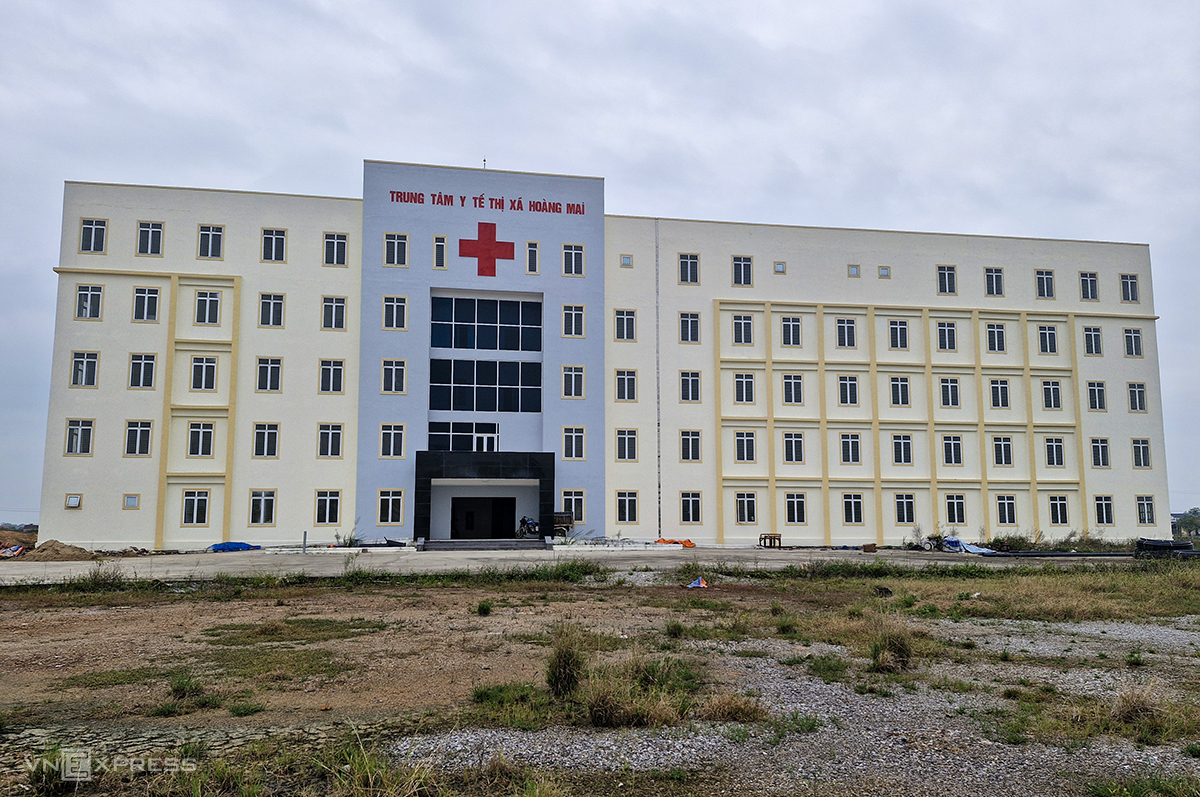 |
Hoang Mai Medical Center is over 95% complete but cannot be used. Photo: Duc Hung |
A leader from the former Hoang Mai Town Project Management Board stated that when the design for phase one was approved, fire safety regulations had not yet been revised. By the time the project neared completion, these regulations had changed, requiring the adjustment of this component as if it were a new project, which caused delays.
Additionally, the phase one design did not include facilities for wastewater and medical waste treatment. When adjusting the technology for phase two, these essential items had to be added. However, local funds proved insufficient, requiring additional funding, which left the project at about 95% completion.
Mr. Ho Van Cay, Chairman of Quynh Mai Ward People's Committee, announced that phase two of the project has a total investment of 115 billion VND. Local authorities have completed the technical-economic report and submitted it to the Department of Construction for review. This is intended to facilitate tendering and expedite construction, bringing the facility into use and preventing waste.
Previously, the Nghe An Provincial People's Committee had instructed relevant departments and local authorities to conduct a review of all stalled, delayed, or incomplete public investment projects. Projects deemed unnecessary or those lacking sufficient capacity for completion were to be scaled down or halted. Only essential projects would proceed if they aligned with planning and had balanced funding.
 |
The old Hoang Mai Medical Center facility is currently dilapidated and overcrowded. Photo: Hung Le |
Duc Hung