


The culinary knowledge behind Nghe An's eel dishes is a form of folk wisdom. Its distinctiveness lies in the careful selection of wild eels, precise cleaning techniques, and a specific blend of local spices such as: shallots, turmeric, chili, pepper, and fish sauce, creating a rich, spicy, and savory flavor.
Eels are a common freshwater aquatic product found in Nghe An's rice fields. For generations, local residents have developed various preparation methods, including stir-frying with lemongrass and chili, or wrapping them in wild betel leaves. Among these, eel porridge and eel soup stand out as signature dishes, defining Nghe An's culinary identity.
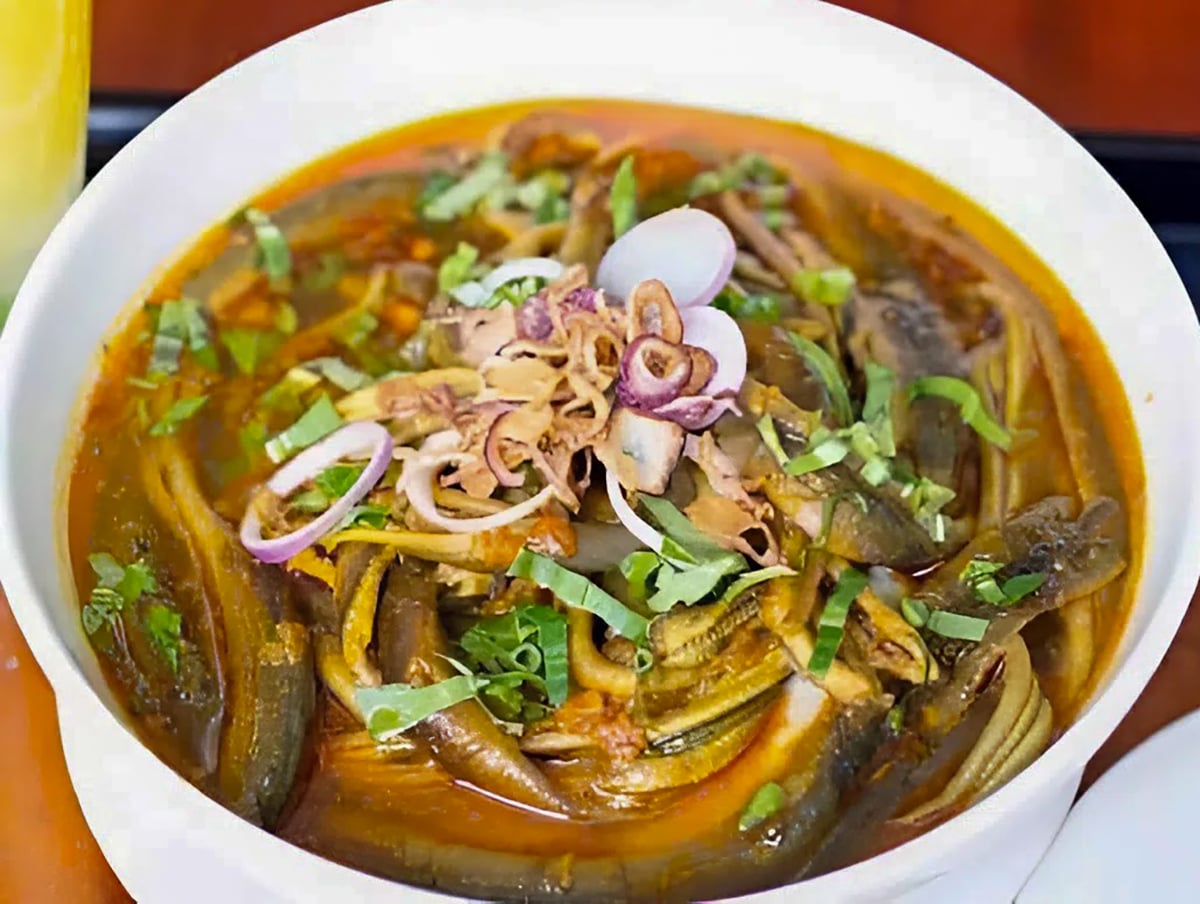 |
Eel soup, served with bread and steamed rice rolls, is a renowned dish in Nghe An. *Duc Hung*
Today, eel is also prepared in modern ways to suit consumer tastes, such as crispy fried eel, eel rolls with meat, dried eel, canned eel, and packaged eel vermicelli. Many communes, formerly part of Yen Thanh district, have established eel farming villages, raising eels without mud and processing them, generating incomes exceeding 50 million VND per month per household.
Nguyen Minh Thao, 34, owner of an eel processing facility in Phan Thanh village, Hop Minh commune (formerly part of Yen Thanh district), stated that the recognition of eel dish preparation as heritage has positively impacted the craft village. "It enhances the value of eels, enriches Vietnamese cuisine, expands the consumer market, and introduces Nghe An's specialty to people nationwide and international friends," Thao said.
 |
Marinated eel and eel rolls with meat are produced in Phan Thanh village, Hop Minh commune. *Duc Hung*
In addition to the eel dishes, the Ministry of Culture, Sports and Tourism also added the Mai Bang Temple Festival (Cua Lo ward) to the list of national intangible cultural heritages. This festival is associated with the worship of Chieu Trung Dai Vuong Le Khoi, a renowned general from the early Le dynasty who played a crucial role in the Lam Son uprising, helping Le Loi defeat the Ming army. It reflects the "drinking water, remembering the source" tradition (a Vietnamese idiom meaning gratitude and respect for one's ancestors and origins) of Nghe An's coastal residents.
To date, Nghe An boasts 14 national intangible cultural heritages recognized by the Ministry of Culture, Sports and Tourism.
Duc Hung


