Speaking with trade union delegates and workers on the morning of 5/6, during the 14th Vietnam General Confederation of Labor Congress, Prime Minister Le Minh Hung stated that the government is directing ministries, sectors, and localities to research and refine policies for housing market development, prioritizing rental housing.
The head of government confirmed he had personally met with Hanoi and other localities with high concentrations of workers, such as Hai Phong, Quang Ninh, Ninh Binh, Hung Yen, and Bac Ninh. The purpose of these meetings was to review planning and allocate resources for worker housing development. Localities are expected to implement rental housing projects starting in june.
"Initially, the state will use its budget to construct long-term rental housing for workers at prices they can afford," he said.
 |
Prime minister Le Minh Hung attended and chaired the exchange and discussion program with delegates at the 14th Vietnam General Confederation of Labor Congress. Photo: VGP |
Prime minister Le Minh Hung attended and chaired the exchange and discussion program with delegates at the 14th Vietnam General Confederation of Labor Congress. Photo: VGP
The prime minister observed that most workers currently lack housing, renting cramped spaces with limited infrastructure and high costs. Healthcare access and spiritual well-being remain insufficient; schools and kindergartens for workers' children also fall short of needs.
"The most important aspect of this process is a shift in mindset from solely focusing on home ownership to ensuring the right to housing. This represents a strategic change in thinking," the government leader stated.
He emphasized that worker housing must be affordable, planned, and built in conjunction with social infrastructure such as schools, kindergartens, healthcare facilities, and cultural centers.
Previously, Nguyen Thi Thanh, Chairwoman of Ba Dinh Ward Trade Union under the Hanoi Federation of Labor, highlighted that many migrant workers in Hanoi and other areas are renting cramped, inconvenient rooms. Many families of 4-5 people live in 10-15 square meter rooms, directly impacting their health, ability to restore their labor capacity, and work productivity.
According to a trade union survey, worker housing needs fall into three groups: long-term rental, home purchase, and rent-to-own. Trade union representatives recommended planning housing areas near industrial zones, with integrated infrastructure like schools, markets, supermarkets, and public transport connections.
 |
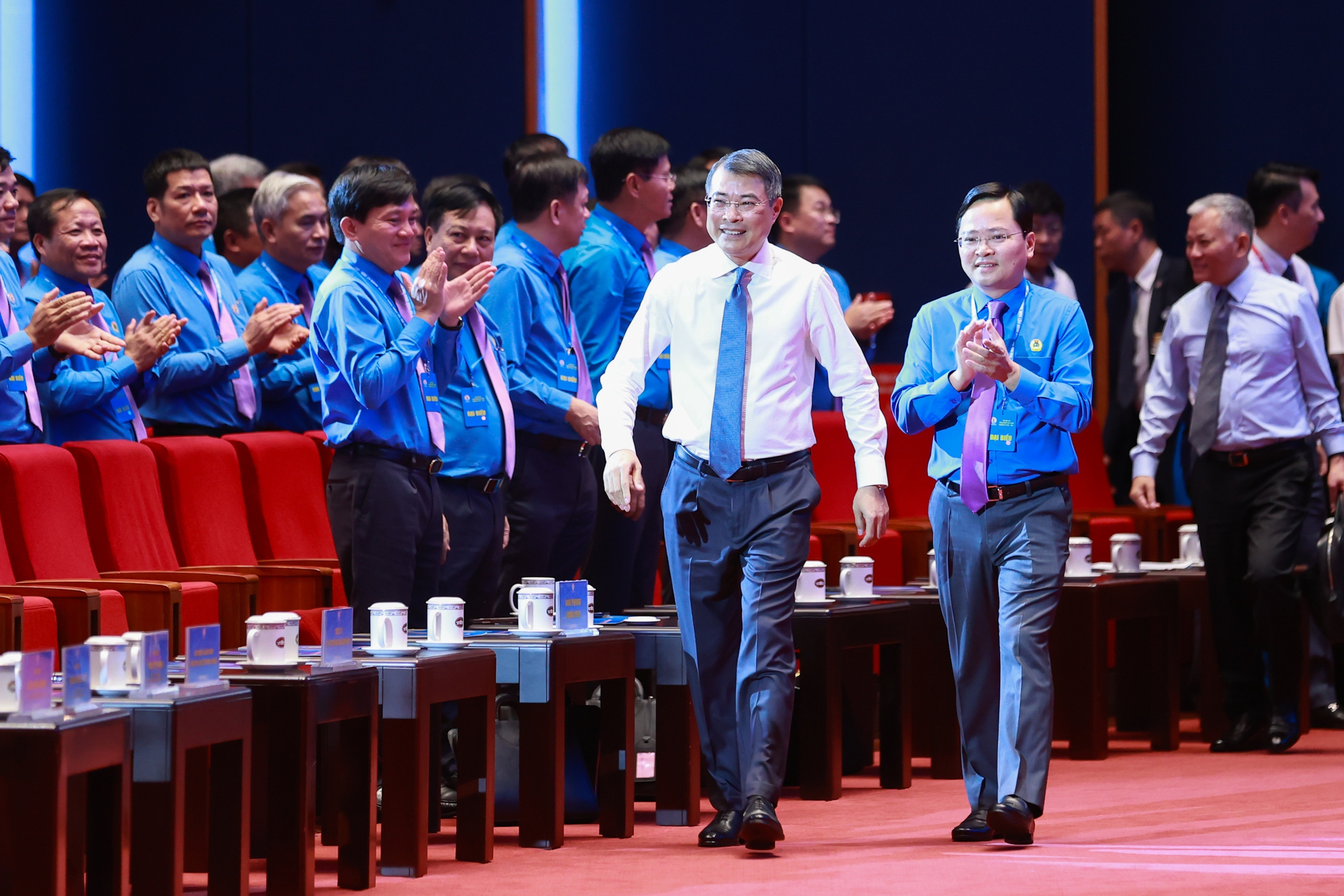
Prime minister Le Minh Hung greeted delegates attending the congress. Photo: VGP |
Prime minister Le Minh Hung greeted delegates attending the congress. Photo: VGP
Beyond housing, the issue of wages was also raised by many trade union delegates during the dialogue.
Nguyen Thi Mai Chi, Chairwoman of the grassroots Trade Union at NewApparel Far Eastern Company, under the Dong Nai Federation of Labor, noted that despite the country's growing economy, many workers' incomes do not meet minimum living needs. Numerous worker families face unstable income, lack savings, and encounter difficulties during unforeseen events.
"If workers constantly worry about basic necessities, will they have enough energy to innovate and improve productivity and income?" Ms. Chi questioned. She proposed that the government research a "living wage" policy, rather than merely ensuring a minimum wage. She also suggested improving welfare policies concerning housing, kindergartens, schools, and healthcare to alleviate the burden of living costs for workers.
 |
Nguyen Thi Mai Chi, Chairwoman of the grassroots Trade Union at NewApparel Far Eastern Company, proposed a living wage. Photo: Nguyen Hai |
Nguyen Thi Mai Chi, Chairwoman of the grassroots Trade Union at NewApparel Far Eastern Company, proposed a living wage. Photo: Nguyen Hai
Responding to this proposal, Prime Minister Le Minh Hung stated that the government would task ministries and sectors with absorbing, researching, and concretizing proposals on wage reform, income, working conditions, and hours. Relevant agencies are also developing a project to reform public sector wage policies and proposing private sector wage policies to ensure workers' livelihoods.
The prime minister affirmed that based on the suggestions from trade unions and workers, the government will continue to refine institutions and policies. This effort aims to improve the business investment environment, promote enterprise development, create sustainable jobs, and enhance the quality of social welfare, especially regarding housing, vocational training, occupational safety, healthcare, education, working hours, and worker meals.
By Hong Chieu