On the morning of 24/8, with all 477 attending delegates voting in favor, the National Assembly passed the Law amending and supplementing a number of articles of the Law on Radio Frequencies, the Law on Telecommunications, the Law on Electronic Transactions, and the Law on Technology Transfer.
In the field of radio frequencies, the law modifies the authority to issue, recognize, and revoke radio operator certificates. This change provides the basis for abolishing the conditional business sector of "training and issuing radio operator certificates".
The Ministry of Construction will manage the issuance, recognition, and revocation of radio operator certificates in maritime and aviation, except for cases related to national defense and security. The Ministry of National Defense and the Ministry of Public Security will be responsible for certificates pertaining to national defense and security tasks. The Ministry of Science and Technology will manage amateur radio operator certificates.
This reallocation of authority aims to prevent overlaps in training, examination, certification, and management of radio equipment users.
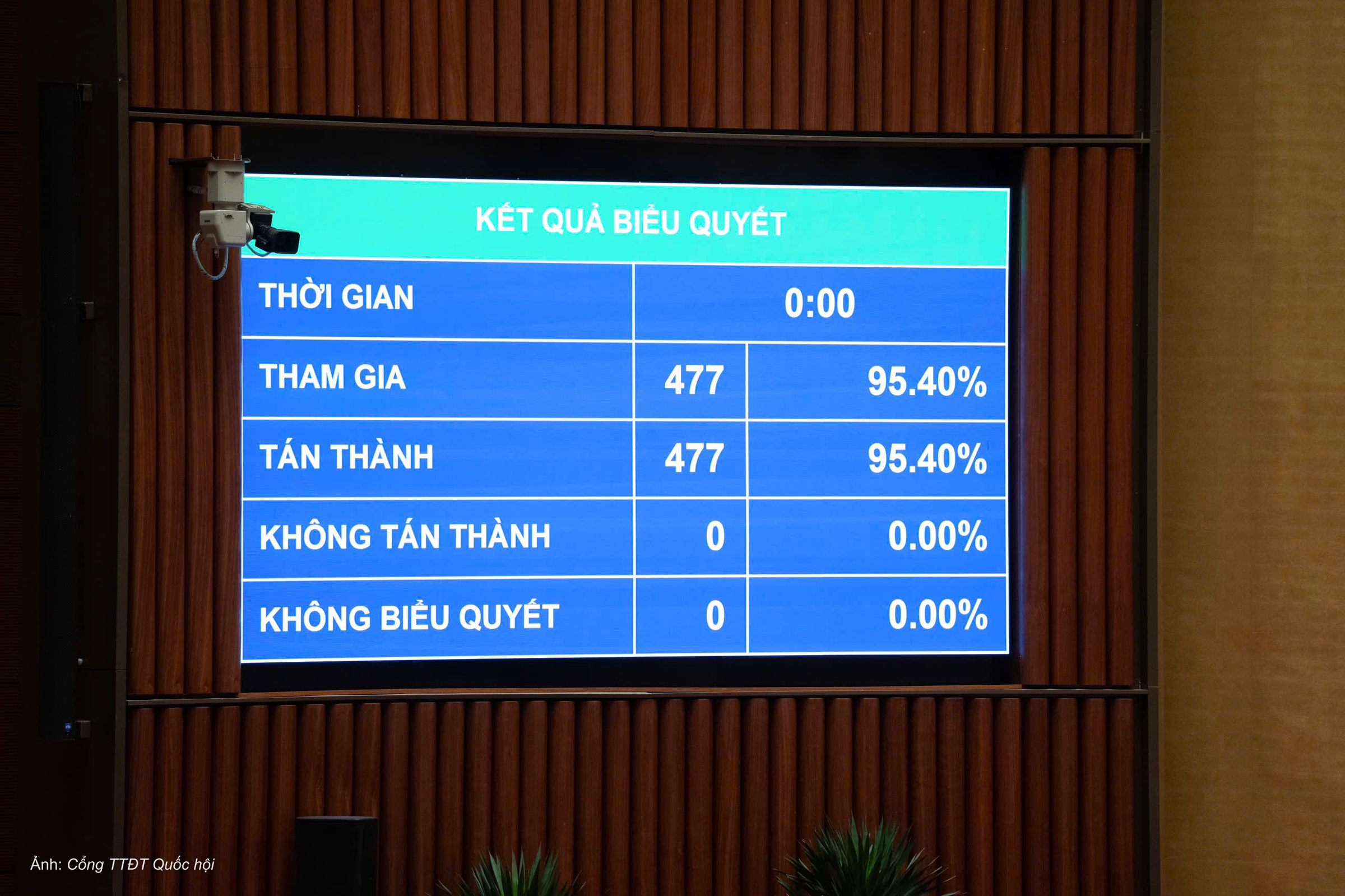 |
The vote results for the Law amending and supplementing a number of articles of the Law on Radio Frequencies, the Law on Telecommunications, the Law on Electronic Transactions, and the Law on Technology Transfer. Photo: National Assembly Portal
The revised Law on Telecommunications reduces certain conditions for telecommunications license issuance, participation in frequency usage auctions and tenders, and the operations of organizations and businesses providing domain name registration and maintenance services. Management agencies will oversee business activities through digital data, reports, inspections, and examinations. Businesses found in violation may face suspension or termination of their service provision.
The law also adds provisions for sharing telecommunications infrastructure to fulfill national defense and security tasks. This sharing will be carried out through contracts or other written agreements, ensuring the legitimate rights and interests of all parties. The government will stipulate specific mechanisms and policies as required during different periods.
In electronic transactions, the law streamlines procedures for renewing licenses and amending the content of trusted service business licenses. The government stated that abolishing these procedures is based on utilizing shared data and connectivity among management agencies. Businesses are only required to notify and update information once at the business registration agency.
Management agencies are transitioning from pre-inspection to post-inspection, monitoring business operations through reports, information sharing in the electronic environment, and checks during service provision.
 |
Deputy Prime Minister Ho Quoc Dung explaining some contents before the National Assembly voted. Photo: National Assembly Portal
Under the Law on Technology Transfer, the Ministry of Science and Technology is assigned to lead and coordinate with relevant ministries and agencies to develop and promulgate a national science and technology market development program.
The program's development must address inter-sectoral and inter-regional issues. It will be appraised by a council comprising representatives from ministries, sectors, localities, and experts, or by collecting written feedback from relevant agencies.
The Ministry of Science and Technology will also lead and coordinate with ministries and provincial People's Committees to develop and issue, within their authority, or submit to competent authorities for issuance, programs, projects, and policies on technology import.
This includes developing the science and technology market, promoting technology transfer, application, and innovation. These policies will apply nationwide, covering small and medium-sized enterprises and innovative businesses in mountainous and border regions.
 |
Prime Minister Le Minh Hung applauding after the law was passed by the National Assembly. Photo: Hoang Phong
**Frequency band allocation for national defense and security**
The law permits the allocation of frequency bands in special cases to state-owned enterprises directly serving national defense and security. This allows them to develop the economy while fulfilling national defense and security tasks. The license duration will not exceed 5 years. The Ministry of National Defense or the Ministry of Public Security will prepare a frequency band usage plan, consult relevant agencies, and submit it to the Prime Minister for approval before the Ministry of Science and Technology issues the license.
The plan must specify the national defense and security tasks assigned to the enterprise. The amount of frequency serving these tasks must constitute a basic proportion of the total frequency requested for licensing. The use of frequency bands must ensure national defense and security, protect state secrets, and foster fair competition in telecommunications.
At least 9 months before the license expires, the Ministry of National Defense or the Ministry of Public Security must assess the effectiveness of the frequency band use and report to the Prime Minister for a decision on whether to stop or continue the plan. The continuation period will not exceed 10 years.
The law takes effect from 1/3/2027. However, provisions for allocating frequency bands to state-owned enterprises directly serving national defense and security, along with amendments to the Law on Technology Transfer, will take effect from 1/10. Frequency band usage plans submitted to the Prime Minister before 1/10 but not yet approved will follow the new regulations. For plans already approved but not yet licensed, or licenses issued before this date, implementation will continue under the regulations in effect at the time of approval or licensing.
Son Ha