


On 6/1, Hue City's department of culture and sports submitted a report to the city People's Committee, proposing the dismantling of several illegally constructed structures within the area of emperor Thieu Tri's mausoleum. Among these is a traditional wooden house erected in front of the burial enclosure of empress dowager Tu Du's tomb.
The department asserted that the construction of the traditional wooden house in the area of empress dowager Tu Du's tomb without prior assessment and permission violates the 2024 Cultural Heritage Law. This action also poses a potential risk to the Outstanding Universal Value of the Complex of Hue Monuments World Heritage Site.
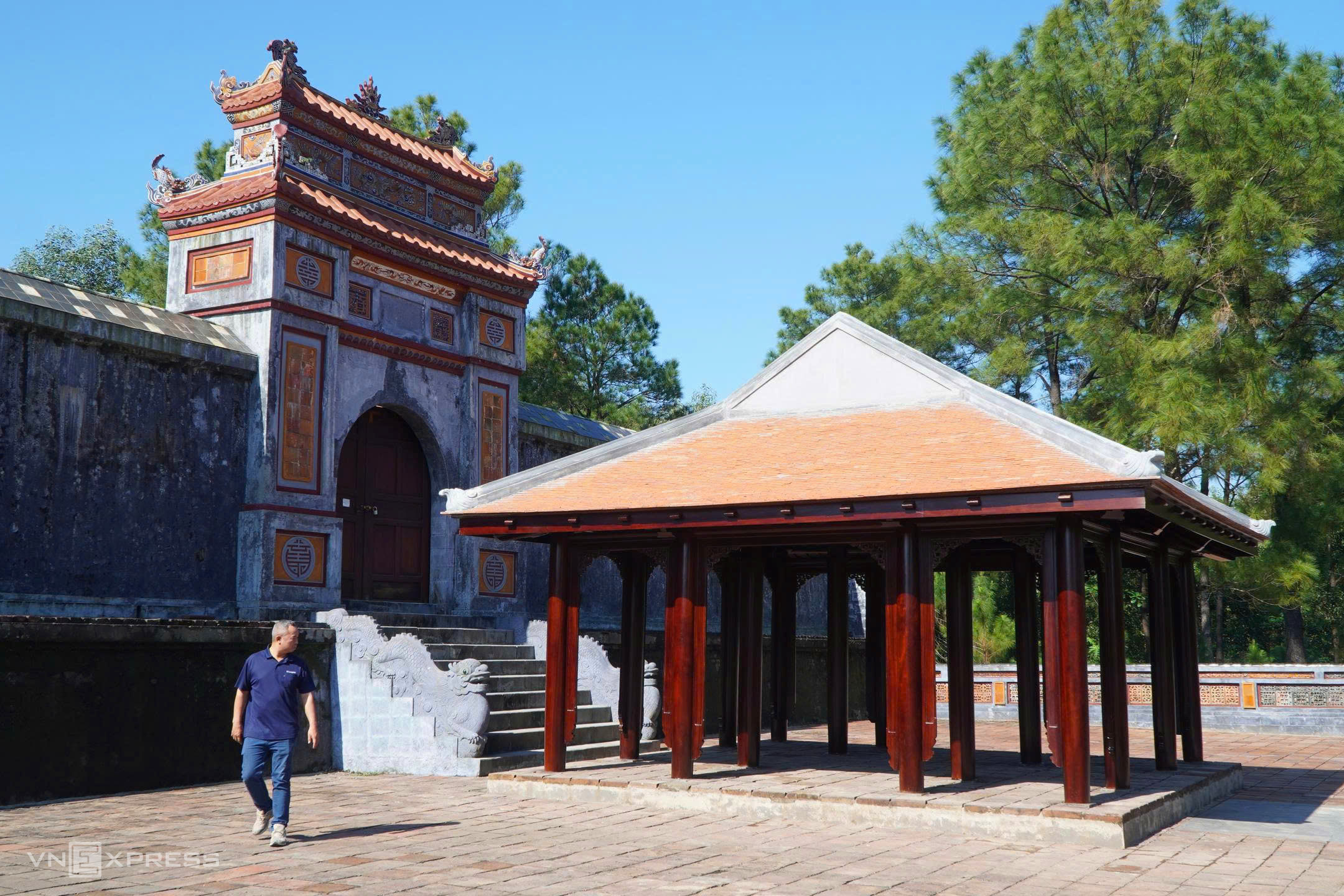 |
Illegally built traditional wooden house at empress dowager Tu Du's tomb. *Van An* |
A field inspection on 29/12 revealed a traditional wooden house, approximately 35 m2 in area and 6m high, permanently constructed on ancient foundations within protection zone I of emperor Thieu Tri's mausoleum, where empress dowager Tu Du's tomb is located. Additionally, a newly built three-arched gate was found at the entrance to emperor Thieu Tri's mausoleum, adjacent to protection zone I. These structures were not included in planning documents and had not received approval from competent authorities.
Hue City's department of culture and sports stated that the Hue Monuments Conservation Center's explanatory report regarding the illegally erected traditional wooden house was insufficient. The report failed to clarify important details such as the legal basis, funding sources, scientific and historical grounds, investment process, and the responsibilities of involved individuals and groups. "Emperor Thieu Tri's mausoleum is a crucial component of the Complex of Hue Monuments – a World Cultural Heritage site. Therefore, all activities involving restoration, embellishment, or new construction here, regardless of scale, must strictly comply with the provisions of the Cultural Heritage Law. According to the UNESCO World Heritage Convention, member states are responsible for notifying the World Heritage Committee in advance of any new construction or major alterations within a heritage site," the document stated.
The department proposed that the city People's Committee instruct the Hue Monuments Conservation Center to promptly submit a full, detailed report on the process of fundraising, receiving sponsorships, and organizing the construction of the structures. It also demanded the immediate dismantling of the illegally built items in protection zone I and the adjacent area of emperor Thieu Tri's mausoleum, restoring the site to its original state. The Hue Monuments Conservation Center was also requested to conduct a review, clarify the responsibilities of relevant individuals and groups, and report the findings to the city People's Committee.
For its part, the department of culture and sports will closely supervise the dismantling process, ensuring safety for the original elements of the monument. Concurrently, based on the explanatory report and directives from the city People's Committee, it will advise on handling any administrative violations in accordance with legal regulations.
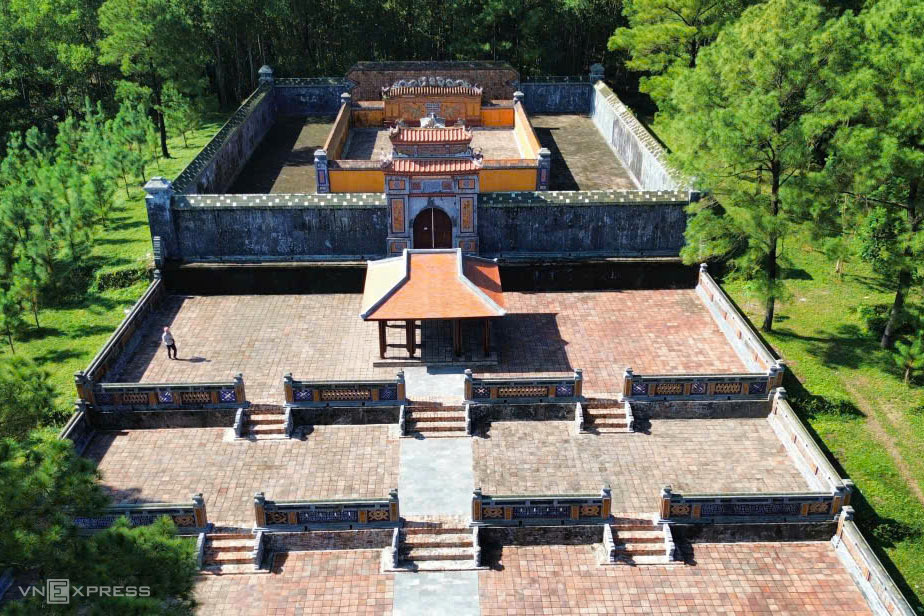 |
Overview of empress dowager Tu Du's tomb. *Vo Thanh* |
Researcher Nguyen Xuan Hoa, former director of Thua Thien Hue province's department of culture, sports and tourism, shared this view. He stated that, according to law and architectural principles, erecting a traditional wooden house in the area of empress dowager Tu Du's tomb is inappropriate and arbitrary. The Hue Monuments Conservation Center must dismantle the structure and restore the monument's original architectural state. "During the Nguyen Dynasty, the area where the traditional wooden house now stands was historically used only for temporary structures to place offerings. After ceremonial occasions, these temporary structures would be dismantled to restore an open and solemn space to the tomb. The architecture of Nguyen royal tombs did not feature traditional wooden houses blocking the front pathway as the newly erected one does," Mr. Hoa said.
The day before, the Hue Monuments Conservation Center had sent a report to Hue City's department of culture and sports regarding the erection of the traditional wooden house at empress dowager Tu Du's tomb. According to the center, the outdoor worship space at the mausoleum was rudimentary, susceptible to weather, and did not meet spiritual activity needs. Based on current conditions and historical documents, the center reconstructed a worship space in the form of a traditional "hoang oc" (royal house) using modular wooden structures, asserting that it did not damage original elements of the monument or utilize state funds. "During the implementation process, driven by strong dedication and a desire to quickly provide a dignified space for worship and solemn rituals for empress Nghi Thien Chuong Hoang Hau Tu Du, the center agreed with the sponsor to proceed with the erection of the traditional 'hoang oc' house," the document stated.
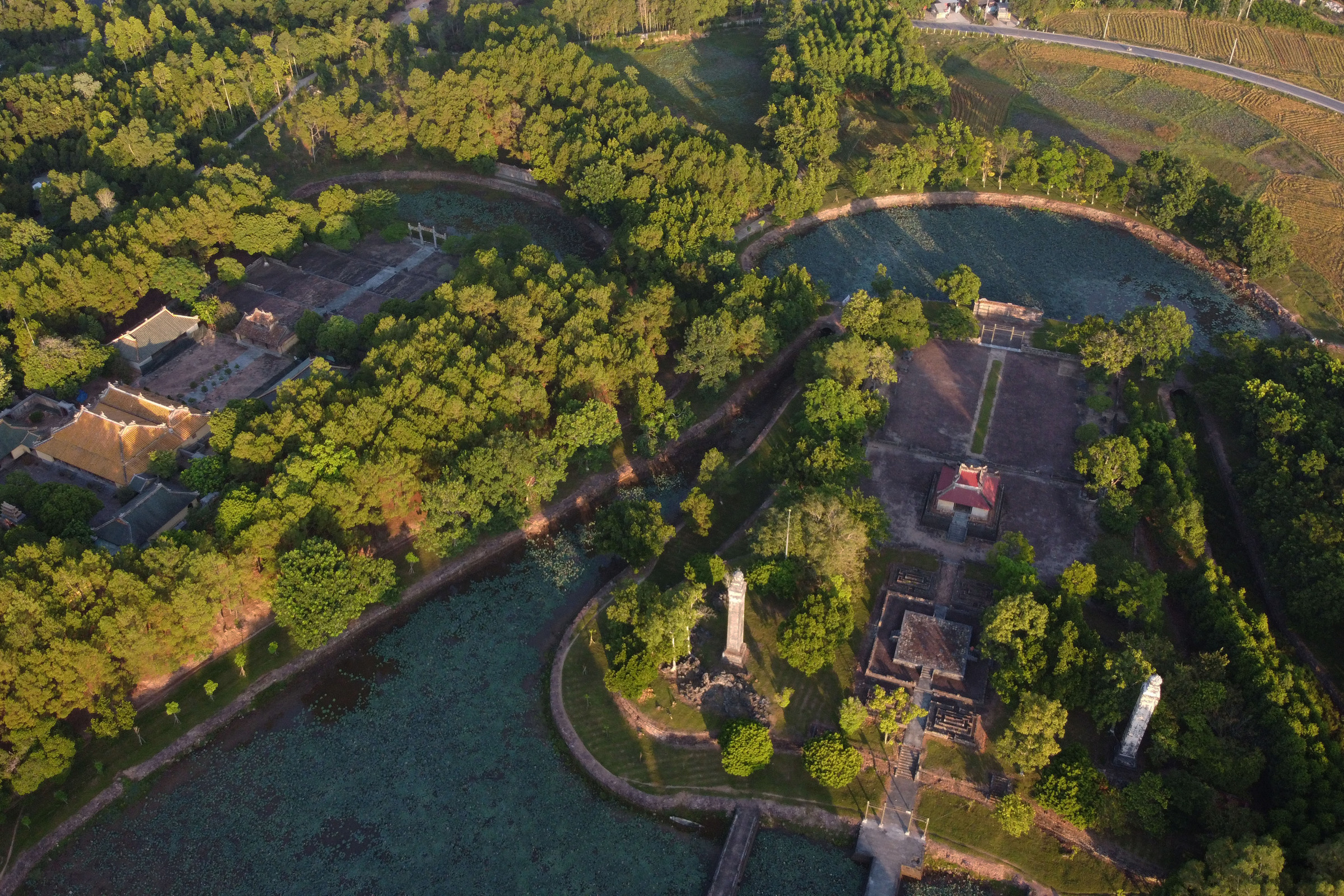 |
Emperor Thieu Tri's mausoleum in Thuy Xuan ward. *Vo Thanh* |
Empress dowager Tu Du's tomb is located within the grounds of emperor Thieu Tri's mausoleum in Cu Chanh village, Thuy Xuan ward. Faced with the mausoleum's degradation, in 2023, the Hue Monuments Conservation Center undertook restoration work, costing nearly 6,9 billion VND. This funding was contributed by the Pham Dang lineage, empress Tu Du's family, through the Hue Heritage Conservation Fund. The project involved restoring various components: steles; Tan Nguyet lake and its drainage system; the forecourt and steps in front of the mausoleum; natural ground areas; the gate; and both the outer and inner walls. The project was completed and became operational in 2024.
Empress dowager Tu Du (20/6/1810-22/5/1901), whose birth name was Pham Thi Hang, was the eldest daughter of Pham Dang Hung, the minister of rites and Duke Duc Quoc Cong. She was a royal concubine of emperor Thieu Tri and the biological mother of emperor Tu Duc. She lived through the reigns of 8 Nguyen Dynasty emperors: Thieu Tri, Tu Duc, Duc Duc, Hiep Hoa, Kien Phuc, Ham Nghi, Dong Khanh, and Thanh Thai.
Vo Thanh


