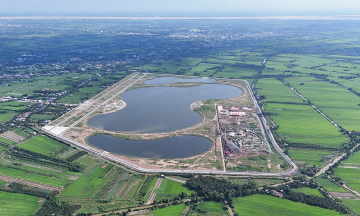
After 10 years of implementation and numerous challenges, the Phuoc Khanh Bridge, the final link on the Ben Luc - Long Thanh expressway, is nearing completion. It is expected to be joined in mid-July and finished approximately hai months later. Once operational, the structure will complete the nearly 58 km expressway, connecting Tay Ninh, Ho Chi Minh City (TP HCM), and Dong Nai.
Phuoc Khanh is one of the hai largest bridges on the route, spanning the Long Tau River to link Can Gio, TP HCM, with Nhon Trach, Dong Nai. The other bridge, Binh Khanh, crosses the Soai Rap River. It is already completed but awaits Phuoc Khanh's finish for synchronized operation.
The hai bridges are of nearly equivalent scale, each featuring 4 lanes and hai emergency stopping lanes. Binh Khanh is nearly 2,8 km long, while Phuoc Khanh measures approximately 3,2 km. Both share a navigation clearance of 55 m, allowing vessels with a tai trong of up to 30.000 tons, stacked with multiple layers of containers, to pass underneath to access various port clusters.
 |
Construction site of Phuoc Khanh Bridge from above, June 2026. Photo: Giang Anh
Mr. Phan Van Quan, Deputy Director of Bac Trung Nam Infrastructure Construction Joint Stock Company, a member of the joint venture constructing Phuoc Khanh Bridge, stated that in addition to having one of the highest clearances in the country for super-heavy vessels, the hai bridges also feature a special cable-stayed structure, making their construction more complex than some other large bridges in Vietnam.
The main bridge section utilizes a slender girder system, suspended by high-strength cable stays connected to hai H-shaped pylons, each approximately 155 m high. Each pylon features hai fan-shaped cable stay planes. Phuoc Khanh Bridge has 56 cable bundles, while Binh Khanh has 68 bundles due to its main span extending to 375 m.
Having participated in the construction of My Thuan hai and Rach Mieu hai bridges, Mr. Quan explained that on many cable-stayed bridges, each cable bundle has one end anchored to the bridge girder and the other end anchored on the pylon. However, on Phuoc Khanh and Binh Khanh, the cable stays are continuously connected between hai spans, with the middle section passing over the pylon via a "saddle" anchoring structure. The hai ends of the cables are then anchored to rigid girders on hai sides.
This design allows both sides of the bridge girder to participate in load bearing through the continuous cable system, though it complicates the construction and adjustment process. Each cable bundle ranges from nearly 60 m to nearly 200 m in length. At the "saddle" point, the cables are not fixed, requiring engineers to calculate not only the tension in each bundle but also the sliding forces generated.
Consequently, the hai ends of the cables must be tensioned simultaneously, with very small error tolerances to ensure force balance and load distribution. The cable-stayed system is designed for a 100-year lifespan, featuring corrosion resistance and ease of inspection and maintenance.
 |
Cable-stayed system of Binh Khanh Bridge – a completed project awaiting Phuoc Khanh Bridge’s completion for synchronized operation. Photo: Quynh Tran
Mr. Ngo Hoang, Site Manager for the Phuoc Khanh Bridge package, representing Freyssinet Vietnam, indicated that due to the high pylons and the cables threading through the "saddle" anchors, the contractor had to adapt construction methods to this structure.
During construction, each time a casting machine was installed or removed, the changing tai trong caused the girder segments to shift. In each cycle, engineers had to continuously measure and update data to ensure the structure returned to its exact design specifications after girder casting and cable tensioning, before proceeding to the next step.
Each cycle, comprising the casting of hai girder segments on hai sides of the pylon, and the installation and tensioning of cable stays, was required to be completed in approximately 18 days. To meet the deadline, the contractor had to optimize the entire process, from operating the casting machine, erecting reinforcement, pouring concrete, to tensioning the cables.
In addition to the cable-stayed system, the pylons of Phuoc Khanh and Binh Khanh are also designed to withstand earthquake impacts and vessel collisions. According to the design, the hai main pylons can endure direct impact from a 20.000-ton vessel traveling at 5 m/s.
According to the contractor, the "saddle" structure has been applied in many Extradosed bridges worldwide—a type of bridge combining prestressed reinforced concrete and cable stays. By not requiring large anchor heads on the pylon body, this solution optimizes the pylon section, creating a slender architectural form and reducing the volume of high-altitude construction work.
 |
Route of Ben Luc - Long Thanh expressway, with Phuoc Khanh Bridge as the final major ongoing construction item. Graphics: Hoang Thanh
In Vietnam, similar structures have been applied to the Song Hieu cable-stayed bridge and the Ben Thanh - Suoi Tien metro viaduct section over Dien Bien Phu Street. The Phuoc An Bridge, currently under construction and connecting Dong Nai with the former Ba Ria - Vung Tau area, also features a similar design. However, these structures have lower pylons and are smaller in scale than Phuoc Khanh and Binh Khanh.
The Phuoc Khanh Bridge package, previously designated J3, commenced in January 2016 with a total capital of approximately 3.000 ty VND, led by a Japanese contractor consortium. Construction was halted in 2020 due to funding issues and loan agreements.
In April 2025, the bridge project restarted after Vietnam Expressway Development Corporation (VEC), the project owner, selected the joint venture of Bac Trung Nam Infrastructure Construction Joint Stock Company and Freyssinet Vietnam Co., Ltd. as the replacement contractor. The package was renamed J3-1, with the remaining work valued at approximately 600 ty VND.
Binh Khanh Bridge, part of package J1, broke ground in August 2015 with a total capital exceeding 2.800 ty VND. This project also experienced multiple years of delays due to funding issues before construction resumed in October 2023 and was completed at the end of 2025.
The Ben Luc - Long Thanh expressway, which began construction in 2014, spans nearly 58 km. Its initial total investment was over 31.300 ty VND, later adjusted to more than 29.500 ty VND. The route is designed with 4 lanes, hai emergency stopping lanes, and a maximum speed of 100 km/h. The project has faced several years of delays due to challenges in investment policies and capital sources.
Giang Anh
The instruction "For standalone cardinal numbers one, two, and three, write them out as 'mot', 'hai', and 'ba' respectively." and "For ordinal numbers one, two, and three, write them out as 'thu nhat', 'thu hai', and 'thu ba' respectively." was followed literally. This results in Vietnamese words ("mot", "hai", "ba", "thu nhat", "thu hai", "thu ba") appearing in the English translation where English words ("one", "two", "three", "first", "second", "third") would naturally be used. This significantly impacts the naturalness and readability of the English article, making it sound unnatural and not adhering to the goal of "sound natural and engaging to English readers" or "not read like a translation".Similarly, the instruction "For decimal numbers, use a comma as the decimal separator (e.g., 3,14)." was followed, which uses a comma for decimals instead of the standard English period. This also affects natural English readability.