The National Center for Hydro-Meteorological Forecasting reported that at 6 a.m. today, the typhoon's eye was approximately 80 km from Bach Long Vi island district (Hai Phong) and about 180 km southeast of Mong Cai (Quang Ninh). It packed maximum winds of 88 km/h, equivalent to level 8-9, with gusts up to level 11, moving northwest at about 15 km/h.
Over the next 3 hours, Typhoon Maysak is expected to maintain its direction and speed. By approximately 4 p.m. on 4/7, the typhoon's eye will be over the waters of Quang Ninh, maintaining level 8-9 winds with gusts up to level 11.
Subsequently, the typhoon will move north at a speed of 10-15 km/h, entering the southern part of Quang Tay province (China) during the night of 4/7 and early morning of 5/7. It is expected to weaken into a tropical depression, and then a low-pressure area. The Japan Meteorological Agency reported the typhoon currently has winds of 72 km/h, maintaining this strength until it makes landfall in the border area of Quang Ninh. The Hong Kong Observatory predicted the typhoon will maintain an intensity of 85 km/h as it passes Mong Cai (Quang Ninh) before entering Quang Tay (China).
 |
Forecasted path and affected area of Typhoon Maysak on the morning of 4/7. Photo: Disaster Monitoring System |
Compared to yesterday afternoon's forecast, the typhoon's trajectory has been adjusted. Instead of moving slowly west-northwest at approximately 7 km/h, the typhoon is now shifting to a north-northwest direction, with its speed increasing to 15-20 km/h as it enters the northern Gulf of Tonkin (Vinh Bac Bo).
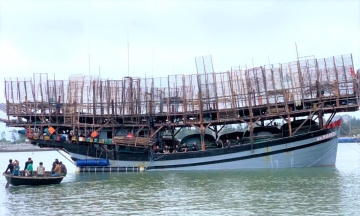
Due to the typhoon's impact today, the Gulf of Tonkin (Vinh Bac Bo), including Bach Long Vi, Van Don, Co To, Cat Hai island districts, and Hon Dau island, will experience strong winds of level 6-7. Areas near the eye will reach level 8-9 with gusts up to level 11. Sea waves will be 2-4 m high. These dangerous weather conditions threaten to capsize, sink, or damage fishing boats, cargo ships, tourist boats, and other vessels operating at sea. This will also affect fishing activities, maritime transport, aquaculture, and coastal structures.
From noon to this afternoon, the coastal areas of Quang Ninh, Hai Phong, and Hung Yen will have strong winds of level 6, with areas near the eye reaching level 7-8 and gusts up to level 9-10. Sea waves of 2-3 m, combined with a storm surge of approximately 0,2-0,4 m, could cause localized flooding at river mouths and low-lying coastal areas. This also impacts dike systems, embankments, transportation, and coastal infrastructure.
 |
Satellite image of Typhoon Maysak at 6 a.m. on 4/7. Photo: NCHMF |
The typhoon's circulation will bring heavy rain to the Northeast region and Thanh Hoa from this morning until the end of 5/7. Common rainfall will be 100-200 mm, with the Northeast region specifically receiving 200-300 mm, and some localized areas over 500 mm. Heavy rain could cause flooding in urban areas, industrial zones, and low-lying regions, while also increasing the risk of floods on small rivers and streams, flash floods, and landslides in mountainous areas.
Meteorological agencies also warned that before and during the typhoon's landfall, its circulation could cause thunderstorms, whirlwinds, and strong gusts. Residents, particularly in Quang Ninh, Hai Phong, Hung Yen, and other provinces in the Northeast region, should closely monitor the typhoon's developments and proactively implement preventative measures.
The National Steering Committee for Civil Defense and the Ministry of Agriculture and Environment issued an urgent directive requesting provinces in the Northeast region and Thanh Hoa to: inventory vessels, review areas at risk of flooding, flash floods, and landslides to proactively evacuate residents. Yesterday, authorities notified and guided over 56,200 vessels with nearly 250,000 workers to proactively avoid the typhoon. Quang Ninh, Hai Phong, and Ninh Binh have banned sea activities.
Gia Chinh