


In 12/2023, at a tea reception hosted by General Secretary Nguyen Phu Trong for Chinese President Xi Jinping at the Central Party Office, a bamboo bonsai pot was placed as the main backdrop. The artwork, named Luong long chau nhat, was shaped from two symmetrically rising bamboo stalks resembling dragons bowing to the sun, attracting attention from the ornamental plant and cultural communities.
The owner of the artwork is Nguyen Sy Luan, 31, from Bac Ninh. Having pursued bamboo bonsai art for seven years, Luan currently owns a 2-hectare garden in Hoang Van commune, where he transforms thousands of rough bamboo roots into artistic bonsai, sought after by enthusiasts nationwide.
Luan had a passion for ornamental plants and Phu Lang pottery since childhood. Seven years ago, while strolling along the Nhu Nguyet River near his home, he noticed many bamboo roots cut down for embankment construction, revealing rough, unusually shaped root sections. "I was captivated and thought these bamboo roots could become valuable bonsai," Luan recounted.
Leveraging his experience with various plants, Luan brought beautiful bamboo roots home to process, cultivate roots, stimulate shoots, then pot them, bending the bamboo stalks to create forms. When he introduced his creations, many were surprised that a herbaceous species like bamboo could enter the world of bonsai – a field traditionally associated with woody plants.
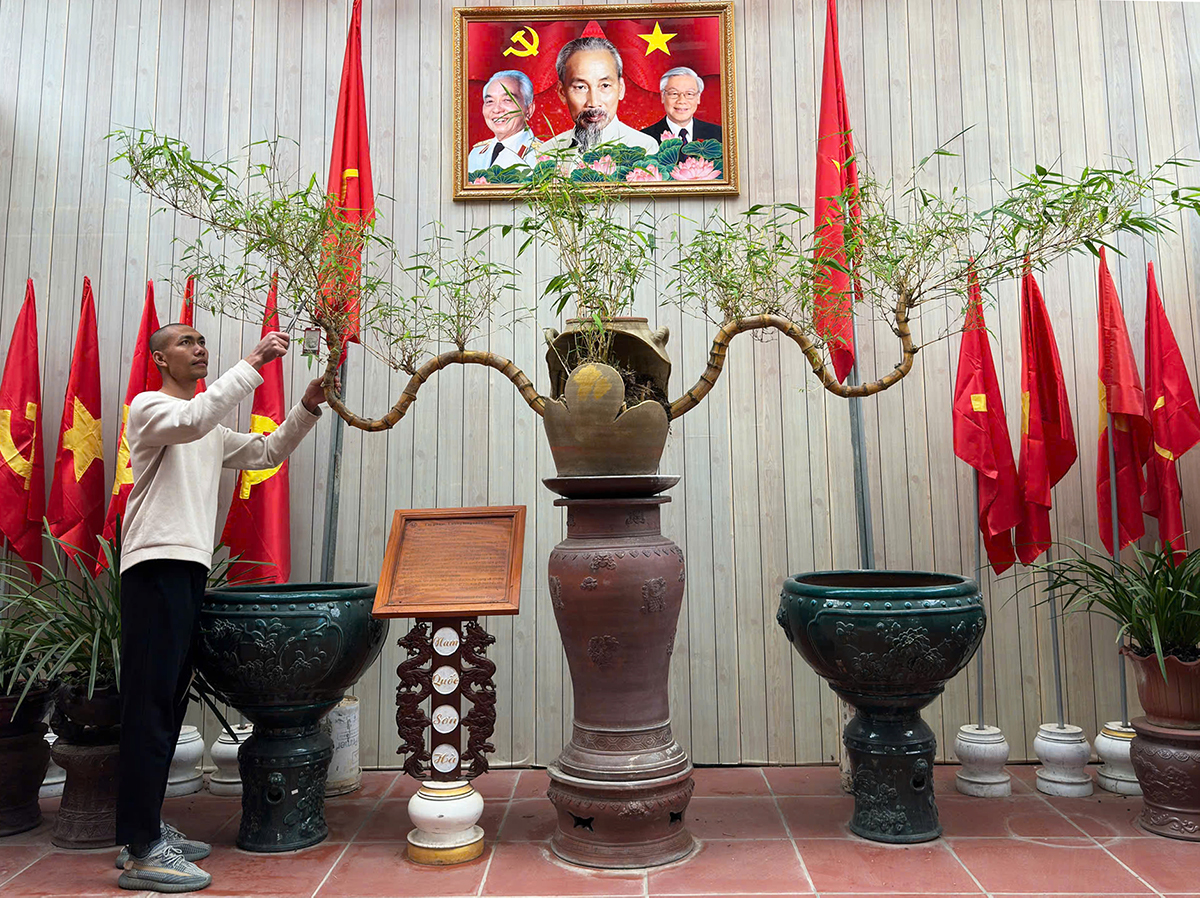 |
The Luong long chau nhat bamboo bonsai artwork, displayed at the tea reception where General Secretary Nguyen Phu Trong hosted Chinese President Xi Jinping, is kept by Sy Luan in his garden in Bac Ninh. *Photo: Sy Luan*
From a few initial roots, Luan gradually collected about 2,000 bamboo roots from various provinces and cities for his nursery. However, bamboo is a demanding species. "Initially, out of 10 roots cultivated, only two survived," he said. Bamboo has straight stalks, requiring early intervention for shaping; cuts at the base are prone to waterlogging and termites if not properly treated.
After numerous failures and financial losses, Luan discovered the secret to selecting bamboo embryos that are neither too young nor too old; controlling humidity during the cultivation phase; and treating cuts with a special mixture to limit termites. As a result, the plant's survival rate gradually increased to about 50%.
Luan's bamboo bonsai pots began to gain market acceptance. Selling prices ranged from several million to tens of millions of VND per pot, providing him with a stable income to pursue his craft almost full-time.
For Luan, each bamboo bonsai pot is not just an ornamental plant but also carries a unique message. He expresses many traditional bonsai styles with bamboo, such as Hanh phuc mau tu (Mother-Child Happiness) and Ty muoi cat tuong (Auspicious Sisters). Some artworks are "tailor-made" for cultural and historical events, bearing names like Hao khi Dong A (Spirit of Dong A), Van Lang hao hung (Heroic Van Lang), and Tay Son tam kiet (Tay Son Three Heroes).
A major turning point came in 2023 when Luan met tea artisan Nguyen Cao Son. At that time, his garden contained a bamboo bonsai pot with two similar-shaped ivory bamboo plants. Initially, Luan named it Luong long chau nguyet (Two Dragons Facing the Moon), later changing it to Luong long chau nhat (Two Dragons Facing the Sun) to signify bright sunlight.
The artwork was brought to Ha Noi, undergoing several inspection and selection stages before its appearance at the diplomatic tea reception. "When I learned the plant would be prominently displayed at the event between the leaders of the two nations, I was truly surprised," Luan stated.
The image of the bamboo bonsai pot at the event became a source of inspiration, helping this hobby gain wider recognition. Currently, bamboo bonsai groups on social media attract about 100,000 members, with lively exchange and trading activities featuring tens of posts daily.
The bamboo bonsai community is divided into three main groups: bamboo root diggers (bamboo embryos); artisans who cultivate and shape them; and buyers for display. Each stage demands patience, experience, and labor.
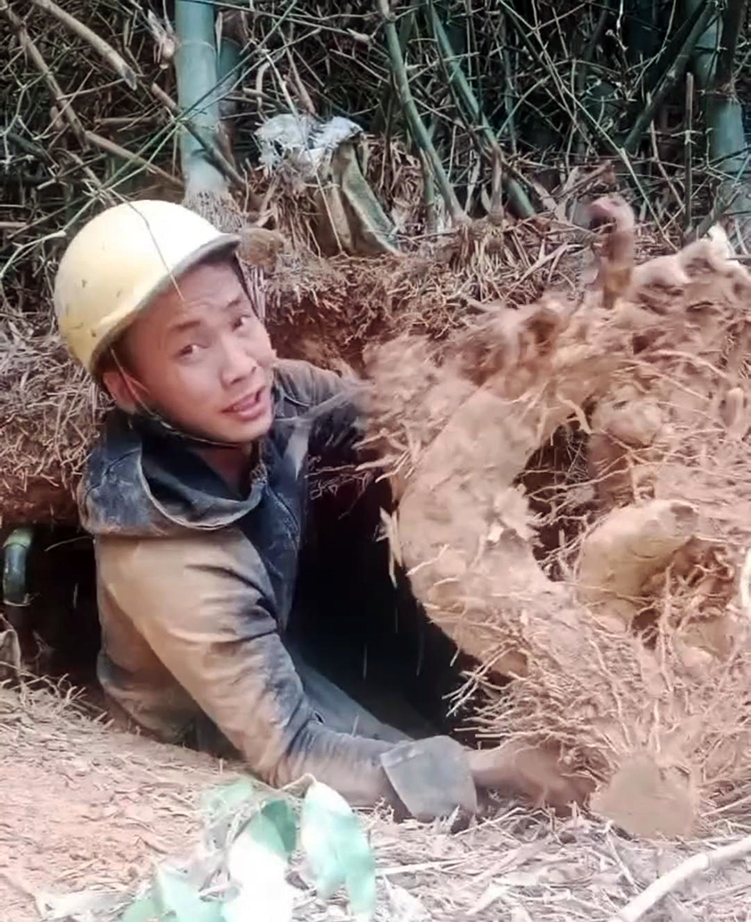 |
Bamboo root diggers in Nghe An sell to artisans who transform them into bonsai. *Photo: Tuan Hung*
Nguyen Tuan Hung, a bamboo embryo hunter in Nghe An, shared that to find valuable bamboo roots, he often ventures along rivers, streams, or difficult-to-access terrain. "These places easily reveal the root shape and often have 'stranger' embryos than bamboo growing in the plains," he said.
After selecting a suitable plant, diggers use shovels to dig deep around the root, and a hand saw to separate the stalk above, taking the root section strong enough to grow roots and shoots. According to Hung, this profession is not only arduous but also risky, as bamboo clumps often harbor bees, and snakes can be found at the base. "I've been bitten by snakes two times and stung by bees many times," he recounted.
After processing, bamboo embryos are sold for about 300,000–500,000 VND per root to nurseries. Some diggers keep beautiful embryos to cultivate and shape themselves.
The cultivation stage determines whether a bamboo embryo lives or dies. Embryos are watered and placed in foam boxes or nylon bags with sand and coconut fiber to retain moisture. After one to two weeks, white roots and bamboo shoots begin to emerge. Once potted, bamboo shoots are bent with wire to create curved branches, completing the bonsai form. The plants continue to receive care, leaf trimming, and cut treatment to maintain their vitality.
Beyond professional artisans, bamboo bonsai also attracts many amateur enthusiasts. In the Ngoc Bao Vien urban area (Quang Ngai), Ho Ngoc Kha, 37, an office worker, began practicing bamboo bonsai in 2023 to relieve work pressure.
Through social groups, Kha connected with local bamboo embryo hunters for cultivation. To date, he has shaped over 100 bamboo bonsai pots in his garden next to his house. Amidst the urban landscape, these shaped bamboo roots attract many passersby.
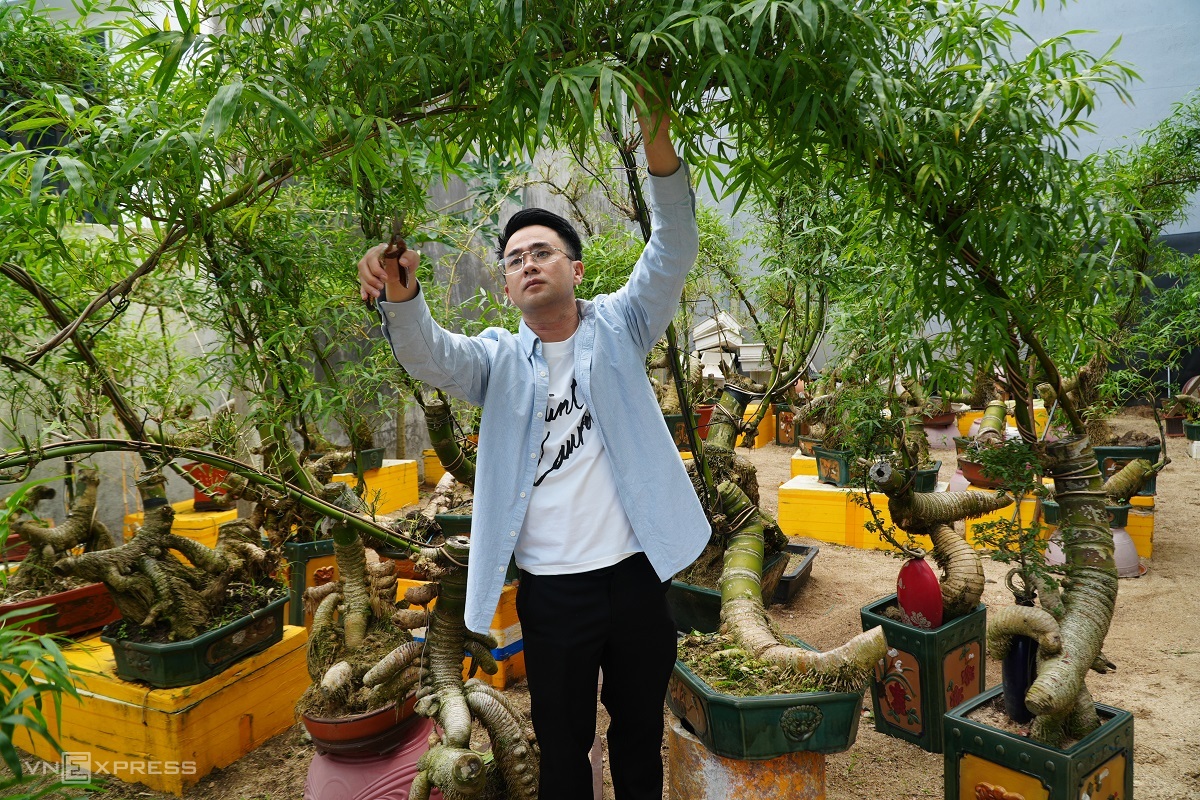 |
Ho Ngoc Kha in his bamboo bonsai garden in Ngoc Bao Vien urban area, Quang Ngai. *Photo: Pham Linh*
According to Kha, due to underground growth and varied care processes, each bamboo bonsai pot has a unique, non-replicable shape. "As urbanization accelerates, many people want to retain the familiar image of bamboo in their living spaces," he said.
Pham Linh


