


A national scientific conference titled "The Tran Dynasty: Historical Stature and Contemporary Value," held on 10/1 to commemorate the 800th anniversary of the dynasty's founding (1226-2026), drew many scholars who clarified the legacy values of this 174-year-long dynasty.
The ideology of "people as the root"
According to Professor Vu Minh Giang, Vice Chairman of the Vietnam Historical Science Association, the Tran dynasty's greatest success was establishing a centralized, "people-centric" state. Although power was consolidated at the center, it firmly based itself on the foundation of villages, clans, and the people's consensus.
The military strategy that defeated the Nguyen-Mong forces three times was not solely tactical; it originated from a "total national defense" strategy. The Tran dynasty organized armed forces into three types of forces: the imperial army, local troops, and militias. This, combined with the "soldiers in farming" policy, enabled them to maintain a massive reserve force without disrupting agricultural production.
Hung Dao Vuong Tran Quoc Tuan's statement, "The will of the entire people is a strong fortress," exemplifies the ideology of relying on the people to save the nation's destiny during critical historical junctures.
Professor Vu Minh Giang noted that the Tran dynasty's emergence not only replaced the weakened Ly dynasty but also marked a profound restructuring of the Dai Viet state and saved the nation's fate.
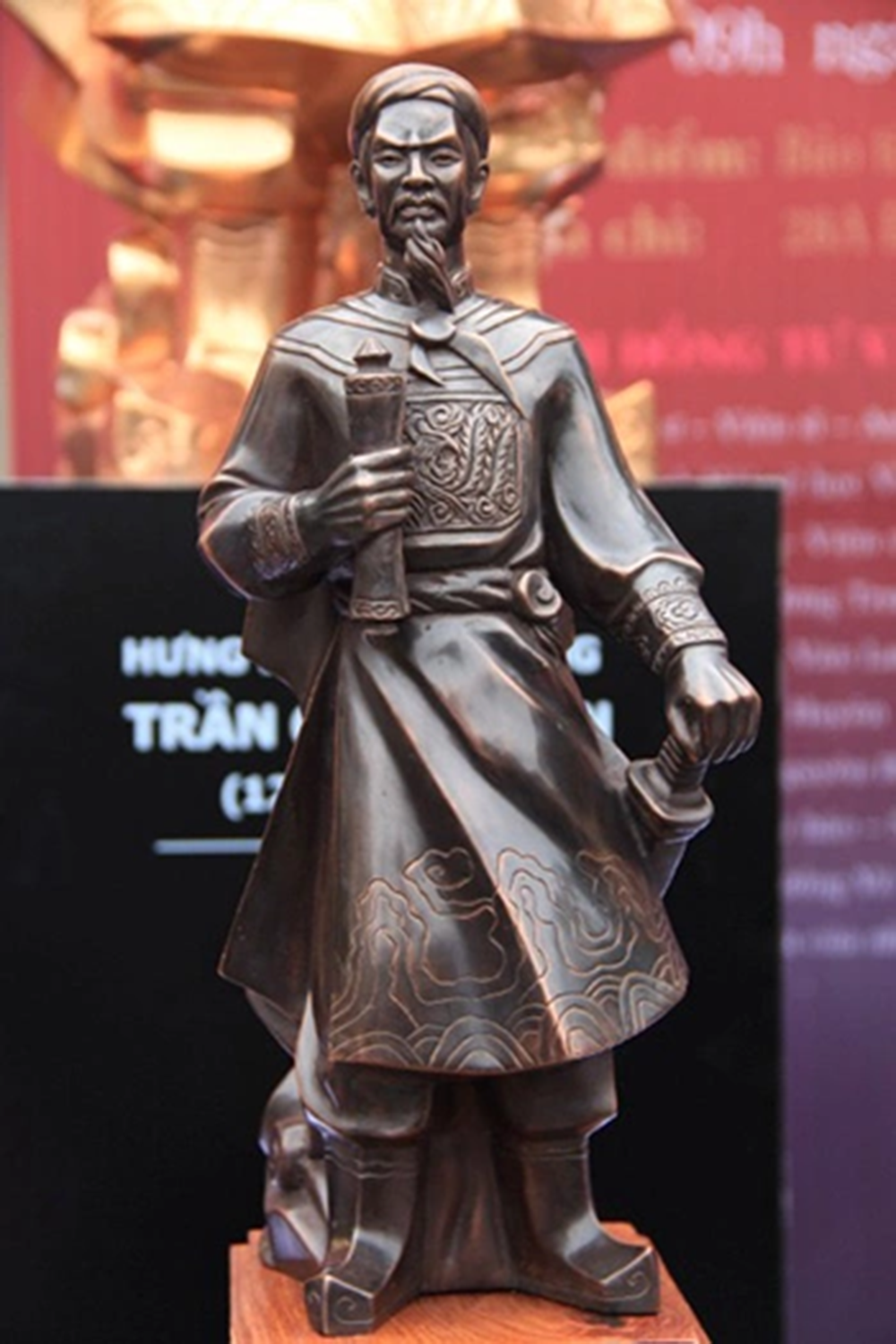 |
Statue of Quoc Cong Tiet Che Hung Dao Dai Vuong Tran Quoc Tuan. *Hoang Phong* |
"Relieving the people's burden" is a strategy for deep roots and lasting stability
Associate Professor Nguyen Thi Thu Thuy (Hanoi National University of Education) emphasized that the "relieving the people's burden" ideology during the Tran era was not mere rhetoric but was concretized through flexible social welfare policies.
During nearly two centuries of rule, Dai Viet frequently faced natural disasters and invasions. Historical records show the Tran era experienced over 30 years of floods, primarily in Thang Long imperial city and the Hong River Delta. The imperial court built dikes to prevent floods, establishing dedicated officials at the local level to oversee dike construction. When dikes encroached on people's fields, the state compensated them based on land value.
Regarding tax policies, whenever droughts or crop failures occurred, the Tran dynasty often issued decrees to reduce or waive taxes (such as in 1242, when one-half of land taxes were remitted).
To recover after war, in 1288, immediately following the third victory against the Nguyen-Mong, the imperial court focused on providing aid to the most severely affected areas to quickly restore the economy. The state also provided emergency relief to help people overcome famine and epidemics.
Associate Professor Thuy analyzed that "The people are a fundamental resource, but their strength is limited. Relieving the people's burden creates a long-term stable foundation for the exercise of state power." She emphasized that this ideology was not a slogan but a guiding principle for governing the nation.
 |
Kiep Bac Temple, located in Tran Hung Dao ward (formerly Hai Duong), was a manor where Hung Dao Vuong Tran Quoc Tuan passed away and was later worshipped. *Le Tan* |
Talent: "numerous and high-caliber"
Professor Pham Hong Tung, from Vietnam National University, Hanoi, stated that the Tran dynasty's "identity of power" was its outstanding team of talented individuals. According to him, the Tran royal family had the most successful system and rules for training talent, unparalleled by any other feudal dynasty in Vietnam.
Beyond systematic training within the royal family, such as Tran Quoc Tuan and Tran Quang Khai, the Tran dynasty also "opened paths" for talented individuals from outside the clan. People of common origin, like Pham Ngu Lao and Nguyen Khoai, or even those from the servant class, like Yiet Kieu and Da Tuong, were trusted and given important responsibilities. The imperial examination system of this era was also more structured than before, establishing the tradition of selecting the "tam khoi" (top three scholars) from the imperial examination in 1247.
From these analyses, experts concluded that the legacy of the Tran dynasty, 800 years later, still offers valuable lessons for modern national governance. These include: the government must not only handle administrative management but also care for the people's welfare, education, and healthcare. The government needs to plan and implement a national talent development strategy, especially for top-tier scientific and technological talent.
Hong Chieu


