The ASEAN Cup 2026 Organizing Committee introduced these changes into the tournament's regulations, drawing from amendments made by the International Football Association Board (IFAB) for the 2026-2027 season. The objective is to reduce unsporting behavior, curb time-wasting, and increase actual playing time.
The most notable regulation concerns players covering their mouths during confrontations or arguments. Referees can issue a direct red card to any player who uses their hand, arm, or jersey to cover their mouth while in a dispute with an opponent.
This rule applies only to on-field conflicts, not throughout the entire match. At the World Cup 2026, two players, Miguel Almiron (Paraguay) and Piero Hincapie (Ecuador), were sent off for this action.
 |
Paraguay's Miguel Almiron (10) covers his mouth during an argument with Mert Muldur, subsequently receiving a red card, in a World Cup Group D match against Turkey at Santa Clara, California, USA on 19/6. *Screenshot.* |
In Southeast Asia, confrontations and provocations between players are not uncommon. However, players do not typically cover their mouths during arguments.
Another new rule grants referees strong authority to act if a player deliberately leaves the field to protest a decision. Any player who intentionally abandons the field to pressure the referee risks receiving a direct red card.
Not only players, but also team officials such as coaches and coaching staff members will face penalties if they incite players to leave the field. If a team deliberately causes a match to be unable to continue, the general principle is that the team will forfeit. This rule was introduced after Senegal abandoned their Africa Cup final against Morocco earlier this year, only to return and still win.
ASEAN Cup 2026 will also tighten regulations on protesting referee decisions, in line with IFAB's adjustments. Similar to many recent major tournaments, only team captains are permitted to approach and discuss on-field decisions with the referee. Actions such as surrounding the referee, pointing, shouting, or excessive reactions will no longer be tolerated, potentially leading to a yellow card for the player. This aims to reduce pressure on the refereeing team and prevent chaotic situations following controversial decisions.
In addition to disciplinary regulations, ASEAN Cup 2026 will implement a series of measures against time-wasting. For throw-ins, if a player deliberately delays, the referee will issue a warning and then begin a 5-second countdown using hand gestures, possibly combined with verbal instructions. If the ball is not put back into play within the allotted time, the throw-in will be awarded to the opposing team.
Similarly, for goal kicks, the team in possession will also have only 5 seconds after the referee begins the countdown. If they continue to delay, the opposing team will be awarded a corner kick, rather than simply waiting for the goalkeeper to put the ball into play as before.
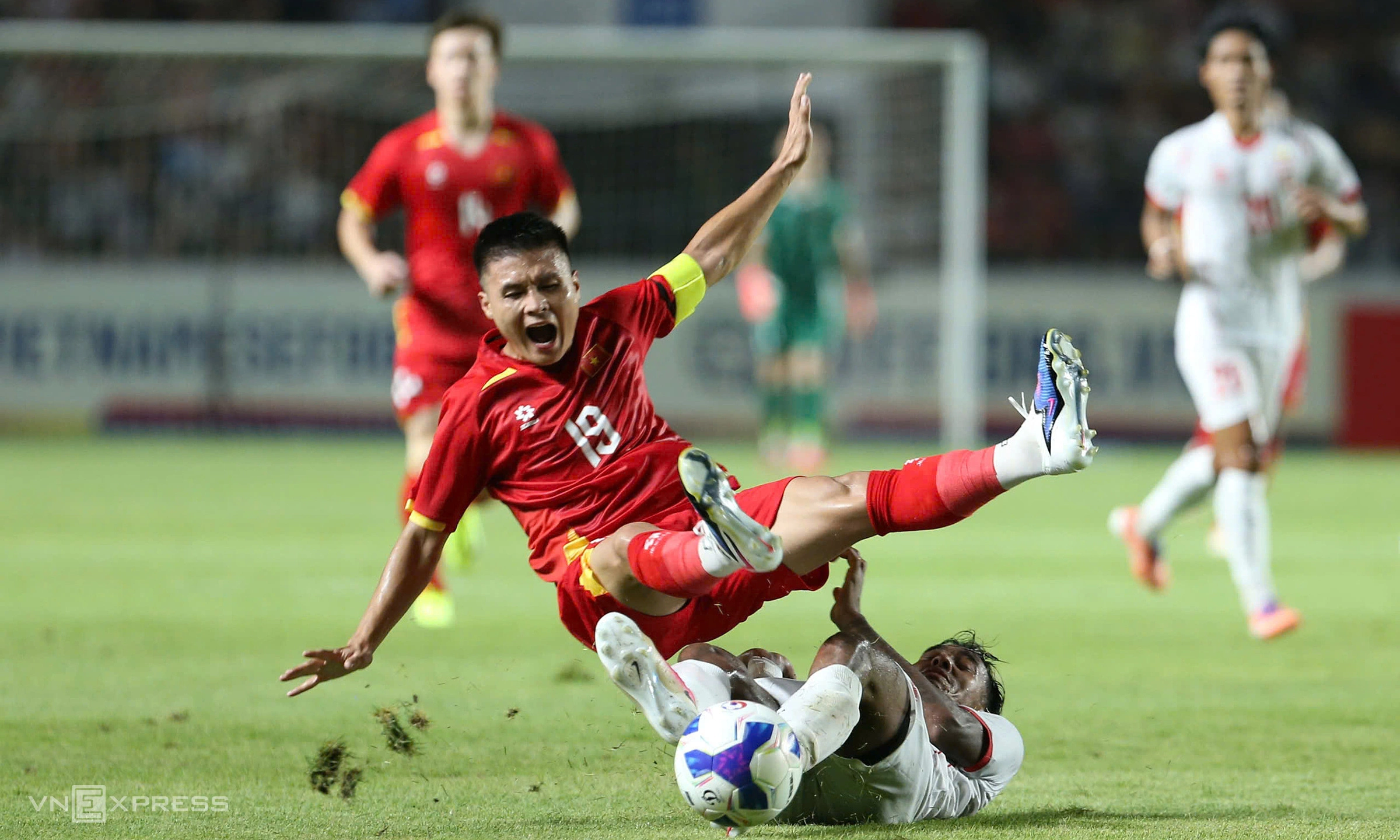 |
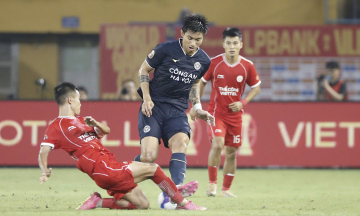
Nguyen Quang Hai is fouled by Maung Maung Lwin during a friendly match between Vietnam and Myanmar at Thai Nguyen Stadium on 18/7. *Luong Hieu.* |
The substitution process has also been tightened. Once the electronic board is raised, the substituted player must leave the field within 10 seconds via the nearest boundary line, unless instructed otherwise by the referee.
If a player intentionally delays their departure, the match will continue, but the substitute will not be permitted to enter the field. The substitution is not canceled; however, the incoming player can only enter the field at the first stoppage in play after the match has resumed for at least one minute, and only with a signal from the referee.
This rule prevents teams from easily exploiting substitutions to slow down the pace of the game in the final minutes.
Another notable change relates to medical procedures. Any player on the field (excluding goalkeepers) who requires medical attention after a stoppage in play due to injury must leave the field for at least one minute after the ball is put back into play.
The one-minute period is measured by a continuous stopwatch. Only after this time has elapsed and with the referee's permission, can the player return to the game.
IFAB introduced this rule to curb players from feigning prolonged injuries to waste time. In previous ASEAN Cup tournaments, many matches were frequently interrupted by non-serious injuries that still required significant treatment time.
However, the rule includes several exceptions to ensure player safety. Injured goalkeepers will not be required to leave the field for one minute. Similar exceptions apply if a goalkeeper collides with another player, two players from the same team collide, a serious injury occurs—especially a head injury—or a player is fouled violently, resulting in the opponent receiving a yellow or red card.
Additionally, if the injured player is also the one designated to take a penalty kick for their team, they are not required to leave the field before taking the kick.
IFAB also issued a specific reminder regarding goalkeepers due to the increasing prevalence of feigned injuries. While a goalkeeper is receiving treatment, referees are instructed to prevent other players from approaching the technical area or substitutes' bench to receive tactical instructions from the coaching staff.
The ASEAN Cup 2026 will take place from 24/7 to 26/8, featuring 10 teams divided into two groups of five. Teams will play a single round-robin format, with the top four advancing to the semifinals. From the semifinals onwards, teams will play two-legged home-and-away matches.
By Luong Hieu and Xuan Binh