In the 84th minute of the match on 14/6 at Monterrey Stadium, Mexico, Sweden earned a free kick on the right flank. The ball soared into the penalty area, where Mattias Svanberg connected with a close-range shot, finding the back of Tunisia's net. However, the Wolfsburg midfielder's celebration was brief, as the assistant referee flagged him for offside, asserting Svanberg was behind Tunisia's defensive line when he received the pass.
Swedish players immediately protested, arguing that forward Alexander Isak had touched the ball before it reached Svanberg. If confirmed, this touch would alter the offside position, placing Svanberg onside.
The challenge lay in the contact itself; it was too subtle for human eyes or standard television replays to detect. VAR consequently undertook a lengthy review before reaching a decision. This prompted the use of "snicko" technology.
 |
Swedish midfielder Mattias Svanberg celebrates a goal that was initially disallowed by the referee but later confirmed by VAR, during the World Cup 2026 Group F match against Tunisia in Guadalupe, near Monterrey, Mexico on 14/6. *Photo: AP* |
In cricket, "snicko" (short for snickometer) assists umpires in detecting subtle touches between the ball and a batter's bat. The system analyzes signals, displaying them as a graph. Even a minimal impact generates a sharp peak on the graph, pinpointing the exact moment of contact.
FIFA's version, implemented for the World Cup 2026, functions similarly. A motion sensor microchip embedded within the ball records contact data 500 times per second, transmitting this information directly to the VAR room.
During the controversial review, the VAR official examined the sensor graph at the precise moment the ball passed Isak's foot. A distinct signal peak on the screen confirmed the Liverpool forward's subtle touch on the ball before it reached Svanberg. This evidence was sufficient to overturn the on-field decision, validating the goal and allowing Svanberg to celebrate a second time.
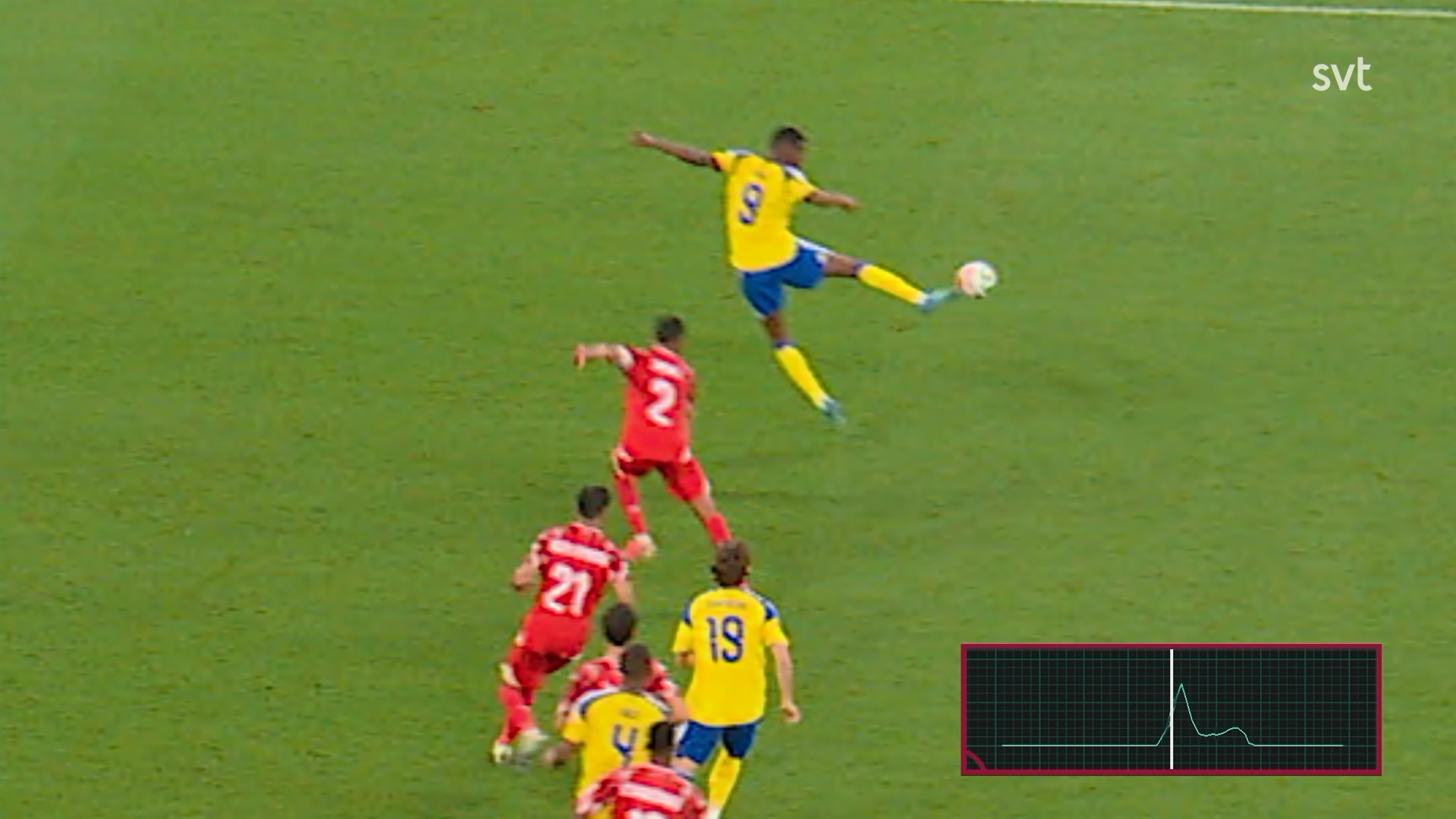 |
Technology confirmed Isak touched the ball before Svanberg scored. *Photo: screenshot* |
This incident marked the most significant technological moment of the World Cup 2026 so far, as many viewers witnessed a cricket-like graph in a football match for the first time. FIFA implemented the in-ball sensor technology to support VAR in cases of handball, fouls, or to identify the last player to touch the ball before a goal. The system featured in the World Cup 2022, though then it was an Adidas sponsor-implemented sensor, not part of FIFA's official protocol. During that tournament, the sensor confirmed Cristiano Ronaldo did not touch the ball in Portugal's goal against Uruguay, despite his initial claim.
Similarly, at Euro 2024, this technology contributed to Belgium having a goal disallowed after it confirmed Lois Openda's handball in the build-up to Romelu Lukaku's strike.
Beyond the "snicko" moment, Sweden delivered a convincing performance, securing a 5-1 victory. Tunisian-born Yasin Ayari scored two goals, including an early opener and the final goal in stoppage time. Isak and Viktor Gyokeres each contributed one goal, with Svanberg scoring just 18 seconds after entering the match.